
土壤污染源头防控

Search documents
生态环境部:实施《土壤污染源头防控行动计划》取得积极进展
Xin Lang Cai Jing· 2025-12-26 04:40
Core Viewpoint - The Ministry of Ecology and Environment has developed the "Soil Pollution Source Prevention and Control Action Plan," which includes 82 tasks aimed at addressing soil pollution through collaborative efforts among various departments and local governments [1] Group 1: Policy Coordination - The initiative promotes industrial layout optimization and green transformation of enterprises, resulting in the revision and formulation of 28 policy regulations and technical standards [1] - The plan includes the identification of key areas for groundwater pollution prevention, which will be integrated into ecological environment zoning control [1] Group 2: Strengthening Regulation - Over 100 issues related to wastewater pipeline problems in industrial parks at the provincial level and above have been investigated and addressed [1] - The first batch of chemical park pilot projects has been completed, implementing a "one park, one policy, one map" strategy [1] - Major projects for soil pollution source control during the 14th Five-Year Plan have been completed [1] Group 3: Focused Remediation - The initiative emphasizes tracing and remediation of heavy metal pollution in agricultural land [1] - Support is provided for projects addressing historical pollution from heavy metal slag [1]
土壤污染隐患排查酝酿新规,到2027年整改合格率超90%
Di Yi Cai Jing· 2025-09-22 01:15
Core Viewpoint - Nearly 70% of enterprises have varying degrees of soil pollution risks, prompting the government to enhance source control and establish new technical regulations for soil pollution risk assessment and remediation [1][3]. Group 1: Government Regulations and Standards - The government will strengthen source control for soil pollution and conduct regular risk assessments in key areas and facilities, with a new technical guideline for soil pollution risk assessment currently open for public consultation [2]. - The "Soil Pollution Prevention Law" mandates that key regulatory units must establish a soil pollution risk assessment system to prevent the leakage and spread of toxic substances [2][7]. - By 2027, the government aims for a compliance rate of over 90% in risk assessment and remediation for key regulatory units [2]. Group 2: Industry Practices and Challenges - The first round of soil pollution risk assessments conducted by the government revealed that nearly 70% of enterprises have some level of soil pollution risk, with significant disparities in assessment quality across regions [3][5]. - Many enterprises lack awareness of soil pollution prevention and legal obligations, leading to inadequate risk assessments and remediation efforts [3][8]. - Common issues in local practices include overlapping responsibilities with emergency management and environmental departments, leading to inefficiencies in risk assessment [5][6]. Group 3: Technical Guidelines and Implementation - The new standard aims to unify and standardize soil pollution risk assessment practices across the country, ensuring compliance with existing environmental laws and policies [7]. - The standard emphasizes the need for accurate risk assessment methods, including leak detection and remediation measures, to ensure effective remediation of identified risks [8]. - There is a call for further refinement of technical requirements and the establishment of a comprehensive technical standard system for soil pollution risk assessment and remediation [8].

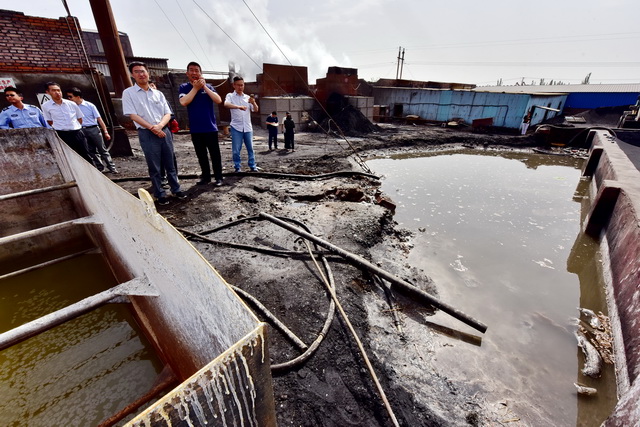
国家发改委郑栅洁:要深入推进环境污染防治 大力提升环境基础设施建设运营水平
Zheng Quan Shi Bao Wang· 2025-08-15 06:19
Core Viewpoint - The article emphasizes the importance of integrating environmental protection with economic development, advocating for a model of modernization that harmonizes human and nature [1] Environmental Infrastructure Development - The article calls for the establishment of a comprehensive environmental infrastructure system that includes facilities for wastewater, garbage, solid waste, hazardous waste, and medical waste treatment and monitoring [1] - It highlights the need to enhance the operational level of environmental infrastructure to improve urban and rural living conditions [1] Pollution Control Measures - The article stresses the importance of strengthening the governance of plastic pollution and excessive packaging throughout the supply chain [1] - It mentions the implementation of comprehensive governance actions for phosphogypsum [1] - There is a focus on enhancing rural ecological environment protection and deepening the prevention and control of soil pollution sources [1] Water Resource Management - The article advocates for a coordinated approach to managing water resources, water environment, and water ecology to continuously improve the ecological quality of the Yangtze River Basin [1] - It emphasizes the need to address ecological governance in key areas such as the "zigzag" of the Yellow River and to promote comprehensive governance and economic development in key river basins [1] Marine Ecological Protection - The article promotes the idea of "land-sea coordination and river-sea linkage" to advance marine ecological protection and restoration [1]
2024年全省生态环境“成绩单”出炉江苏交出“经济生态双优”答卷
Xin Hua Ri Bao· 2025-06-27 23:15
Core Insights - Jiangsu Province is set to achieve a GDP growth of 5.8% in 2024, leading the nation while also meeting its major pollutant reduction targets ahead of schedule [1] - The province has maintained a public satisfaction rate of over 90% regarding its ecological environment for six consecutive years [1] Environmental Quality Improvement - In 2024, Jiangsu's ecological environment quality continues to improve, meeting national assessment targets [2] - The annual average concentration of PM2.5 and the ratio of days with good air quality have both improved year-on-year [2] - Surface water quality has remained at a high standard, with no monitoring points below Class V for three consecutive years [2] Water Ecological Protection - Jiangsu has implemented a comprehensive strategy for water ecological protection, focusing on the Yangtze River and other water bodies [3] - The province has achieved a total sewage treatment capacity of 9.923 million tons per day, with a rural sewage treatment rate of 93.7% [3] - The province has established a high-density automatic monitoring network for water quality [3] Pollution Control Initiatives - Jiangsu has developed action plans for the comprehensive management of water ecosystems, including pollution control and ecological restoration [4] - The province has successfully reduced total nitrogen and phosphorus discharges by 9,204 tons and 1,194 tons respectively since the beginning of the "14th Five-Year Plan" [4] Soil Quality Management - The overall soil quality in Jiangsu is reported to be good, with no monitored pollutants exceeding risk control values [5] - The province has completed inspections of 1,543 key regulatory units for soil pollution risks [5] Biodiversity Protection - Jiangsu has designated 22.49% of its land area for strict ecological protection, combining ecological red lines with controlled ecological spaces [6][7] - The province has conducted biodiversity baseline surveys using advanced technologies, completing investigations in all 95 counties [7] Hazardous Waste Management - Jiangsu's hazardous waste management focuses on collection, treatment, regulation, and enforcement [8] - The province has initiated measures to phase out older diesel vehicles and promote the use of new energy vehicles [9]