场外交易市场

Search documents
告别高门槛上市!OTCQB 市场全解析:准入、流程、合规一步到位
Sou Hu Cai Jing· 2026-02-04 05:38
Core Insights - The OTCQB market serves as a public trading platform for entrepreneurial and growth-oriented companies, connecting them to higher standards of the OTCQX market and the basic OTC Pink market, providing flexible and efficient capital access channels [1] Group 1: Market Positioning and Core Advantages - OTCQB demonstrates significant inclusivity for international companies, characterized by low entry barriers and high flexibility [2] - Companies are not required to establish a physical presence in the U.S. to apply for listing [2] - Once listed, companies gain a certain level of market credibility, often viewed as a transitional platform for future listings on Nasdaq or NYSE [2] Group 2: Key Admission Requirements - Companies must meet several basic requirements to apply for OTCQB listing, including being listed on a qualifying foreign exchange or having submitted registration documents to the SEC [4] - The stock price must not be less than $0.01 for at least 30 consecutive calendar days prior to application [4] - Companies must have at least 50 beneficial shareholders and a public float of at least 10% [4] Group 3: Application Process - The application process for OTCQB is fully online, typically involving six steps, including self-assessment, submission of application materials, and uploading disclosure documents [7] - Foreign Private Issuers (FPI) are not subject to mandatory PCAOB audit requirements [8] - A compliance review is conducted by the OTC Markets Group to verify the authenticity and completeness of the disclosures [9] Group 4: Ongoing Compliance Obligations - After listing, companies must continuously meet requirements such as maintaining a stock price of at least $0.01 [11] - Companies must comply with specific governance requirements and notify of any violations [12] - Timely payment of annual fees is required to avoid delisting [13] Group 5: Delisting and Reinstatement Mechanisms - Companies may be given a grace period of 30 to 90 days to rectify compliance issues before delisting [18] - Immediate delisting may occur for severe violations, such as a stock price falling below $0.001 for consecutive days [19] - Companies can voluntarily apply for delisting with a written notice [21] Group 6: Market Value and Strategic Significance - OTCQB provides a low-cost, high-efficiency public trading channel for growth-oriented companies, particularly foreign firms seeking access to international capital [24] - It helps companies gain public market liquidity in early development stages and build compliance records for future listings on mainstream exchanges [24] - The platform offers clear rules and controllable processes for admission, ongoing compliance, and exit, allowing companies to formulate phased capital strategies [24]


利多星科普:场外交易市场——中小企业融资的 “秘密武器”
Sou Hu Cai Jing· 2025-06-09 06:38
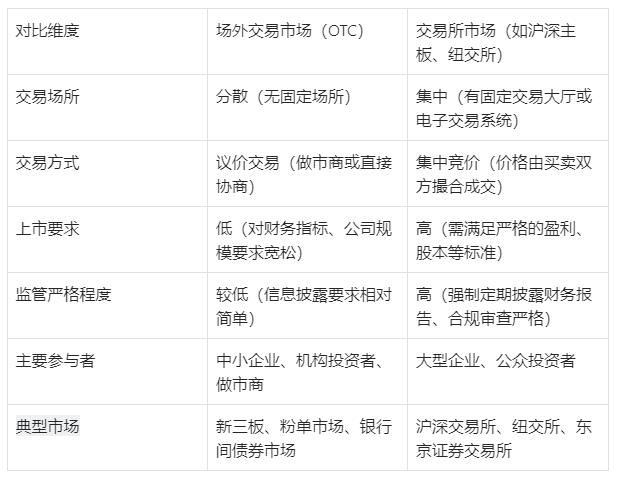
Group 1 - The OTC market is a crucial component of the financial market, distinct from traditional exchange markets, and plays a unique role in economic operations and financial investments [1] - The OTC market is defined as a decentralized market where securities are traded outside of formal exchanges, relying on various communication methods for transactions [1][2] - The characteristics of the OTC market include its decentralized nature, the market maker system, a wide variety of securities, price negotiation, and relatively loose regulation compared to exchange markets [2][3] Group 2 - The main types of the OTC market include stock OTC markets like the Pink Sheets and OTCQB, which serve small, non-listed companies, as well as bond and derivative OTC markets [3][4] - The OTC market provides financing channels for small and medium-sized enterprises (SMEs), acting as an incubator for companies to eventually transition to formal exchanges [3][4] - The OTC market enhances market liquidity through the market maker system, allowing for the trading of less liquid securities that may struggle in traditional exchanges [3][4] Group 3 - A comparison between the OTC market and exchange markets highlights differences in trading venues, methods, listing requirements, regulatory strictness, and participant types [4] - The OTC market supports diverse financing and investment needs, playing an indispensable role in the development of SMEs and enriching the financial product ecosystem [6]