债券

Search documents
2026年一季度债券承销排行榜
Wind万得· 2026-04-01 05:45
Key Points - The total bond market in mainland China reached 199.70 trillion yuan by the first quarter of 2026, an increase of 3.52 trillion yuan from the beginning of the year [2] - The total issuance of bonds in the first quarter of 2026 was 19.7 trillion yuan, a year-on-year decrease of 4% [2] - The issuance of interest rate bonds increased by 8% year-on-year to 8.5 trillion yuan, while credit bonds remained flat at 4.5 trillion yuan [2][4] - The issuance of interbank certificates of deposit decreased by 19% year-on-year to 6.7 trillion yuan [2] Bond Issuance Breakdown - Interest rate bonds: 837 issues, 851.47 billion yuan, 8% growth [4] - Government bonds: 43 issues, 362.00 billion yuan, 9% growth [4] - Local government bonds: 521 issues, 310.59 billion yuan, 9% growth [4] - Policy bank bonds: 273 issues, 178.82 billion yuan, 3% growth [4] - Credit bonds: 5528 issues, 445.65 billion yuan, 0% growth [4] - Financial bonds: 267 issues, 62.57 billion yuan, 23% decline [4] - Insurance company bonds: 8 issues, 1.81 billion yuan, 63% decline [4] - Securities company bonds: 185 issues, 47.87 billion yuan, 147% growth [4] Bond Underwriting Rankings - The top three banks in bond underwriting for the first quarter of 2026 were China Bank, Construction Bank, and Industrial and Commercial Bank, with underwriting amounts of 359.35 billion yuan, 357.37 billion yuan, and 331.23 billion yuan respectively [10][11] - The top three securities firms in bond underwriting (excluding local government bonds) were CITIC Securities, Guotai Junan, and CITIC Jinpu, with underwriting amounts of 305.59 billion yuan, 245.82 billion yuan, and 198.23 billion yuan respectively [20][24] Trends in Financing Costs - The "CCB-Wind Interbank Bond Issuance Index" indicated a downward trend in financing costs in the first quarter of 2026, with the index currently at around 31.6 [6]



Stocks, bonds and commodities: How global markets have traded the Iran war
CNBC· 2026-03-31 13:07
Core Viewpoint - The ongoing U.S.-Iran war has led to significant volatility across various asset classes, resulting in major losses and bearish sentiment in the markets [1][2]. Equities - Global equities have experienced a severe sell-off during the five weeks of the U.S.-Iran war, with all three major U.S. indices expected to end the month in negative territory [2] - The war's impact on energy and inflation has particularly affected markets in Europe and Asia, with South Korea's Kospi index falling nearly 20% in March due to its vulnerability to energy price shocks [3] - Goldman Sachs has indicated that the "balance of risks has worsened" for equity markets, with an increased probability of stagflation, which historically leads to poor equity performance [4][5] Bonds - Government borrowing costs have risen amid a broad sell-off of developed-market sovereign debt, with bond yields increasing as investors adjust expectations for central bank rate hikes [7][8] - The U.S. and European breakeven curves have surged as markets reprice inflation expectations, with some European bond yields reaching multi-decade highs [10] Currencies - The foreign exchange market has been volatile, with the U.S. dollar index projected to gain around 3% in March, supported by energy-driven stagflation risks [11] - Asian and European currencies are struggling due to higher commodity prices, while Latin American currencies are preferred within the emerging market context [11] Metals - The metals market has seen significant volatility, with gold on track for its worst monthly performance since 2008, influenced by a stronger dollar and rising interest rate expectations [12] - Despite the current decline, there is a bullish outlook for gold, with forecasts suggesting a rebound to USD 6,200 per ounce by the end of June [13] - Aluminum prices are under pressure due to geopolitical tensions affecting supply, while copper markets are influenced by economic pessimism [13] Energy - The energy market is at the center of market volatility, with the Iran war disrupting oil and gas supplies, leading to skyrocketing prices [14] - Euro zone inflation has risen above the European Central Bank's target, with energy inflation expected to hit 4.9% in March, up from a contraction the previous month [14][15] - The rapid increase in oil prices poses a risk of rising living costs for consumers, potentially leading to reduced consumption until clarity on price stability is achieved [15]

投资时钟:赢在周期
泽平宏观· 2026-03-31 01:57
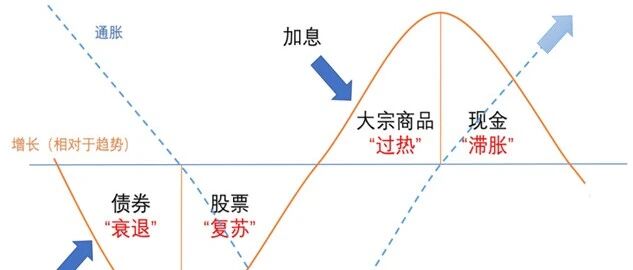
Core Viewpoint - The article introduces the "Investment Clock" as a classic asset allocation method that aligns with economic cycles, emphasizing its effectiveness in identifying optimal asset classes during different phases of the economic cycle [2][5]. Economic Cycle Overview - The economic cycle consists of four phases: recession, recovery, overheating, and stagflation, driven by the "animal spirits" of investors and businesses, which oscillate between greed and fear [3][4]. - Key indicators for determining the economic cycle include GDP growth and CPI inflation, which help classify the economy into the four phases [4]. Investment Clock Theory - The Investment Clock concept, initially proposed by Merrill Lynch, suggests that different asset classes perform variably across the economic cycle, with bonds leading during recession, stocks during recovery, commodities during overheating, and cash during stagflation [5][6]. - Historical data from the U.S. (1970-2020) and China (2001-2020) supports the effectiveness of the Investment Clock framework in guiding asset allocation [8][13]. Asset Allocation Strategies Recovery Phase - In the recovery phase, the recommended asset allocation is: stocks > commodities > bonds > cash, as stocks tend to outperform due to improving corporate earnings and declining interest rates [20][21]. - Key indicators of recovery include a shift to accommodative policies, improvement in leading economic indicators, and a warming market sentiment [19][20]. Overheating Phase - During the overheating phase, the optimal allocation shifts to: commodities > stocks > cash/bonds, as commodity prices rise due to strong demand and inflationary pressures [26][28]. - Characteristics of this phase include strong economic data, rising inflation, and a shift in policy towards tightening [24][25]. Stagflation Phase - In the stagflation phase, the focus should be on cash > bonds > commodities/stocks, as economic growth slows while inflation remains high, necessitating a defensive investment strategy [36][37]. - Key indicators include slowing economic growth, rising inflation, and a challenging policy environment [33][34]. Recession Phase - The recession phase favors bonds > cash > stocks > commodities, as bonds typically provide the best returns during economic downturns due to falling interest rates and increased demand for safe assets [39][44]. - Indicators of recession include declining GDP growth and inflation, rising unemployment, and a shift towards accommodative monetary policy [41][42]. Summary of Investment Clock - The Investment Clock serves as a strategic framework for asset allocation, suggesting that investors should buy bonds during recessions, stocks during recoveries, commodities during overheating, and hold cash during stagflation to achieve superior returns [49][50].
债券研究周报:固收看卖方情绪开始回暖-20260330
Guohai Securities· 2026-03-30 15:17
Report Information - Report Title: Bond Research Weekly Report [1][2] - Report Date: March 30, 2026 [1] - Analyst: Yan Ziqi [4] - Contact: Guo Xiyuan [7] Industry Investment Rating No relevant information provided. Core Viewpoints - The bond market performance was better than other assets last week. The bond market's buying and selling sentiment index both rebounded as banks bought bonds at the end of the month, pushing interest rates down. The market's concerns about inflation have been digested. Fixed - income sellers hold a neutral - to - bullish attitude towards the current bond market. The market believes the short - end is more stable, and institutions are concentrated on the short - end. Meanwhile, the long - end still has cost - effectiveness at the current position, and the "asset shortage" logic still exists. It is recommended to continue to pay attention to geopolitical situations, oil prices, and changes in the capital market [4]. Summary by Directory 1. Seller Market Sentiment 1.1 Seller Market Interest - Rate Bond Sentiment Index (March 24 - March 30) - The unweighted sentiment index from March 24 to March 30 was 0.15, up 0.08 from March 17 - March 23. Some institutions' market views turned bullish. Currently, institutions generally hold a neutral - to - bullish view, with 7 bullish, 17 neutral, and 3 bearish [12]. - 26% of institutions are bullish, believing that the curve is still steep, the allocation funds will return after the end of the quarter, and the supply pressure is low. The probability of long - end repair and narrowing of term spreads is high, and the odds of going long on long - term bonds are high. Geopolitical conflicts mainly bring hedging allocation demand due to "stagflation" in China, which is beneficial to the bond market [5][12]. - 63% of institutions are neutral, believing that the verification period of inflation and stagnation, the policy observation period, and loose funds, the differentiation between long and short ends, and narrowing spreads lead to mainly range - bound oscillations. It is generally expected that the 10 - year bond yield will likely move in a range of 1.75% - 1.90%. The short - end has limited downward space, and the long - end is more uncertain due to oil - price inflation and supply disturbances, but its upward movement is also constrained by central bank support and weak demand [5][12]. - 11% of institutions are bearish, believing that the economic and nominal growth is rebounding, deflation is easing, and the oil - price shock is increasing inflation risks. The need for easing has decreased, and the central bank's bond - buying volume has shrunk. The probability of a short - term bond - market correction is higher [5][12]. 1.2 Buyer Market Interest - Rate Bond Sentiment Index (March 24 - March 30) - The unweighted sentiment index from March 24 to March 30 was - 0.12, up 0.16 from March 17 - March 23, with a relatively large increase. Currently, institutions generally hold a neutral - to - bearish view, with 1 bullish, 13 neutral, and 3 bearish [13]. - 6% of institutions are bullish, believing that the market's game on inflation expectations continues, and the high - level oscillation of crude - oil prices provides some support for long - end interest rates [6][13]. - 76% of institutions are neutral, believing that geopolitical and oil - price news is frequently disturbing, but concerns about inflation are marginally easing. The capital market is generally loose, and the central bank maintains support, so the short - end is relatively stronger. The ultra - long - end is more volatile due to supply and risk - asset sentiment. It is more suitable to trade based on price points, enter and exit quickly, and control stop - losses [6][13]. - 18% of institutions are bearish, believing that the uncertainty of the US - Iran situation supports the high - level oscillation of oil prices, the game on inflation expectations continues, putting upward pressure on long - end interest rates, and the trend of a steeper curve continues. The mid - and short - ends have fully reflected the positive factors, and there is limited further downward space. Moreover, the signal of geopolitical easing drives the recovery of equity sentiment, and the stock - bond seesaw suppresses the bond - market performance [6][13][14].
——近期市场反馈及思考11:多空博弈,市场方向怎么选?
Shenwan Hongyuan Securities· 2026-03-30 07:05
Group 1 - The report discusses the current market's focus on the direction of the bond market amid a tug-of-war between bullish and bearish sentiments, emphasizing the need to monitor factors beyond inflation that could exceed expectations [1][7] - Key factors influencing the bond market include the recovery strength and sustainability of the macroeconomic fundamentals, which are seen as the core contradictions to watch in the next phase [4][9] - The steepening of the yield curve is attributed to a shift in long-term macro narratives, with a focus on the transition from old to new economic drivers and the easing of credit contraction pressures [10][12] Group 2 - The report suggests that the bond market environment in the first half of 2026 will differ from that of 2025, with limited downward space for bond yields and potential upward risks requiring new catalysts [16] - Investment strategies for credit bonds should focus on the 3-year maturity range, with a cautious approach to duration while seeking opportunities in the upcoming credit market [19][21] - The report highlights the anticipated recovery of perpetual bonds issuance in the second quarter, with manageable pressure expected, particularly in the context of the evolving demand dynamics [23][24] Group 3 - The report identifies the next observation window for the growth of credit bond ETFs as potentially occurring in April-May, driven by market conditions and the recent regulatory changes in the technology innovation bond sector [25][26] - The recent decline in the convertible bond market is linked to external shocks and a risk-averse approach by investors, leading to significant reductions in positions [27][28] - Future pricing logic in the convertible bond market will increasingly depend on how equities are priced in response to external shocks, with a focus on potential mispricing opportunities relative to equities [29]
宝城期货资讯早班车-20260330
Bao Cheng Qi Huo· 2026-03-30 05:33
1. Report Industry Investment Rating No information provided in the given content. 2. Core Viewpoints of the Report - The global economic and political situation is complex, with the ongoing conflict between the US, Israel, and Iran having a significant impact on the energy market, leading to increased fuel costs in the shipping industry and potential disruptions to the supply chain [10][16]. - The Chinese economy shows a mixed picture, with some positive signs in industrial profits but also challenges in areas such as manufacturing PMI and consumer spending [2][19]. - The financial market is experiencing volatility, with bond ETFs becoming a safe - haven due to rising risk aversion, and the stock and bond markets being affected by energy price increases and inflation expectations [21][22]. 3. Summary by Directory Macro Data - GDP growth in Q4 2025 was 4.5% year - on - year, lower than the previous quarter and the same period last year [1]. - The manufacturing PMI in February 2026 was 49.0%, down from the previous month and the same period last year, indicating a contraction in the manufacturing sector [1]. - The non - manufacturing PMI in February 2026 was 49.5%, remaining the same as the previous month but lower than the same period last year [1]. - Social financing in February 2026 was 2385.5 billion yuan, slightly lower than the previous month but higher than the same period last year [1]. - M0, M1, and M2 growth rates in February 2026 were 14.1%, 5.9%, and 9.0% respectively, showing an upward trend compared to the previous month and the same period last year [1]. - New RMB loans in February 2026 were 900 billion yuan, higher than the previous month but lower than the same period last year [1]. - CPI in February 2026 was 1.3% year - on - year, up from the previous month and a significant improvement from the same period last year [1]. - PPI in February 2026 was - 0.9% year - on - year, an improvement from the previous month and the same period last year [1]. - Fixed - asset investment in the first two months of 2026 increased by 1.8% year - on - year, a significant improvement from the previous year [1]. - Retail sales of consumer goods in the first two months of 2026 increased by 2.8% year - on - year, lower than the previous year [1]. - Exports in February 2026 increased by 39.6% year - on - year, a significant improvement from the previous month and the same period last year [1]. - Imports in February 2026 increased by 13.8% year - on - year, also showing an upward trend [1]. Commodity Investment Comprehensive - From January to February, the total profit of industrial enterprises above designated size increased by 15.2% year - on - year, and the growth rate of operating income improved significantly [2]. - China's Ministry of Commerce launched two trade barrier investigations against the US in response to the latter's 301 investigations [2]. - From April 22, QFIIs and RQFIIs can trade 20 - rubber and international copper option contracts [3]. - On March 27, 31 domestic commodity varieties had positive basis, and 38 had negative basis [3]. - The conflict between the US, Israel, and Iran continues, with Iran increasing its attacks on the US and Israel, and the US claiming to control the Strait of Hormuz [3][4]. - The Fed Vice - Chair expects the US economy to expand at about 2% or slightly faster in 2026, with stable unemployment [4]. Metals - Since late March, international gold prices have experienced a "historic" shock, and after a sharp decline, there is a mixed reaction in the market [5]. - Since March, the domestic non - ferrous futures sector has shown a downward trend, especially copper futures, which have fallen by more than 8% this month [5]. - Two large aluminum plants in Bahrain and the UAE were attacked by Iran, which may impact the market [6][7]. Coal, Coke, Steel and Minerals - A new rare earth - niobate mineral, Xianhuaite - (La), was discovered in the Bayan Obo deposit, which is of great value for the study of the deposit's formation [8]. - Due to the obstruction of shipping in the Strait of Hormuz, some Asian countries are increasing coal production and use [9]. - Indonesia has no plan to levy windfall taxes on coal and nickel exports on April 1 [9]. - Bauxite shipments increased by 16% year - on - year, but experts are cautious about the market outlook [9]. Energy and Chemicals - The conflict between the US, Israel, and Iran has led to a significant increase in the fuel cost of the global shipping industry, and the industry is facing pressure but also has an opportunity for energy transformation [10]. - Russia will ban gasoline exports from April 1 to July 31 to stabilize prices and ensure domestic supply [10]. - India has imposed windfall taxes on diesel and aviation turbine fuel exports [10]. - Saudi Arabia's key oil pipeline is operating at full capacity, but the Red Sea may become a new conflict front [11]. - The US allows Cuba to receive a large - scale oil shipment from Russia, breaking the oil blockade [11]. Agricultural Products - On March 29, the national pig market showed a widespread upward trend, but the increase was regional and phased [12]. - In the third week of March, the average price of pigs in 30 monitored provinces decreased by 28% year - on - year, reaching a new low since June 2018 [13]. - The State Council's Food Safety Office and the State Administration for Market Regulation have taken measures to address food safety issues exposed by the "3.15" Gala [13]. - China will implement zero - tariff measures for all African diplomatic countries starting from May 1, 2026 [13]. Financial News Open Market - This week, 474.2 billion yuan of reverse repurchases will mature in the central bank's open market. Last week, the central bank conducted 474.2 billion yuan of reverse repurchase operations, achieving a net injection of 231.9 billion yuan. Additionally, 450 billion yuan of MLF matured last week, and the central bank conducted 500 billion yuan of MLF operations [14]. - On March 27, the central bank conducted 146.2 billion yuan of 7 - day reverse repurchase operations, with a net injection of 125.7 billion yuan [14]. Key News - The US - Israel - Iran conflict continues, with the US claiming to control the Strait of Hormuz and Iran increasing its counter - attacks [16]. - The US is preparing for a ground operation in Iran, and there are large - scale protests against the Trump administration in the US [17]. - This week, there are many important events in the global market, including economic data releases, policy changes, and corporate earnings announcements [18]. - The State Council emphasizes the development of the service industry and the construction of a hierarchical diagnosis and treatment system [19]. - From January to February, the profits of industrial enterprises above designated size increased significantly, especially in the non - ferrous, chemical, and semiconductor industries [19]. - The People's Bank of China requires the improvement of the financial risk prevention and resolution system [20]. - China's foreign exchange market shows strong resilience, and the RMB exchange rate remains stable [20]. - China and the EU agree to set up a trade and investment working group and continue dialogue on export control [20]. - China's Ministry of Commerce launches two trade barrier investigations against the US [21]. - Some banks in China have lowered deposit interest rates, and bond ETFs have become a safe - haven for investors [21]. - Energy price increases have led to stagflation expectations, hitting the stock, bond, and gold markets, and investors are flocking to cash [22]. - Some companies have bond - related events, such as default and regulatory measures [22]. - Some companies' credit ratings have changed [23]. Bond Market - The inter - bank bond market is slightly bullish, with most yields of major interest - rate bonds declining, but the 30 - year treasury bond futures contract closed down [24]. - The exchange - traded bond market has mixed performance, with some bonds rising and some falling [24]. - The convertible bond index rose, with some bonds having significant gains and losses [25]. - Most money market interest rates declined, and Shibor short - term varieties also decreased [25][26]. - The winning bid rate of the Import - Export Bank's 3 - year fixed - rate bond was 1.5045% [26]. - European bond yields rose, while US bond yields showed mixed trends [26][27]. Foreign Exchange Market - The on - shore RMB against the US dollar closed down, and the US dollar index rose, with non - US currencies showing mixed performance [28]. Research Report Highlights - Citic Securities suggests focusing on countries with resource, geographical, and manufacturing advantages, and recommends sticking to China's advantageous manufacturing industries [29][30]. - Citic Securities believes that the long - term demand for bank self - operated funds in exchange - traded corporate bonds and ABS products is unlikely to change fundamentally [30]. - Citic Securities expects the Strait of Hormuz's passing capacity to partially recover, which may drive up oil shipping prices and increase the profits of oil shipping companies in 2026 [30]. - Tianfeng Fixed - Income believes that there is no need to overly worry about large banks selling ultra - long - term bonds in March, and their buying power may increase in April [30]. - Xingzheng Fixed - Income believes that the credit bond curve showed a bull - steep trend in March, and the end - of - quarter adjustment may be a good investment opportunity [30]. Stock Market - The Shanghai Stock Exchange will deepen the comprehensive reform of capital market investment and financing, focusing on serving new - quality productivity, building a "long - term investment" ecosystem, and cultivating Chinese - characteristic financial culture [33]. Today's Reminders - On March 30, 263 bonds will be listed, 60 bonds will be issued, 113 bonds will be paid, and 653 bonds will have principal and interest repaid [31][32].
类滞胀-将进一步发酵-勿低估美元流动性紧缩
2026-03-30 05:15
Summary of Key Points from Conference Call Records Industry Overview - The current market is experiencing a "stagflation-like" environment, characterized by rising inflation and stagnant economic growth, primarily driven by increasing oil prices and tightening dollar liquidity [1][2][3]. Core Insights and Arguments - **Market Performance**: The U.S. stock market has entered a correction phase, with the Nasdaq index down over 10% from its January peak, and the Dow Jones Industrial Average also falling more than 10% [2][3]. - **Oil Price Impact**: Oil prices have surged past $83 per barrel, reaching $100, negating the effects of fiscal tax cuts and significantly impacting consumer purchasing power [3][4]. - **Macroeconomic Data**: Recent macroeconomic indicators, including a decline in the composite PMI and rising import price indices, suggest a slowdown in economic growth, with Q1 GDP growth projected at only 1% [4][5]. - **Tightening Dollar Liquidity**: There are signs of tightening dollar liquidity, as evidenced by the overnight repo rates consistently exceeding excess reserve rates, indicating a shift towards a more restrictive monetary environment [1][6][7]. - **Credit Market Conditions**: High-yield bond spreads have widened, and there are emerging restrictions in private credit markets, indicating a tightening of credit conditions [7][8]. Additional Important Content - **Consumer Confidence**: The University of Michigan's consumer confidence index has been revised downwards, reflecting consumer concerns over rising inflation and economic uncertainty [4][5]. - **Comparison with Historical Context**: The current stagflation risks differ from the 1970s due to reduced reliance on imported energy and improved energy efficiency, but the impact is expected to be more severe than during the 2022 Ukraine crisis due to a lack of substantial policy support [5][9]. - **Asset Performance**: Traditional safe-haven assets like gold have underperformed, with the market now favoring the dollar and oil as primary safe assets [8][9]. - **Investment Strategy for 2026**: Given the current economic and market conditions, a defensive investment strategy is recommended, focusing on risk reduction and waiting for more stable market conditions before making significant investment decisions [9].
上交所最新发声!
券商中国· 2026-03-29 06:33
Core Viewpoint - The Shanghai Stock Exchange (SSE) is committed to deepening comprehensive reforms in capital market financing, fostering a unique Chinese financial culture, and enhancing market resilience through various initiatives [1][2][4]. Group 1: Capital Market Reforms - SSE emphasizes the advantages of equity and debt financing to support the development of new productive forces, with significant reforms in the Sci-Tech Innovation Board leading to over 600 companies listed and cumulative stock financing exceeding 1.1 trillion yuan by the end of 2025 [1][2]. - The SSE has facilitated 1,233 asset restructuring cases since the introduction of the "merger and acquisition six guidelines," with nearly 70% focused on new productive forces [2]. Group 2: Long-term Investment Ecosystem - SSE aims to create a "long money, long investment" ecosystem by enhancing the channels for long-term capital to enter the market, resulting in the number of newly compiled indices reaching approximately 3,500 and the scale of ETF products increasing from 0.9 trillion yuan to 4.2 trillion yuan during the 14th Five-Year Plan period [2]. Group 3: Quality of Listed Companies - The SSE is focused on improving the quality of listed companies, with revenue and net profit growth rates of 3.8% and 4.6% respectively during the 14th Five-Year Plan period, alongside a 150% increase in share buybacks and a 51% increase in announced dividend amounts [3]. Group 4: Cultivating Financial Culture - SSE promotes rational, value, and long-term investment philosophies, advocating for a culture of integrity and compliance within the financial industry, and has released action plans to guide the industry in fostering a trustworthy environment [4].
上交所最新发声!
证券时报· 2026-03-29 05:20
Core Viewpoint - The Shanghai Stock Exchange (SSE) is committed to deepening comprehensive reforms in capital market financing and cultivating a distinctive Chinese financial culture, focusing on market-oriented, rule-of-law, and international development directions [1]. Group 1: Capital Market Reforms - SSE emphasizes the advantages of equity and debt financing to support the development of new productive forces, enhancing the construction of the Sci-Tech Innovation Board and the bond and REITs markets [1][2]. - By the end of 2025, the Sci-Tech Innovation Board is expected to have 600 companies, with cumulative stock financing exceeding 1.1 trillion yuan and a total market value surpassing 10 trillion yuan [1]. - The bond issuance scale in the Shanghai market reached 33 trillion yuan during the 14th Five-Year Plan period, marking a 50% increase, with 7.9 trillion yuan issued in 2025 alone [2]. Group 2: Long-term Investment Ecosystem - SSE is focused on creating a "long money, long investment" ecosystem to enhance the market's inherent resilience, promoting collaboration between investment and financing [2]. - The number of newly compiled indices reached approximately 3,500, and the scale of ETF products increased from 900 billion yuan to 4.2 trillion yuan during the 14th Five-Year Plan period [2]. Group 3: Quality of Listed Companies - SSE aims to build a high-quality group of listed companies, enhancing investor satisfaction, with revenue and net profit growth rates of 3.8% and 4.6% respectively during the 14th Five-Year Plan period [3]. - The amount of share repurchases and increases has grown by over 150%, with a cumulative dividend announcement amount increasing by 51% [3]. Group 4: Cultivating Financial Culture - SSE promotes rational, value, and long-term investment philosophies, advocating for a rational investment ecosystem and the importance of respecting market rules [4]. - The exchange emphasizes the cultivation of a culture of honesty, integrity, and compliance within the industry, aligning with the principles of Chinese financial culture [4].

全球股债金三杀!“这是最糟的局面,投资者无处可躲”
华尔街见闻· 2026-03-28 03:42
Core Viewpoint - The energy shock triggered by the Iran conflict is pushing global financial markets into a rare synchronized decline across multiple asset classes, with stocks, bonds, and gold all experiencing significant drops in March, leading to one of the most severe risk-off environments in recent years [2][5]. Group 1: Market Performance - The MSCI Global Index tracking developed and emerging market stocks fell approximately 9% in March, while the S&P 500 Index recorded its longest losing streak since 2022, declining for five consecutive weeks [2][5]. - The composite indicators for global government and corporate bonds dropped over 3%, marking the worst monthly performance for the traditional "60-40" stock-bond portfolio since September 2022 [2][5]. - Gold prices plummeted 15% in March, as investors were forced to liquidate previously profitable long positions due to liquidity pressures [2][5]. Group 2: Market Sentiment and Reactions - The core fear in the market is stagflation risk, as the sharp rise in energy prices following the Middle East conflict raises concerns about a simultaneous slowdown in economic growth and rising inflation, prompting central banks to reconsider their interest rate paths [2][5]. - Trump's extension of the deadline for attacks on Iranian energy infrastructure failed to calm investor sentiment, leading to a 1.7% drop in the S&P 500 on a single day, marking the largest two-day decline since the tariff crisis last year [6]. - Market reactions to statements from U.S. officials have shown signs of distrust, with investors increasingly focusing on the reality of energy shortages rather than verbal reassurances from the government [7]. Group 3: Investment Strategies and Challenges - The current sell-off is notable for the simultaneous decline of stocks, bonds, and gold, challenging the effectiveness of multi-asset diversification strategies [5][8]. - Research indicates that the probability of bonds and gold rising on days when stocks fall has dropped to about 43%, significantly lower than over 60% a decade ago [8]. - Some market participants believe that the failure of fixed income diversification may be temporary, anticipating a return to a rate-cutting logic in the bond market once tensions ease [10]. Group 4: Structural Changes in the Market - The market environment has undergone a deeper structural shift, moving from demand-side shocks to supply-side shocks, necessitating a revision of traditional investment narratives [11][12]. - The concept of safe-haven assets is increasingly being challenged, as the dynamics of the global economy and financial markets evolve [12].