跨境资本市场

Search documents
纳斯达克上市备案困局中,美国OTC市场成中小企业“不得已的选择”?
Sou Hu Cai Jing· 2026-02-26 05:00
Core Viewpoint - The cross-border capital market is facing a dual transformation in 2026, with tightened listing channels for Chinese companies in the U.S. and a significant increase in financial thresholds for Nasdaq listings, creating challenges for small and medium-sized enterprises (SMEs) seeking to enter the U.S. market [1][4]. Group 1: Nasdaq Regulations - Nasdaq's new regulations, effective January 17, 2026, have raised the minimum net income requirement for companies listing under the "net income standard" from $5 million to $15 million, an increase of 200% [4]. - For companies listing under the "revenue standard," the requirement has increased from $8 million to $15 million, a rise of 87.5% [4]. - Nasdaq now has "substantive discretion," allowing it to reject listing applications even if companies meet all written conditions if there are perceived risks of securities manipulation [4]. Group 2: Challenges for SMEs - Many SMEs, with revenues just exceeding $10 million and profits barely positive, now face a transition from a "difficult mode" to a "hell mode" when attempting to list on Nasdaq [5]. - The domestic A-share market has stringent requirements for profitability and compliance duration, making it inaccessible for many SMEs in the tech and manufacturing sectors [6]. - The lack of capital inflow can lead to a cash flow crisis for these companies, as they cannot afford to wait for market conditions to improve [6][7]. Group 3: OTC Market as an Alternative - The U.S. OTC market is being reconsidered as a strategic option for SMEs due to its lower entry barriers and lack of strict profitability requirements [9]. - The annual fees for OTC listings are significantly lower, ranging from a few thousand to twenty thousand dollars, compared to Nasdaq's fees, which can be five times higher [9]. - The timeline for listing on the OTC market is much shorter, taking only 3-6 months compared to 12-24 months for Nasdaq, making it a viable option for companies needing immediate access to capital [9]. Group 4: Case Study of EasyPark - EasyPark serves as a representative case, having previously attempted to list on Nasdaq but ultimately opting for an OTC listing through a reverse merger due to the new regulations [11]. - With revenues of $4.65 million and profits of $800,000, EasyPark could not meet Nasdaq's new thresholds, making the OTC market a practical choice for survival and future growth [11]. - The strategy of listing on the OTC market allows companies to build compliance experience and governance structures while waiting for better market conditions to pursue a Nasdaq listing later [14]. Group 5: Realities of OTC Market - While the OTC market provides a necessary entry point, it is not a perfect solution, as liquidity and valuations are generally lower than those on Nasdaq [12]. - The success rate for transitioning from OTC to Nasdaq is only about 1.5%, indicating the challenges that lie ahead for companies aiming for higher-tier listings [12]. - Nevertheless, for companies unable to access Nasdaq, the OTC market represents a critical opportunity to remain operational and gradually improve their market position [14].

告别高门槛上市!OTCQB 市场全解析:准入、流程、合规一步到位
Sou Hu Cai Jing· 2026-02-04 05:38
Core Insights - The OTCQB market serves as a public trading platform for entrepreneurial and growth-oriented companies, connecting them to higher standards of the OTCQX market and the basic OTC Pink market, providing flexible and efficient capital access channels [1] Group 1: Market Positioning and Core Advantages - OTCQB demonstrates significant inclusivity for international companies, characterized by low entry barriers and high flexibility [2] - Companies are not required to establish a physical presence in the U.S. to apply for listing [2] - Once listed, companies gain a certain level of market credibility, often viewed as a transitional platform for future listings on Nasdaq or NYSE [2] Group 2: Key Admission Requirements - Companies must meet several basic requirements to apply for OTCQB listing, including being listed on a qualifying foreign exchange or having submitted registration documents to the SEC [4] - The stock price must not be less than $0.01 for at least 30 consecutive calendar days prior to application [4] - Companies must have at least 50 beneficial shareholders and a public float of at least 10% [4] Group 3: Application Process - The application process for OTCQB is fully online, typically involving six steps, including self-assessment, submission of application materials, and uploading disclosure documents [7] - Foreign Private Issuers (FPI) are not subject to mandatory PCAOB audit requirements [8] - A compliance review is conducted by the OTC Markets Group to verify the authenticity and completeness of the disclosures [9] Group 4: Ongoing Compliance Obligations - After listing, companies must continuously meet requirements such as maintaining a stock price of at least $0.01 [11] - Companies must comply with specific governance requirements and notify of any violations [12] - Timely payment of annual fees is required to avoid delisting [13] Group 5: Delisting and Reinstatement Mechanisms - Companies may be given a grace period of 30 to 90 days to rectify compliance issues before delisting [18] - Immediate delisting may occur for severe violations, such as a stock price falling below $0.001 for consecutive days [19] - Companies can voluntarily apply for delisting with a written notice [21] Group 6: Market Value and Strategic Significance - OTCQB provides a low-cost, high-efficiency public trading channel for growth-oriented companies, particularly foreign firms seeking access to international capital [24] - It helps companies gain public market liquidity in early development stages and build compliance records for future listings on mainstream exchanges [24] - The platform offers clear rules and controllable processes for admission, ongoing compliance, and exit, allowing companies to formulate phased capital strategies [24]

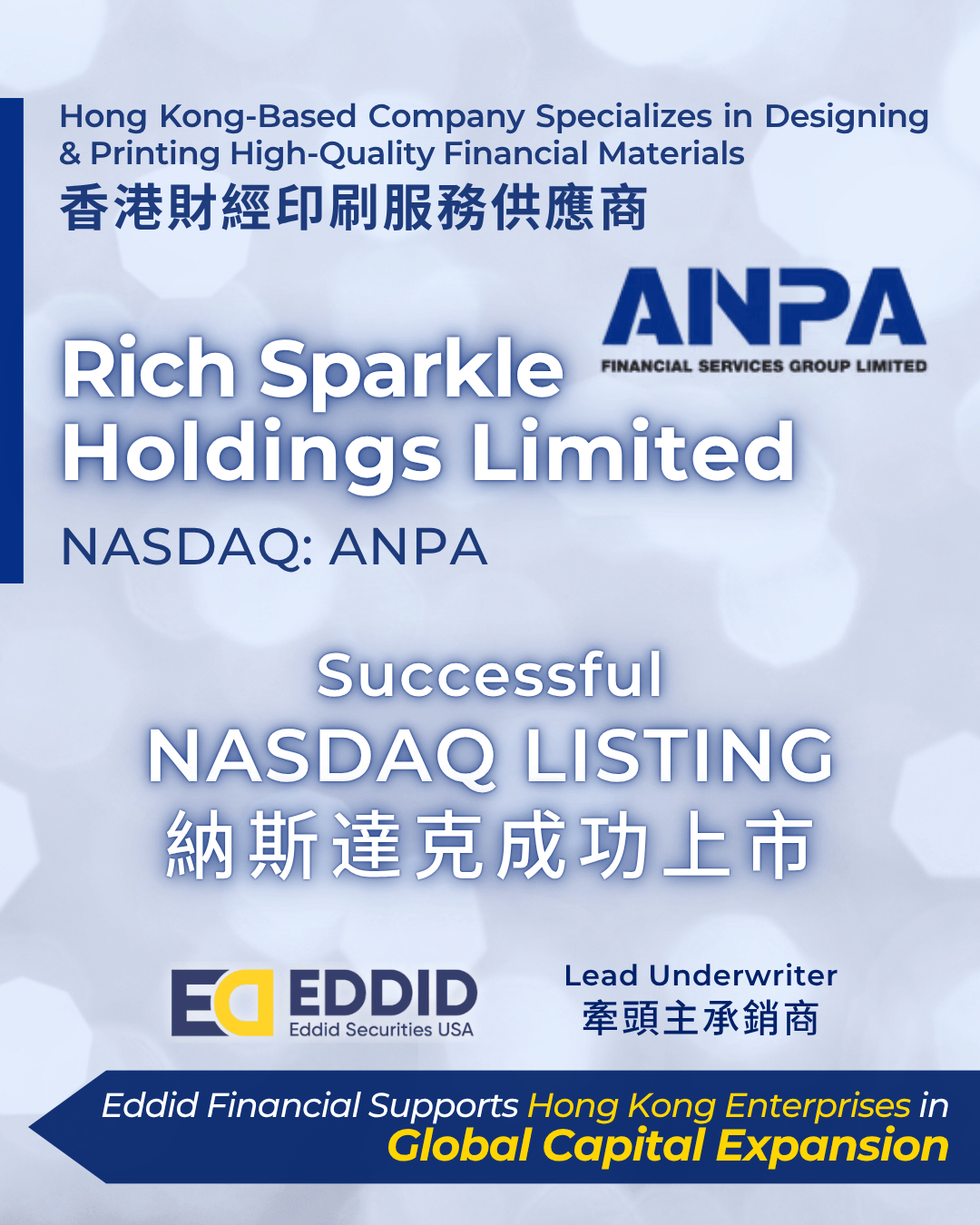
恭贺香港企业Rich Sparkle于纳斯达克上市,艾德金融全力助企业拓展国际资本平台
Sou Hu Cai Jing· 2025-07-10 06:39
Group 1 - Rich Sparkle Holdings Limited has successfully listed on NASDAQ, marking a significant step towards entering the international market [1] - The company, headquartered in Hong Kong, provides high-quality financial printing services to a wide range of clients, including over 190 listed companies in 2024 [3] - Rich Sparkle offers comprehensive solutions such as typesetting, proofreading, translation, design, and printing, helping clients effectively communicate their corporate image and financial information [3] Group 2 - The successful listing highlights Rich Sparkle's strong corporate strength and sustainable growth potential, as well as Eddid Financial's expertise in cross-border capital markets [4] - Eddid Financial is a comprehensive financial group rooted in Hong Kong, focusing on integrating the latest technology into its services, including investment banking and digital assets [5] - Eddid Securities USA Inc., a subsidiary of Eddid Financial, is registered with the SEC and CTFC, providing investment banking services and online retail securities account services in the U.S. [6]