垂类智能体

Search documents
AI应用爆发背后存“同质化”问题 “小而美”智能体或成突围关键
Mei Ri Jing Ji Xin Wen· 2026-02-27 12:52
Core Insights - The AI industry is transitioning from a "technology frenzy" to a "value realization" phase, with a focus on developing specialized intelligent agents to overcome challenges of application homogenization and low ROI [1][4][9] Group 1: Industry Trends - By 2025, China's AI core industry is projected to exceed 900 billion yuan, with over 5,300 companies, making AI applications a crucial driver for digital transformation [2] - The AI application market saw over 23,000 new companies in 2023, with 80% concentrated in common areas like intelligent customer service and voice assistants, leading to a high similarity in product interfaces [2][3] - The market is experiencing a surge in AI shopping, exemplified by Alibaba's 3 billion yuan promotional campaign, which has sparked competition among major players like Tencent and ByteDance [1] Group 2: Challenges in AI Applications - The industry faces three main bottlenecks: application homogenization, difficulties in commercial monetization, and mismatched supply and demand for computing power [2][3][7] - AI applications are struggling with low user engagement, with quality content reaching less than 0.3% of the target audience, resulting in a 65% overall loss rate in the domestic AI application market in 2023 [3][6] - Many AI products rely on similar underlying logic, leading to minimal perceived differences for users, which contributes to the homogenization issue [3][4] Group 3: Financial and Operational Insights - Despite high demand, many AI companies have not achieved substantial financial transformation, with token consumption in industrial AI applications showing significant scale compared to consumer-level products [6] - The average utilization rate of computing power in AI data centers is below 20%, leading to high energy consumption and operational inefficiencies [7] - Companies are currently facing a mismatch between high investment in AI capabilities and low revenue generation, indicating a need for better monetization strategies [7][8] Group 4: Future Directions - Experts suggest a shift from general models to specialized intelligent agents in high-value sectors like healthcare and education to address the challenges of homogenization and improve ROI [7][8] - The future of AI competition will depend on the ability to solve specific problems rather than merely utilizing large models, emphasizing the importance of industry-specific knowledge [9]
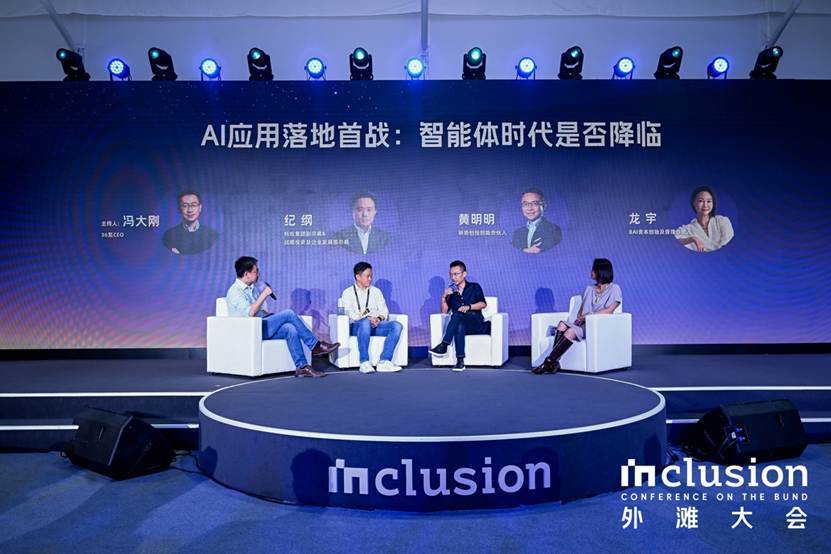
外滩大会一线投资人热议Agent投资路径:通用与垂类智能体的路径权衡
Huan Qiu Wang· 2025-09-13 02:43
Group 1 - The core viewpoint of the articles revolves around the rapid development and potential of AI agents in various sectors such as finance, healthcare, and education, with a focus on their transition from digital to physical realms [1][3][4] - The expectation for AI agents has significantly surpassed previous generations, with the possibility of AI exceeding human intelligence, particularly in high-tolerance scenarios like emotional companionship [3][4] - China is leading in AI applications, with many of the world's first AI agents emerging from Chinese startups, attributed to the country's strong product management capabilities and rapid technological advancements [3][4] Group 2 - The current landscape of AI agents is characterized by a lack of established valuations and early-stage commercialization, with two main categories: general-purpose and vertical-specific agents, each with distinct risk and return profiles [5][7] - Investment strategies are diversifying, with a focus on vertical AI agents that have large market potential and strong willingness to pay, while also considering foundational infrastructure like computing power [7][8] - A "dumbbell strategy" is suggested for investments, balancing between high-risk general-purpose applications and more stable, workflow-integrated business-to-business (B2B) applications to mitigate technological iteration risks [7][8]