城乡收入差距

Search documents
2025年陕西居民人均可支配收入同比增长5.6%
Shan Xi Ri Bao· 2026-01-25 00:18
Core Insights - In 2025, the per capita disposable income of residents in Shaanxi is projected to be 35,790 yuan, representing a nominal growth of 5.6% year-on-year, and a real growth of 5.3% after adjusting for price factors [1] - The growth rate of per capita disposable income in Shaanxi exceeds the national average by 0.6 percentage points [1] Income Growth - All four income sources have shown comprehensive growth: - Per capita wage income is expected to reach 19,420 yuan, an increase of 1,044 yuan or 5.7%, accounting for 54.3% of disposable income [2] - Per capita operating net income is projected at 4,553 yuan, up by 220 yuan or 5.1%, making up 12.7% of disposable income [2] - Per capita transfer net income is anticipated to be 9,719 yuan, increasing by 569 yuan or 6.2%, representing 27.2% of disposable income [2] - Per capita property net income is expected to be 2,097 yuan, rising by 52 yuan or 2.5%, which constitutes 5.9% of disposable income [2] Urban-Rural Income Disparity - The income growth rate for rural residents in Shaanxi is 1.2 percentage points higher than that of urban residents, with the urban-rural income ratio at 2.54, a decrease of 0.03 from the previous year [2] Consumption Expenditure - Per capita living consumption expenditure in Shaanxi is projected to be 24,409 yuan, reflecting a year-on-year growth of 5.2% [2] - Urban residents are expected to have a per capita living consumption expenditure of 29,807 yuan, growing by 4.4%, while rural residents are projected to spend 17,692 yuan, an increase of 5.7% [2] - Per capita service consumption expenditure is anticipated to be 11,559 yuan, with a growth of 6.2%, accounting for 47.4% of total consumption expenditure [2]
上过央视的汪正年,还住在1988年的木屋子里|我们的四分之一世纪
Jing Ji Guan Cha Bao· 2025-12-20 05:38
Core Viewpoint - The story of Wang Zhengnian, a migrant worker from Guizhou, highlights the struggles and resilience of rural laborers in China, showcasing their journey from poverty to a more hopeful future despite numerous challenges faced over the years [1][2][3]. Group 1: Early Life and Migration - Wang Zhengnian left his village at the age of 17 in 1997 to work in Guangdong, marking the beginning of his 28-year journey as a migrant worker [1][2]. - In 2000, he purchased a small recording device, symbolizing a significant personal achievement amidst his family's poverty [1][4]. - The income disparity between urban and rural areas was a major driving force for Wang and many like him to seek work outside their hometowns, with urban residents earning an average of 6,280 yuan compared to rural residents' 2,253 yuan in 2000 [4]. Group 2: Work Experience and Economic Changes - Wang's first job on a construction site provided minimal income, with meals consisting of basic dishes, highlighting the harsh conditions faced by migrant workers [4][5]. - By 2010, after 13 years of work, Wang's income significantly improved as he worked in a furniture factory during a period of rapid growth in the real estate sector, with average wages for urban private sector employees rising from 1,730 yuan/month in 2010 to 4,811 yuan/month by 2020 [7]. - The furniture industry boom allowed Wang to earn up to 800 yuan a day, a stark contrast to his earlier earnings [7]. Group 3: Family and Personal Challenges - Wang's wife, Peng Shuangqin, also faced economic hardships, earning only 90 yuan in her first month at a textile factory, which barely covered her living expenses [5]. - The couple's financial struggles intensified when their second daughter was diagnosed with a severe illness, leading them to seek help through social media to cover medical expenses [13][14]. - Wang's family faced significant emotional and financial strain, including the loss of his mother and the burden of debt from medical bills, which impacted their overall well-being [15]. Group 4: Living Conditions and Social Changes - Wang's living conditions remained poor, as he continued to reside in a wooden house built in 1988, while many in his village upgraded to modern homes [19]. - The working conditions for migrant workers have seen some improvements over the years, with better safety measures and labor rights awareness, although challenges remain [12]. - The narrative reflects a broader trend of rural workers adapting to changing economic landscapes while maintaining hope for a better future for their children [19].


人均可支配收入半年报:江苏首破“3万”,广东增速垫底
Sou Hu Cai Jing· 2025-07-22 03:44
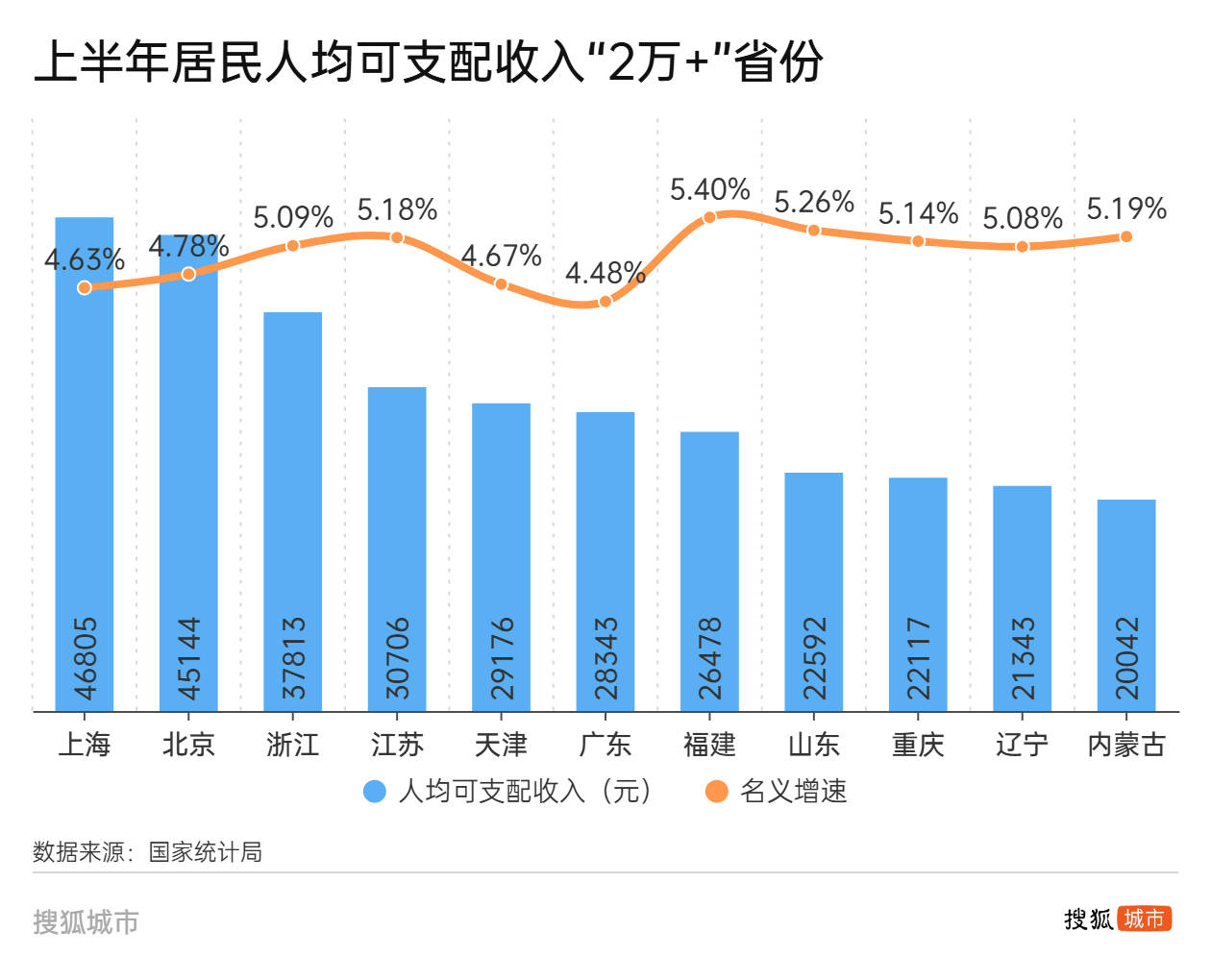
Core Insights - The average per capita disposable income in China for the first half of 2025 is 21,800 yuan, reflecting a year-on-year growth of 5.3%, with an actual growth rate of 5.4% after adjusting for price factors [1][4]. Group 1: Regional Income Distribution - Among the 31 provinces, 11 have a per capita disposable income exceeding 20,000 yuan, with Shanghai leading at 46,800 yuan and Beijing at 45,100 yuan [4]. - Jiangsu has surpassed the 30,000 yuan mark for the first time, reaching 30,700 yuan, ranking fourth nationally, while Zhejiang is third with 37,800 yuan [4][9]. - The Yangtze River Delta region, represented by Shanghai, Zhejiang, and Jiangsu, holds three of the top four positions in per capita disposable income, indicating a significant economic advantage over other regions [4][9]. Group 2: Economic Structure and Income Sources - The high income levels in Shanghai and Beijing are primarily driven by a concentration of modern service industries and headquarters economy effects, with wage income accounting for over 60% in Shanghai and over 65% in Beijing [5][9]. - Chongqing has the highest income growth among direct-controlled municipalities, attributed to its focus on high-tech manufacturing and new economic sectors, with a notable 65.4% increase in integrated circuit production [9]. - Jiangsu's income growth is supported by both traditional manufacturing resilience and emerging industries, contributing to job creation and wage increases [9]. Group 3: Urban-Rural Income Disparities - The average disposable income for urban residents is 28,800 yuan, while for rural residents it is 11,900 yuan, resulting in an urban-rural income ratio of 2.42:1 [15]. - Coastal regions like Shanghai, Zhejiang, and Jiangsu have narrowed the urban-rural income gap to below 2:1, while some central and northeastern provinces still exhibit significant disparities [15][18]. - Zhejiang has the smallest urban-rural income ratio at 1.67:1, reflecting a higher degree of labor market integration and rural residents' participation in urban employment [18].