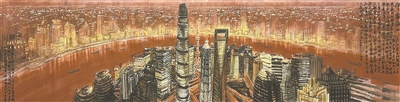
城市山水

Search documents
岁月不改丹青志
Ren Min Ri Bao· 2025-11-22 22:00
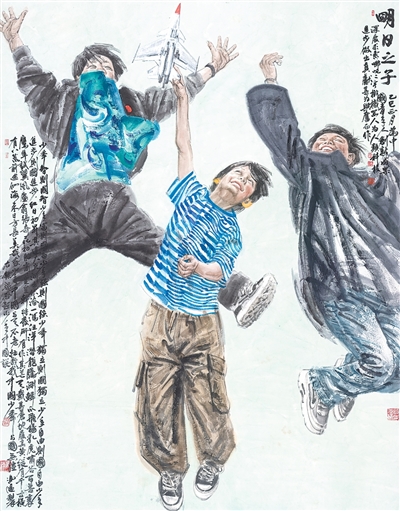
Core Perspective - The exhibition "Mirror of Time - Feng Yuan's Chinese Painting Exhibition" at the National Grand Theatre Art Museum reflects the intertwining of individual growth and societal changes, showcasing Feng Yuan's artistic journey and his thoughts on the modern transformation of Chinese painting [2][3]. Group 1: Exhibition Structure and Themes - The exhibition is divided into four sections: "Ancient Capital Chronicles," "Life Reflections," "Echoes of the Ancients," and "Heaven and Earth Affection," representing Feng Yuan's artistic career and his exploration of modern Chinese painting [2][3]. - Feng Yuan's diverse life experiences, from education to cultural administration, enrich his artistic perspective, allowing him to infuse more varied thoughts into his creations [3]. Group 2: Artistic Focus and Techniques - The "Ancient Capital Chronicles" section emphasizes urban landscapes through Chinese painting, while the "Heaven and Earth Affection" section connects with nature, showcasing the duality of modern city life and traditional landscapes [4]. - Feng Yuan's latest series "Old Beijing Firewood Families" captures the essence of ordinary people's lives in Beijing, reflecting cultural nuances and emotional depth [4]. - He believes that modern urban landscapes will become significant subjects in Chinese painting, particularly "urban landscapes," which represent a new tradition in the evolution of Chinese landscape painting [4]. Group 3: Human Element in Art - The "Life Reflections" section focuses on the authentic state of life through vivid character portrayals, emphasizing the importance of capturing the essence of contemporary individuals, especially in the context of modernization [5]. - Feng Yuan's work "Tomorrow's Son" symbolizes the aspirations of youth and the future of the nation, reflecting his commitment to portraying the ideals of the younger generation [5]. Group 4: Historical Context and Responsibility - The "Echoes of the Ancients" section highlights significant historical events and figures, addressing the lack of representation of such themes in Chinese art history [6][7]. - Feng Yuan feels a personal responsibility to document the era through his art, believing that some artworks hold value beyond monetary worth, serving as cultural and historical records [7]. Group 5: Future of Chinese Painting - Feng Yuan advocates for a modern transformation of Chinese painting, emphasizing the need to balance traditional techniques with contemporary themes and styles [8]. - He poses the challenge for contemporary artists to innovate and explore new expressions of future life, reflecting the evolving cultural landscape in the age of artificial intelligence [8].

上海的艺术家们|邱岸雄:从《新山海经》到当代山水之旅
Xin Lang Cai Jing· 2025-09-25 00:13
Core Viewpoint - Artist Qiu Anxiong draws inspiration from traditional Chinese culture, transitioning from ink animation to painting, and exploring contemporary landscapes through a journey that combines various art forms [1][20]. Group 1: Artist Background and Evolution - Qiu Anxiong was born in 1972 in Guangyuan, Sichuan, and later moved to Chengdu, where he studied oil painting at Sichuan Fine Arts Institute [3]. - He studied at Kassel University in Germany for five years, which deepened his understanding of traditional culture and the differences between Eastern and Western art [10]. - After returning to China, he settled in Shanghai and began his artistic career, teaching at East China Normal University [3]. Group 2: Artistic Transition and Current Work - Initially focused on ink animation, Qiu has shifted to painting, requiring a different studio space that accommodates larger works [5]. - His studio in Baoshan, Shanghai, is described as spacious and conducive to creativity, allowing him to work extensively [5]. - Qiu's recent works reflect a blend of traditional Chinese aesthetics with contemporary themes, particularly through his exploration of landscape painting [18]. Group 3: Recent Projects and Collaborations - In early spring, Qiu embarked on a contemporary landscape journey with a group of creators from various fields, resulting in collaborative works that integrate music, dance, and visual art [20]. - The exhibition titled "Early Spring Long Song" showcases these collaborative efforts, emphasizing the connection between historical and contemporary artistic expressions [20][22]. - Qiu's works in the exhibition include a series that combines painting and video, reflecting a modern interpretation of traditional themes [25]. Group 4: Artistic Philosophy and Future Directions - Qiu emphasizes the importance of experiencing nature directly to inform his artistic practice, advocating for a contemporary approach to traditional themes [20]. - His recent works incorporate color, moving away from the monochrome of his earlier animations, and he expresses a preference for colors derived from natural sources [18]. - The artist aims to create a dialogue between past and present, ensuring that his works resonate with contemporary audiences while honoring traditional roots [20].
用笔墨为城市立传
Ren Min Ri Bao· 2025-05-24 21:52
Core Perspective - The integration of urban themes into contemporary Chinese painting has become an essential focus, reflecting the natural connection between life in cities and artistic expression [1][2]. Group 1: Development of Urban Landscape Painting - Over 20 years ago, the Chinese painting department at Shanghai University began exploring urban themes in ink painting, driven by individual passion and a sense of mission to advance Chinese painting [1]. - By around 2009, urban landscape works started gaining recognition in major exhibitions, leading to a collective realization among artists that they were building a "city of ink" through diverse artistic expressions [1]. - The concept of "urban" quickly became a consensus within the Chinese painting department, guiding their creative and educational strategies to respond to the innovative development of Chinese painting [1][2]. Group 2: Recent Initiatives and Exhibitions - In 2021, the "Urban·Landscape" seminar and exhibition at the China Art Palace marked the first institutional recognition of "urban landscape" at the university level, significantly promoting the development of urban landscape creation and education across various regions [2]. - Recent years have seen a surge in urban landscape creations, with numerous outstanding works emerging, establishing urban landscape as a new representation of contemporary Chinese painting [2]. - The recent exhibition "Ink and City" in Beijing aimed to showcase the collective efforts of the Shanghai University artists and engage with peers and audiences in a national art venue [2]. Group 3: Cultural Context and Artistic Standards - The discussion of urban landscapes is not new, but the contemporary context has shifted, with increased cultural confidence among Chinese people and a broader understanding of "Chinese painting" as a cultural spirit rather than a conservative practice [2]. - Unlike traditional landscape painting, urban landscapes focus on human-made structures, emphasizing the importance of exploring the historical and cultural context of cities and the spiritual attributes of architecture [2]. - The integration of urban elements into landscape painting necessitates a creative transformation that maintains the artistic standards and core values of Chinese painting while responding to contemporary life [3].