中国画现代转型

Search documents
“广东美术百年大展”延期至3月8日,借此契机我们再谈谈他
Xin Lang Cai Jing· 2026-01-15 00:55
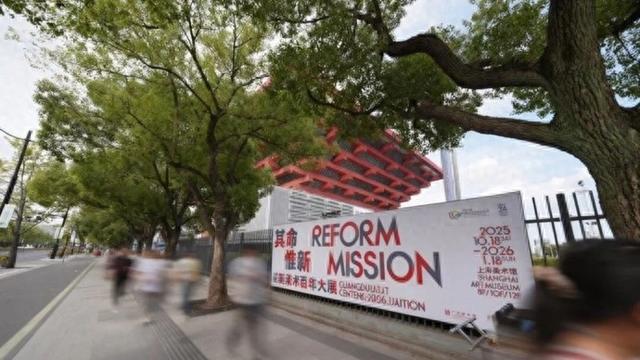
Core Viewpoint - The "Its Fate is Renewed - Guangdong Art Century Exhibition" at the Shanghai Art Museum has been extended until March 8, 2024, providing an opportunity to discuss Lin Fengmian's construction of a modern Chinese painting paradigm that is rooted in Eastern poetry yet possesses a global language [4][21]. Group 1: Historical Context and Artistic Fusion - The early 20th century saw a consensus in Chinese art regarding "Sinicization and Westernization" as a response to modernity, with even the Guangdong National Painting Research Association acknowledging the need to learn from Western art [6][7]. - The Guangdong National Painting Research Association published "National Painting Special Issue" in 1926, where traditional painters discussed the acceptance of Western techniques and expressionism [6]. - The debate on "fusion" concealed fundamental disagreements on the reasons and methods for such integration, leading to distinct paths represented by the Lingnan School, Xu Beihong, and Lin Fengmian [6][12]. Group 2: Influences of Western Art - Two main influences of Western art emerged in China: the classical-academic realism tradition and the modernist art tradition, each shaping the evolution of Chinese painting [7][10]. - The classical tradition emphasized realistic representation and was seen as a tool for national rejuvenation, while modernism offered a departure from narrative focus towards exploration of form and subjective experience [10][12]. - The interaction between Western realism and modernism with traditional Chinese aesthetics was complex, leading to a multi-faceted influence rather than a linear adoption [10][12]. Group 3: Lin Fengmian's Artistic Philosophy - Lin Fengmian proposed a "Sino-Western Harmony" that transcended mere technical integration, addressing the fundamental question of "what painting is" [12][13]. - His approach involved merging Chinese and Western artistic resources, emphasizing structural training and a comprehensive understanding of art history [13][15]. - Lin simplified traditional Chinese elements and integrated them with Western techniques, achieving a balance in line, color, and texture, as exemplified in his work "Qingyi Shini" [15][17]. Group 4: Broader Artistic Impact - Lin Fengmian expanded the boundaries of "tradition," advocating for a global perspective in art that included influences from various cultures beyond Europe [17][19]. - His exploration of folk art and traditional Chinese theater provided new visual languages, leading to a unique modern aesthetic that resonated with Chinese cultural roots [19]. - The retrospective view of Lin's work reveals a forward-thinking approach that liberated Chinese aesthetics from traditional constraints, allowing for a dialogue with global modern art [19][21].

周末看展好去处,“艺术为人民”大展呈现上海中国画院65年脉络
Xin Lang Cai Jing· 2026-01-11 12:04
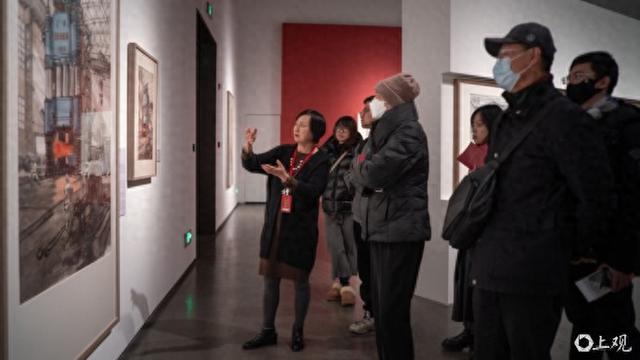
Core Viewpoint - The Shanghai Chinese Painting Academy is hosting a significant academic exhibition titled "Art for the People" to commemorate its 65th anniversary, showcasing the evolution of Chinese painting over the decades [3]. Group 1: Exhibition Overview - The exhibition features rare collections, meticulous curation, and enthusiastic volunteers, attracting many visitors over the weekend [5]. - The first exhibition area at the Cheng Shifa Art Museum focuses on the themes of "what to paint" and "how to paint," displaying nearly 170 pieces that trace the creative practices and ideological shifts of the Shanghai Chinese Painting Academy since its establishment [6]. - The "Era and Classics" section has become a focal point for visitors, highlighting how Chinese painting responded to societal changes from the early years of the People's Republic of China to the period of reform and opening up [6]. Group 2: Historical Context and Artistic Evolution - The exhibition addresses the critical question of whether Chinese painting can reflect reality, particularly during the early years of the People's Republic of China, when traditional literati painting faced criticism for being disconnected from real life [6]. - Artists began to engage with real-life settings, such as factories and rural areas, to find new artistic expressions, marking a significant transition from individual expression to social realism in Chinese painting [6]. Group 3: Featured Works and Audience Reception - Notable works include Feng Zikai's 1962 piece "Drinking Water and Remembering the Source," which resonates with viewers for its sincere emotional expression, and Cheng Shifa's 1956 "Singing the Spring of the Motherland," which exemplifies the modern transformation of Chinese figure painting [8]. - The industrial theme section features impactful works like Wu Hufan's "Celebrating the Success of China's Atomic Bomb Explosion," showcasing modern industrial achievements through traditional ink techniques, surprising many visitors with their bold colors and compositions [10][11]. - The landscape painting segment, including Lu Yanshao's "Shanghai Port," reflects modern urban landscapes, while the collaborative scroll "Xin'an River" captures historical narratives of water conservancy and migration, appreciated for its artistic and documentary value [13]. Group 4: Artistic Pathways and Cultural Revival - The flower-and-bird painting and calligraphy sections present another approach to "Art for the People," with Zhang Dazhuang's "Bountiful Harvest of Fish" integrating marine themes into traditional art, demonstrating innovation in daily life [15]. - Calligraphy and seal carving works by artists like Shen Yinmo and Qian Shoutie reflect the continuity of traditional practices and the revival of calligraphy under the new cultural framework of China [15]. Group 5: Visitor Engagement and Future Prospects - The exhibition is expected to run until April 6, attracting a diverse audience, including art professionals, families, and students, who find the exhibition informative and accessible [16][17]. - The dual exhibition area approach not only reviews the historical accumulation of the Shanghai Chinese Painting Academy but also showcases the ongoing vitality of Chinese painting in the contemporary context, aiming to deepen the understanding of "Art for the People" [17].
岁月不改丹青志
Ren Min Ri Bao· 2025-11-22 22:00
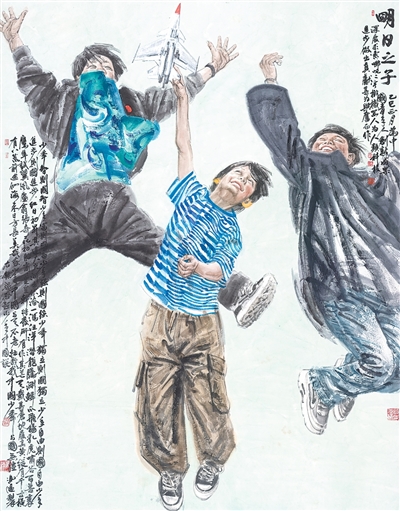
Core Perspective - The exhibition "Mirror of Time - Feng Yuan's Chinese Painting Exhibition" at the National Grand Theatre Art Museum reflects the intertwining of individual growth and societal changes, showcasing Feng Yuan's artistic journey and his thoughts on the modern transformation of Chinese painting [2][3]. Group 1: Exhibition Structure and Themes - The exhibition is divided into four sections: "Ancient Capital Chronicles," "Life Reflections," "Echoes of the Ancients," and "Heaven and Earth Affection," representing Feng Yuan's artistic career and his exploration of modern Chinese painting [2][3]. - Feng Yuan's diverse life experiences, from education to cultural administration, enrich his artistic perspective, allowing him to infuse more varied thoughts into his creations [3]. Group 2: Artistic Focus and Techniques - The "Ancient Capital Chronicles" section emphasizes urban landscapes through Chinese painting, while the "Heaven and Earth Affection" section connects with nature, showcasing the duality of modern city life and traditional landscapes [4]. - Feng Yuan's latest series "Old Beijing Firewood Families" captures the essence of ordinary people's lives in Beijing, reflecting cultural nuances and emotional depth [4]. - He believes that modern urban landscapes will become significant subjects in Chinese painting, particularly "urban landscapes," which represent a new tradition in the evolution of Chinese landscape painting [4]. Group 3: Human Element in Art - The "Life Reflections" section focuses on the authentic state of life through vivid character portrayals, emphasizing the importance of capturing the essence of contemporary individuals, especially in the context of modernization [5]. - Feng Yuan's work "Tomorrow's Son" symbolizes the aspirations of youth and the future of the nation, reflecting his commitment to portraying the ideals of the younger generation [5]. Group 4: Historical Context and Responsibility - The "Echoes of the Ancients" section highlights significant historical events and figures, addressing the lack of representation of such themes in Chinese art history [6][7]. - Feng Yuan feels a personal responsibility to document the era through his art, believing that some artworks hold value beyond monetary worth, serving as cultural and historical records [7]. Group 5: Future of Chinese Painting - Feng Yuan advocates for a modern transformation of Chinese painting, emphasizing the need to balance traditional techniques with contemporary themes and styles [8]. - He poses the challenge for contemporary artists to innovate and explore new expressions of future life, reflecting the evolving cultural landscape in the age of artificial intelligence [8].