
基本养老金调整

Search documents
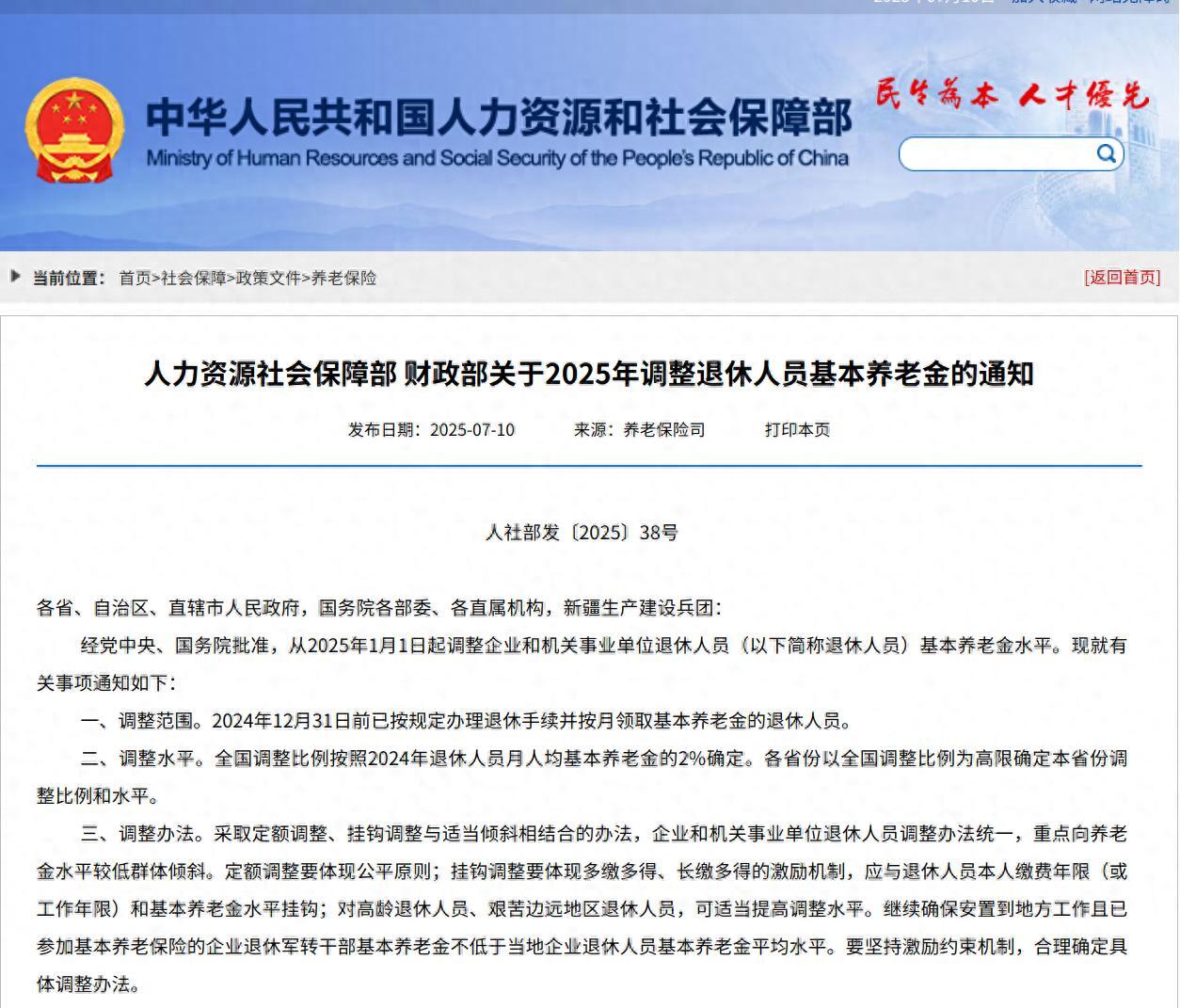
涨多少?怎么算?带你了解2025年基本养老金再调整
Xin Hua She· 2025-07-11 04:06
Core Points - The Ministry of Human Resources and Social Security and the Ministry of Finance announced an adjustment to the basic pension for retirees starting January 1, 2025, with an overall increase of 2% based on the average monthly basic pension of retirees in 2024 [2] - The adjustment will not uniformly apply a 2% increase to every retiree, as it represents the national average adjustment level [2] - The adjustment method combines fixed adjustments, link-based adjustments, and appropriate inclinations, focusing on lower pension groups [3] Group 1 - The adjustment will benefit approximately 150 million retirees across the country [5] - The fixed adjustment ensures fairness by applying the same adjustment standard for all types of retirees within the same region [3] - Link-based adjustments encourage higher contributions during employment, rewarding those who pay more and for longer periods [3] Group 2 - The appropriate inclination in the adjustment method provides special consideration for elderly retirees and those in remote or difficult areas [3] - Each province will develop specific implementation plans based on local conditions to ensure timely distribution of the increased pensions [5]


再涨2% 惠及约1.5亿退休人员——基本养老金待遇水平稳步提高
Jing Ji Ri Bao· 2025-07-10 22:01
Core Viewpoint - The Chinese government will increase the basic pension level by 2% starting January 1, 2025, benefiting approximately 150 million retirees, reflecting the government's commitment to support retirees amid economic uncertainties [1][2]. Group 1: Pension Adjustment Details - The adjustment will be based on a combination of fixed amount increases, linkage adjustments related to individual contribution years and pension levels, and targeted increases for specific groups such as the elderly and those in remote areas [3]. - The fixed amount adjustment ensures fairness across different pension levels, while linkage adjustments incentivize longer and higher contributions [3][4]. Group 2: Economic Context and Rationale - The 2% adjustment rate considers factors such as inflation, with the consumer price index (CPI) expected to rise only 0.2% in 2024, ensuring retirees' purchasing power is maintained [2]. - The adjustment aligns with wage growth trends, where average wages in urban non-private sectors increased by 2.8% and in private sectors by 1.7% last year, reflecting a policy to share economic development benefits with retirees [2]. Group 3: Policy Implications - The adjustment method aims to balance fairness and efficiency, with a focus on supporting low-income retirees while encouraging higher contributions during their working years [4]. - This approach is expected to enhance public welfare, stabilize expectations, promote consumption, and facilitate economic circulation [4].
今年养老金调整重点向中低收入群体倾斜
Ren Min Ri Bao· 2025-07-10 14:16
Core Viewpoint - The adjustment of pension benefits is crucial for ensuring the basic living standards of retired individuals, reflecting the government's commitment to social welfare and economic development [1][2]. Group 1: Pension Adjustment Mechanism - The national adjustment ratio for pensions this year is set at 2%, aligning with the increase in urban residents' Consumer Price Index (CPI) and average monthly wages, effectively supporting retirees' basic living needs [2]. - The adjustment method combines fixed amount increases, linkage adjustments based on individual contributions, and targeted increases for specific groups, ensuring a fair and efficient distribution of benefits [2][3]. - Fixed adjustments provide equal increases for all retirees in a region, while linkage adjustments vary based on individual contribution years and pension levels, promoting long-term contributions [2][3]. Group 2: Impact on Income Distribution - The pension adjustment policy favors lower-income retirees, resulting in a higher actual adjustment ratio for those with lower pension levels, thus addressing income inequality [3]. - The adjustment strategy aims to balance fairness and efficiency, encouraging longer and higher contributions while ensuring basic living standards for lower-income groups [3]. - The adjustment policy is integral to the government's broader goals of enhancing social welfare and promoting common prosperity, impacting both retirees and current contributors [3].
基本养老金上调2%,还有这些信息需要关注
Zhong Guo Jing Ji Wang· 2025-07-10 11:06
Core Points - The Ministry of Human Resources and Social Security and the Ministry of Finance announced a 2% increase in the basic pension level for retirees starting January 1, 2025, benefiting those who have completed retirement procedures by the end of 2024 [1][4] - The adjustment ratio of 2% aligns with the increase in the Consumer Price Index (CPI) and the average monthly wage of urban employees, aiming to ensure retirees' basic living standards and share in economic development [4][5] - The pension adjustment method combines fixed adjustments, link-based adjustments, and appropriate preferential treatment, ensuring fairness and linking benefits to individual contributions and service years [4] - The adjustment reflects the government's commitment to social welfare and signals the stable operation of the pension system, which is crucial for maintaining the purchasing power of pensions against inflation [5] Summary by Sections - **Pension Increase Announcement** - A 2% increase in basic pensions for retirees effective January 1, 2025 [1] - **Adjustment Rationale** - The 2% adjustment is in line with CPI and wage growth, aimed at safeguarding retirees' living standards [4] - **Adjustment Methodology** - The adjustment combines fixed, link-based, and preferential methods, promoting fairness and incentivizing longer contributions [4] - **Economic Context and Implications** - The pension adjustment is a response to economic recovery and external uncertainties, reflecting the government's focus on social welfare and the dynamic optimization of the pension system [5]
惠及约1.5亿退休人员!2025年基本养老金再涨2%
Xin Hua She· 2025-07-10 10:35
Core Viewpoint - The Chinese government will increase the basic pension by 2% starting January 1, 2025, benefiting approximately 150 million retirees, reflecting the government's commitment to improving the welfare of its citizens [1][2]. Group 1: Pension Adjustment Details - The 2% increase is based on the average monthly basic pension of retirees as of 2024, but individual increases may vary [2]. - The adjustment will utilize a combination of fixed adjustments, link adjustments based on individual contributions, and targeted increases for specific groups, such as the elderly and those in remote areas [3][4]. - The final pension increase for individuals will depend on the sum of these three components, with lower pensioners receiving a higher percentage increase [4]. Group 2: Financial Sustainability - The number of retirees is expected to rise as the population born during the 1960s reaches retirement age, which will increase pension fund expenditures [4]. - In 2024, the income from the enterprise employee basic pension insurance fund is projected to be 7.5 trillion yuan, with expenditures at 6.8 trillion yuan, indicating a slight surplus [4]. - The central government has increased its financial support for pensions, and the pension insurance system has transitioned to a nationwide pooling mechanism to better support regions with financial difficulties [5]. Group 3: Pension Fund Reserves - The cumulative balance of the enterprise employee basic pension insurance fund is expected to reach 7.1 trillion yuan in 2024, with the national social security fund holding over 2.6 trillion yuan in strategic reserves [6]. - The central government has transferred 1.68 trillion yuan of state-owned capital to bolster the social security fund [6].
两部门印发!今年基本养老金上调2%
证券时报· 2025-07-10 09:48
Core Viewpoint - The article discusses the adjustment of basic pensions for retirees in China, effective from January 1, 2025, with an overall increase of 2% based on the average monthly basic pension of retirees by the end of 2024 [3]. Group 1: Pension Adjustment Details - The adjustment is based on various factors, including price changes and wage growth, to determine a reasonable pension adjustment ratio [4]. - Each province is required to develop specific implementation plans to ensure timely distribution of the increased pensions to retirees [5]. - The adjustment method combines fixed amount increases, linkage adjustments based on individual contributions, and appropriate tilting towards lower-income groups [7][12]. Group 2: Focus on Low-Income Groups - The current pension adjustment emphasizes support for middle and low-income retirees, ensuring that those with lower pension levels receive more significant increases [6][7]. - The adjustment mechanism includes a fixed increase for all retirees in the same region, reflecting fairness, while also linking adjustments to individual contribution history [12]. Group 3: Financial Stability and Support - The pension fund's income for urban employees in 2024 is projected at 7.5 trillion yuan, with expenditures at 6.8 trillion yuan, indicating a balanced budget with a slight surplus [13]. - Central government support has increased, with a fund transfer of 271.6 billion yuan in 2023 to assist provinces facing difficulties in pension payments [13]. - The cumulative surplus of the urban employee pension fund is expected to reach 7.1 trillion yuan by 2024, alongside a strategic reserve of over 2.6 trillion yuan in the national social security fund [13].

两部门:此次基本养老金调整重点是向养老金水平较低群体倾斜
news flash· 2025-07-10 08:15
Core Viewpoint - The adjustment of basic pensions for retirees in 2025 focuses on benefiting groups with lower pension levels, continuing a trend of gradual increases in pension benefits since 2005 [1] Summary by Relevant Categories Pension Adjustment Methodology - The adjustment will utilize a combination of fixed adjustments, link-based adjustments, and appropriate tilting towards lower pension levels [1] Impact on Retirees - The pension adjustments are crucial for the basic living standards of millions of retirees, indicating a strong material foundation for timely and full pension payments in China [1]