
基金绩效改革

Search documents
绩效新规|兴证全球基金的外资股东赚的盆满钵满:2008年投入约2亿元取得49%股权,近十年获分红23亿
Xin Lang Cai Jing· 2025-12-19 01:17
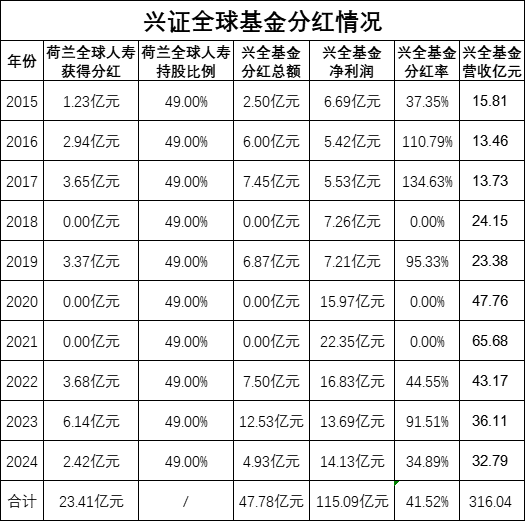
Core Viewpoint - The recent draft of the "Guidelines for Performance Assessment Management of Fund Management Companies" has sparked significant discussion in the industry, emphasizing a shift towards performance-based evaluations and potential salary reductions for nearly a thousand fund managers [1][7]. Group 1: Performance Assessment Guidelines - The guidelines require fund companies to prudently determine dividend frequency and ratio based on the long-term performance of fund products and investor profit and loss situations [1][7]. - For fund products with poor performance and significant investor losses over the past three years, the guidelines suggest a reduction in both dividend frequency and ratio [1][7]. Group 2: Financial Performance of Xingzheng Global Fund - In 2024, Xingzheng Global Fund reported revenues of 3.279 billion yuan and a net profit of 1.413 billion yuan, with foreign shareholder Dutch Global Life Insurance receiving dividends of 242 million yuan [1][7]. - Over the past decade (2015-2024), Xingzheng Global Fund has accumulated revenues of 31.604 billion yuan, net profits of 11.509 billion yuan, and total dividends of 4.778 billion yuan, resulting in an average dividend rate of 41.52% [1][7]. Group 3: Dividend Distribution to Foreign Shareholders - Dutch Global Life Insurance, holding 49% of Xingzheng Global Fund, has received a total of 2.341 billion yuan in dividends from 2015 to 2024 [1][6]. - The dividend distribution data shows fluctuations, with the highest dividend received in 2023 at 614 million yuan, and a notable drop in 2024 to 242 million yuan [2][8].

公募基金绩效改革:在不断调适中寻求共识
经济观察报· 2025-12-10 10:39
Core Viewpoint - The revised "Guidelines for Performance Evaluation Management of Fund Management Companies" aims to reshape the asset management industry, which has a scale of 36 trillion and involves over 700 million investors, by emphasizing long-term value creation for investors [2]. Group 1: Key Design Features of the Guidelines - The guidelines extend the evaluation period, requiring at least 80% of performance indicators to be based on a three-year horizon, encouraging institutions to develop investment capabilities that endure market fluctuations [3]. - Performance compensation is closely tied to fund performance, with increased mandatory co-investment ratios, effectively aligning the interests of practitioners with those of investors, and introducing accountability measures that apply even to departing employees [4]. - The guidelines allow for differentiated assessments, focusing on performance deviations for fund managers, enhancing credit and liquidity management for fixed-income investments, and emphasizing client profit and loss for sales personnel, reflecting a nuanced regulatory approach [4][5]. Group 2: Industry Concerns and Challenges - Industry concerns include how sales personnel can be held accountable for uncontrollable client timing decisions and whether fund managers might adopt overly conservative strategies to avoid penalties, potentially harming market vitality and long-term investor returns [4]. - The intent behind assessing sales personnel is to shift their role from "seller" to "buyer advisor," promoting a service-oriented approach that requires collaboration across the distribution ecosystem [5]. - Balancing risk prevention with the encouragement of innovation will be crucial in evaluating the effectiveness of the guidelines, as a compatible incentive system can support a healthy industry ecosystem in the long run [5]. Group 3: Overall Impact and Future Outlook - The guidelines aim to transition the industry from a "scale competition" to a "value creation" focus, aligning with the fundamental interests of investors and the public [5]. - The implementation process will involve ongoing adjustments among regulatory intentions, institutional transformations, and public perceptions, fostering a dynamic consensus [5].

公募基金绩效改革:在不断调适中寻求共识
Jing Ji Guan Cha Wang· 2025-12-09 11:47
Core Viewpoint - The revised "Guidelines for Performance Assessment Management of Fund Management Companies" aims to reshape the value logic of China's asset management industry, which manages approximately 36 trillion yuan and involves over 700 million investors [1] Group 1: Key Design Features of the Guidelines - The guidelines extend the assessment period, requiring that at least 80% of performance indicators be based on a three-year horizon, encouraging institutions to develop investment capabilities that endure market fluctuations [2] - Performance compensation is closely tied to fund performance, with increased mandatory co-investment ratios, effectively aligning the interests of practitioners with those of investors, promoting a "shared risk and shared benefit" mechanism [2] - The guidelines allow for differentiation in assessments, focusing on performance deviations for fund managers, credit and liquidity management for fixed-income investments, and customer profit and loss for sales personnel, reflecting a nuanced regulatory approach [2] Group 2: Industry Concerns and Challenges - There are concerns regarding how sales personnel can be held accountable for uncontrollable client timing decisions, and whether fund managers might adopt overly conservative strategies to avoid penalties, potentially harming market vitality and long-term investor returns [3] - The intent behind assessing sales personnel is to shift their role from "seller" to "buyer advisor," encouraging a focus on servicing client accounts rather than merely selling products, which requires collaboration across the distribution ecosystem [3] - Balancing risk prevention with the encouragement of innovation is crucial for evaluating the effectiveness of the guidelines, as ensuring long-term investor interests and providing reasonable incentives for managers are not mutually exclusive [3] Group 3: Implementation and Industry Transformation - The guidelines represent a shift from a "scale competition" to a "value creation" focus, aligning with the fundamental interests of investors and the public [4] - The implementation process will involve ongoing adjustments among regulatory intentions, institutional transformations, and public perceptions, aiming for a consensus that fosters a healthier and more sustainable industry ecosystem [4]