增值税预缴

Search documents
【实用】个税经营所得A、B、C表区别&申报看过来
蓝色柳林财税室· 2026-03-05 08:30
Group 1 - The article discusses the applicable objects and reporting deadlines for individual income tax on business income in China, specifically focusing on the prepayment and annual settlement tax declaration forms [4][5][6]. - The prepayment tax declaration form (Form A) is applicable to individual business owners, sole proprietors, partners in partnerships, and other individuals engaged in production and business activities in China, who must report their business income to tax authorities within 15 days after the end of each month or quarter [4][5]. - The annual settlement tax declaration form (Form B) is for those who are subject to accounting assessments and must submit their tax declaration by March 31 of the following year [6][7]. - The combined declaration form (Form C) is for individuals who earn business income from multiple sources and must submit their annual summary tax declaration by March 31 of the following year [7][8]. Group 2 - The article provides operational guidelines for submitting the three tax forms through the Natural Person Electronic Tax Bureau, detailing the steps for filling out Form A, Form B, and Form C [9][10][11]. - For Form A, users can log in to the tax bureau, select the business income option, and input the necessary information, including the social credit code of the business entity [10]. - After completing Form B, individuals with multiple sources of income can proceed to fill out Form C, where the system will automatically gather necessary data based on historical submissions [11].


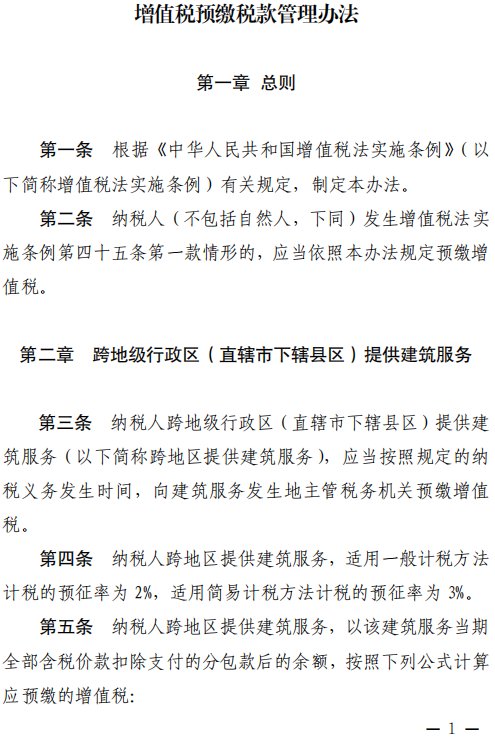
财政部、税务总局公布《增值税预缴税款管理办法》
智通财经网· 2026-02-02 09:06
Core Points - The Ministry of Finance and the State Taxation Administration announced the "Management Measures for Prepaid Value-Added Tax" effective from January 1, 2026, which outlines new tax rates for various services and transactions [1]. Group 1: Construction Services - Taxpayers providing construction services across regions will have a prepayment rate of 2% under the general taxation method and 3% under the simplified taxation method [1]. - Taxpayers using advance payment methods for construction services will also have a prepayment rate of 2% for general taxation and 3% for simplified taxation [1][6]. Group 2: Real Estate Transactions - Taxpayers transferring or leasing real estate not located in the same county as their institution must pay a prepayment rate of 5% for general taxpayers and 3% for small-scale taxpayers [1][10]. - Real estate developers selling self-developed projects through pre-sale methods will need to prepay VAT at a rate of 3% based on the received advance payments [8][9]. Group 3: Oil and Gas Services - Oil and gas companies selling services related to the production of crude oil and natural gas across provinces will have a prepayment rate of 5% in Xinjiang and 3% in other regions [1][14]. - The calculation for prepaid VAT for oil and gas services will follow the same formula as other services, based on the total taxable amount [14][24].
合法纳税9大要点丨建筑行业预缴税款常见问题知悉
蓝色柳林财税室· 2026-01-09 09:04
Core Viewpoint - The article discusses the tax obligations of construction companies regarding the prepayment of value-added tax (VAT) based on their monthly sales revenue, emphasizing the importance of accurately reporting sales figures and understanding the implications of multiple projects within the same tax jurisdiction [2][5]. Group 1: Tax Prepayment Guidelines - Taxpayers must fill out the "VAT and Additional Tax Prepayment Form" and are responsible for the accuracy of the reported information, confirming it with a signature in the declaration section [2]. - The monthly sales revenue for VAT prepayment is calculated after deducting subcontractor costs, which is crucial for determining eligibility for the small-scale taxpayer exemption of 100,000 yuan [3]. - If multiple construction projects exist within the same tax jurisdiction, the total sales revenue across all projects is considered for VAT prepayment, and if it exceeds 100,000 yuan, prepayment is required [5]. Group 2: Refund Policies - Small-scale taxpayers whose monthly sales revenue does not exceed 100,000 yuan are not required to prepay VAT, and any prepayments made can be refunded upon application to the tax authority [5].

一问一答丨建筑行业预缴税款热点问答
蓝色柳林财税室· 2025-12-25 14:38
Group 1 - The article discusses the tax obligations of small-scale taxpayers in the construction industry regarding VAT prepayment based on their monthly sales figures [2][4]. - It clarifies that if the total sales amount of multiple projects in the same prepayment location exceeds 100,000 yuan, VAT must be prepaid at a reduced rate of 1% [2]. - The article emphasizes that the monthly sales amount considered for VAT prepayment is the amount after deducting any subcontracting fees [4][5]. Group 2 - It states that if the quarterly sales amount does not exceed 300,000 yuan, small-scale taxpayers are not required to prepay VAT, and any prepaid tax can be refunded [5]. - The type of invoice issued (special VAT invoice or general VAT invoice) does not affect the obligation to prepay VAT for projects located in different regions [5]. - The article references specific tax regulations and announcements from the State Taxation Administration to support its points [2][4].

漫解税收|用购物卡买东西商家需要开发票吗?
蓝色柳林财税室· 2025-12-19 06:44
Core Viewpoint - The article discusses the recent policies regarding the VAT exemption and management for small-scale taxpayers, emphasizing the conditions and procedures for changing tax reporting periods and the implications for tax exemptions [10][12][15]. Group 1: Tax Reporting Period Changes - Small-scale taxpayers can choose their tax reporting period as either monthly or quarterly, and once selected, it cannot be changed within the same accounting year [10]. - Taxpayers can apply to change their tax reporting period without needing to provide any documentation [11]. - The effective date for the new tax reporting period varies based on when the application is made within the quarter [13]. Group 2: VAT Exemption Policies - Small-scale taxpayers with monthly sales not exceeding 100,000 yuan can enjoy VAT exemption, and sales returns must be deducted from the current sales to determine eligibility [13][14]. - Taxpayers whose quarterly sales do not exceed 300,000 yuan are also exempt from prepaying VAT [15]. - The calculation of sales for small-scale taxpayers under the reduced VAT rate policies is specified, with formulas provided for converting taxable sales amounts [16].