外资投资偏好

Search documents
6家AH股“倒挂”背后:流通股比例小,外资更爱行业龙头
Di Yi Cai Jing· 2025-12-02 06:25
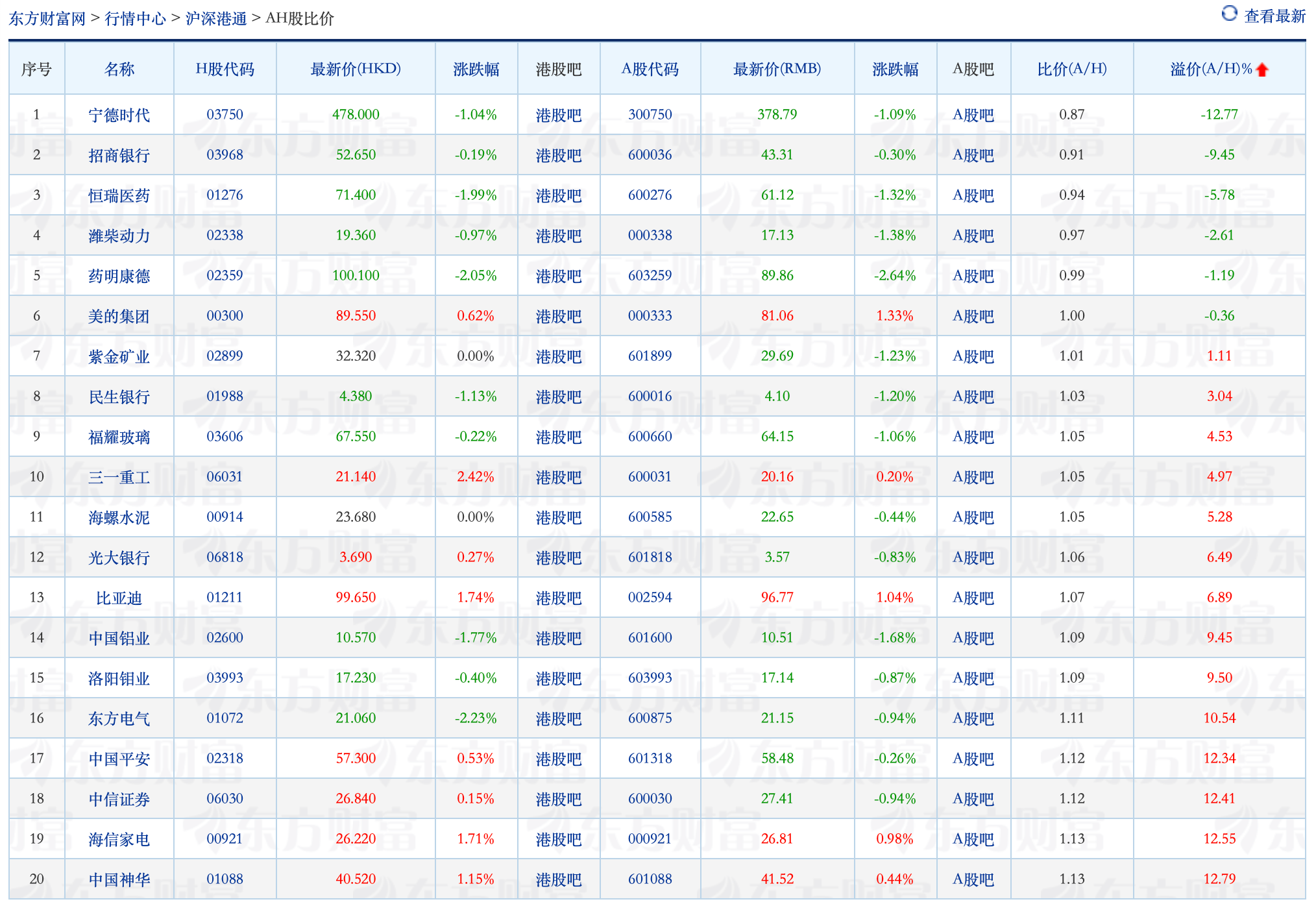
Core Viewpoint - The phenomenon of "AH share premium inversion" is observed in six companies, where H-shares are priced higher than A-shares, attributed to low liquidity and foreign investors' preference for industry leaders [1][2]. Group 1: Market Dynamics - The Heng Seng AH Share Premium Index (HSAHP) remains above 120, indicating a 20% premium of A-shares over H-shares [1]. - The six companies experiencing this inversion include CATL, China Merchants Bank, Hengrui Medicine, Weichai Power, WuXi AppTec, and Midea Group [2]. - The market sees a preference for newly listed stocks in the H-share market, which have lower liquidity, leading to higher valuations [2]. Group 2: Liquidity and New Listings - The "inversion" stocks are characterized by a high proportion of newly listed shares, with three of the six companies listed for less than a year [2]. - The market capitalization of H-shares is often significantly smaller than that of A-shares, contributing to the liquidity scarcity and price inversion [2]. - As institutional investors gradually exit their IPO allocations, the liquidity in the H-share market is expected to increase, potentially narrowing the premium [2]. Group 3: Foreign Investment Preferences - Foreign investors show a strong preference for industry leaders that have established market positions and stable financials [3][4]. - These companies typically operate in traditional sectors such as finance, energy, and infrastructure, which have predictable profit models [3]. - The preference for H-shares is also driven by the perception of higher growth potential and better governance structures in these companies [4]. Group 4: Examples of Inversion - BYD and China Merchants Bank are highlighted as typical examples of companies where H-shares occasionally exhibit a premium over A-shares [5]. - The presence of monopolistic characteristics in H-shares can attract foreign investment, as these companies are often seen as irreplaceable in the global market [5].




6家AH股“倒挂”背后:流通股比例小,外资更爱行业龙头|市场观察
Di Yi Cai Jing· 2025-12-02 04:52
Core Insights - A-shares have lower trading costs and better market liquidity compared to H-shares, with an overall premium of 20% for A-shares as indicated by the Hang Seng AH Premium Index (HSAHP) remaining above 120 [1][2] - A peculiar situation has arisen where H-shares of certain companies, such as CATL, are trading at higher prices than their A-shares, attributed to factors like limited liquidity and the preference of overseas investors for industry leaders [1][2][3] Group 1: Market Dynamics - The six companies experiencing H-share price premiums over A-shares include CATL, China Merchants Bank, Hengrui Medicine, Weichai Power, WuXi AppTec, and Midea Group, with others like Zijin Mining and BYD showing closer price alignment [2][3] - The phenomenon of "inverted pricing" is largely due to the smaller market capitalization of H-shares compared to A-shares, leading to relative scarcity in liquidity which drives up prices [2][3] Group 2: Investor Preferences - Foreign investors show a strong preference for industry leaders that are scarce in the international market, often leading to higher valuations for these companies in H-shares [4][5] - Companies with stable financials and established operational histories, particularly in traditional sectors like finance and energy, tend to attract more foreign investment, reflecting differing growth expectations between domestic and international investors [3][4] Group 3: Future Outlook - As large institutional investors gradually exit their positions, the liquidity of H-shares is expected to increase, potentially narrowing the premium of H-shares over A-shares [2][4] - The case of CATL illustrates this trend, where its H-share premium over A-shares decreased from over 30% to approximately 13% following the unlocking of shares held by certain investors [2][4]