AH股倒挂

Search documents
AH股价格“倒挂”增至8只,多为行业龙头
2 1 Shi Ji Jing Ji Bao Dao· 2026-02-24 13:17
Group 1 - The A-share market experienced a positive start to the Year of the Horse, with the Shanghai Composite Index rising by 0.87% and the Shenzhen Component Index increasing by 1.36% on February 24 [2] - The Hang Seng Index fell by 1.82%, and the Hang Seng Tech Index decreased by 2.13% on the same day [2] - As of February 24, there were 8 A+H listed companies experiencing an AH price inversion, where H-share prices exceeded A-share prices, representing approximately 4.6% of the total 174 A+H listed companies [3] Group 2 - The companies with AH price inversion include leading firms across various sectors such as new energy, banking, innovative pharmaceuticals, semiconductors, home appliances, mining, and machinery [4] - The phenomenon of AH price inversion is relatively rare, with no companies experiencing it a year ago on February 24, 2025 [2][4] - The average AH premium rate is typically around 125%, considering the 20% dividend tax on H-shares and the tax exemption for A-shares held for over a year [5] Group 3 - On February 24, the trading volume of A-shares for China Merchants Bank was 75.47 million shares, which is 7.7 times that of its H-shares at 9.8 million shares [5] - The market capitalization of China Merchants Bank is approximately 1.005 trillion yuan, with an AH premium rate of 0.89, indicating an 11% discount of A-shares relative to H-shares [5] - CATL, another leading company, saw its A-shares decline by 0.93% while H-shares fell by 3.13%, with A-share trading volume being 12.5 times that of H-shares [6] Group 4 - The AH premium index closed at 116.99 on February 24, indicating that A-shares are trading at a premium to H-shares, and this index has been on a downward trend since April 9, 2025 [11] - The index has dropped from a high of 144.85 to a low of 113.56, marking an eight-year low [11] - Analysts suggest that the recent trend of foreign capital favoring Hong Kong stocks may be influenced by the appreciation of the yuan, which could lead to a convergence of AH premiums [13] Group 5 - Morgan Stanley highlighted investment opportunities in sectors such as technology and cyclical recovery, particularly in leading companies within these fields [13] - Tianfeng Securities expressed a cautiously optimistic outlook for the Hong Kong market, suggesting a focus on value-oriented investments while maintaining growth as a secondary consideration [13]

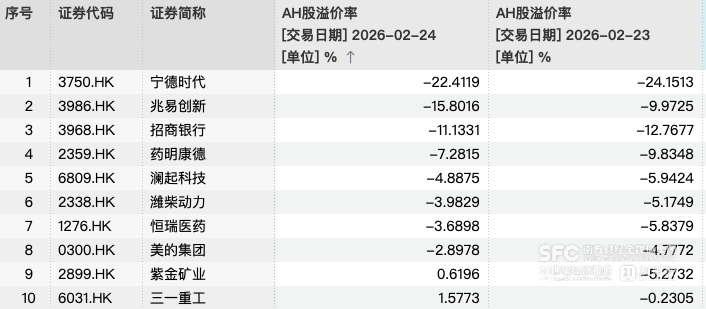
6家公司AH股倒挂背后:流通股比例小,外资更爱行业龙头
Xin Lang Cai Jing· 2025-12-02 07:05
Core Insights - The article discusses the phenomenon of six companies having higher stock prices in the Hong Kong market (H-shares) compared to their A-share counterparts, which is contrary to the typical market behavior where A-shares usually trade at a premium due to lower transaction costs and better liquidity [1][3]. Group 1: Market Dynamics - The Hang Seng AH Share Premium Index (HSAHP) remains above 120, indicating a 20% premium of A-shares over H-shares on average [1][3]. - The six companies, including Ningde Times (300750.SZ, 03750.HK), are identified as newly listed stocks expected to debut by 2025, contributing to their higher H-share prices due to limited circulation [1][3]. Group 2: Investor Behavior - There is a noted preference among foreign investors for industry leaders in niche markets, which makes it challenging to find comparable stocks in the international market, leading to the observed price discrepancies [1][3].

6家AH股“倒挂”背后:流通股比例小,外资更爱行业龙头
第一财经· 2025-12-02 06:29
Core Viewpoint - A-shares have lower trading costs and better market liquidity compared to H-shares, with a current premium of about 20% for A-shares as indicated by the Hang Seng AH Premium Index (HSAHP) being above 120. However, certain companies like CATL have shown a reverse phenomenon where H-shares are priced higher than A-shares [2][4]. Group 1: Market Dynamics - The phenomenon of H-shares trading at a premium over A-shares is attributed to the smaller market capitalization of H-shares compared to A-shares, leading to relative scarcity in liquidity [5]. - Among the six companies exhibiting this "inversion," three are newly listed, resulting in lower liquidity for H-shares, which can lead to inflated prices due to concentrated holdings by large institutions [5][6]. - As institutional investors gradually exit their positions, the liquidity of H-shares is expected to increase, potentially narrowing the premium of H-shares over A-shares [5]. Group 2: Characteristics of A-H Share Companies - Companies with inverted pricing typically share common traits: they are large enterprises with stable operating histories and solid financials, often in traditional industries like finance and energy [6]. - The valuation of these companies tends to be higher in the A-share market, reflecting differing expectations from overseas investors regarding future growth potential [6][8]. Group 3: Foreign Investment Preferences - Foreign investors prefer industry leaders that have a competitive edge in the market, which are often scarce in the international market [8]. - These leading companies usually possess strong brand recognition, stable profitability, and good governance structures, aligning with foreign investors' long-term investment criteria [8][9]. - The preference for H-shares over A-shares is also influenced by the perceived monopolistic characteristics of certain companies, which can lead to higher valuations in the H-share market [9].


6家AH股“倒挂”背后:流通股比例小,外资更爱行业龙头
Di Yi Cai Jing· 2025-12-02 06:25
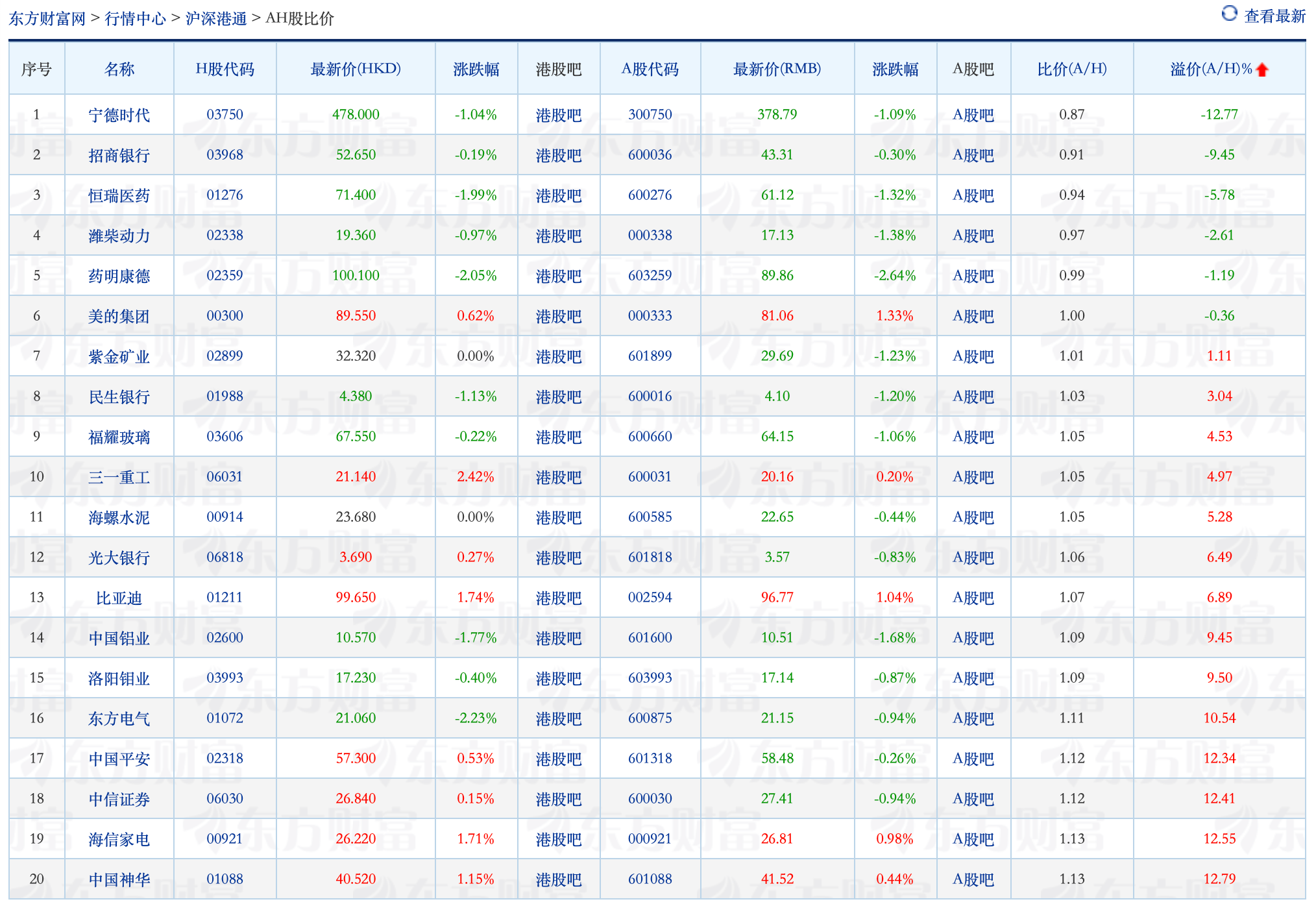
Core Viewpoint - The phenomenon of "AH share premium inversion" is observed in six companies, where H-shares are priced higher than A-shares, attributed to low liquidity and foreign investors' preference for industry leaders [1][2]. Group 1: Market Dynamics - The Heng Seng AH Share Premium Index (HSAHP) remains above 120, indicating a 20% premium of A-shares over H-shares [1]. - The six companies experiencing this inversion include CATL, China Merchants Bank, Hengrui Medicine, Weichai Power, WuXi AppTec, and Midea Group [2]. - The market sees a preference for newly listed stocks in the H-share market, which have lower liquidity, leading to higher valuations [2]. Group 2: Liquidity and New Listings - The "inversion" stocks are characterized by a high proportion of newly listed shares, with three of the six companies listed for less than a year [2]. - The market capitalization of H-shares is often significantly smaller than that of A-shares, contributing to the liquidity scarcity and price inversion [2]. - As institutional investors gradually exit their IPO allocations, the liquidity in the H-share market is expected to increase, potentially narrowing the premium [2]. Group 3: Foreign Investment Preferences - Foreign investors show a strong preference for industry leaders that have established market positions and stable financials [3][4]. - These companies typically operate in traditional sectors such as finance, energy, and infrastructure, which have predictable profit models [3]. - The preference for H-shares is also driven by the perception of higher growth potential and better governance structures in these companies [4]. Group 4: Examples of Inversion - BYD and China Merchants Bank are highlighted as typical examples of companies where H-shares occasionally exhibit a premium over A-shares [5]. - The presence of monopolistic characteristics in H-shares can attract foreign investment, as these companies are often seen as irreplaceable in the global market [5].

6家AH股“倒挂”背后:流通股比例小,外资更爱行业龙头|市场观察
Di Yi Cai Jing· 2025-12-02 04:52
Core Insights - A-shares have lower trading costs and better market liquidity compared to H-shares, with an overall premium of 20% for A-shares as indicated by the Hang Seng AH Premium Index (HSAHP) remaining above 120 [1][2] - A peculiar situation has arisen where H-shares of certain companies, such as CATL, are trading at higher prices than their A-shares, attributed to factors like limited liquidity and the preference of overseas investors for industry leaders [1][2][3] Group 1: Market Dynamics - The six companies experiencing H-share price premiums over A-shares include CATL, China Merchants Bank, Hengrui Medicine, Weichai Power, WuXi AppTec, and Midea Group, with others like Zijin Mining and BYD showing closer price alignment [2][3] - The phenomenon of "inverted pricing" is largely due to the smaller market capitalization of H-shares compared to A-shares, leading to relative scarcity in liquidity which drives up prices [2][3] Group 2: Investor Preferences - Foreign investors show a strong preference for industry leaders that are scarce in the international market, often leading to higher valuations for these companies in H-shares [4][5] - Companies with stable financials and established operational histories, particularly in traditional sectors like finance and energy, tend to attract more foreign investment, reflecting differing growth expectations between domestic and international investors [3][4] Group 3: Future Outlook - As large institutional investors gradually exit their positions, the liquidity of H-shares is expected to increase, potentially narrowing the premium of H-shares over A-shares [2][4] - The case of CATL illustrates this trend, where its H-share premium over A-shares decreased from over 30% to approximately 13% following the unlocking of shares held by certain investors [2][4]
宁德时代股价回调,机构称H股溢价可能会持续
Guang Zhou Ri Bao· 2025-05-26 15:06
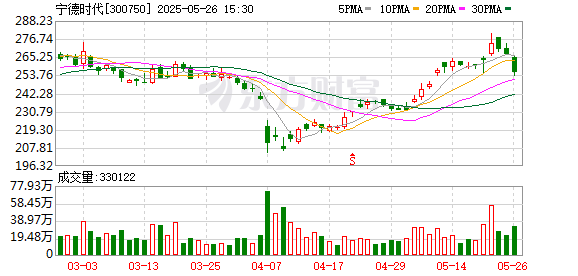
Group 1 - Ningde Times' A-shares and H-shares both experienced declines on May 26, with A-shares dropping 4.15% to 255.9 yuan per share and H-shares falling 2.61% to 314 HKD per share, indicating a pullback from last week's highs [2] - The H-shares of Ningde Times were listed on the Hong Kong Stock Exchange on May 20, with a notable premium over A-shares, which is rare in the Hong Kong market [2] - The premium of H-shares over A-shares is attributed to several factors, including different investor structures in the two markets, increased demand from international funds, and heightened interest in the zero-carbon economy and renewable energy sectors [2] Group 2 - Credit Lyonnais reaffirmed a "highly confident outperform" rating for Ningde Times, setting a target price of 385 HKD, suggesting that the current H-share premium may represent a new norm for dual-listed companies [3] - The H-share premium of 11% for Ningde Times is believed to be driven by optimistic sentiment following its Hong Kong listing, with expectations that this premium may persist even after initial market excitement [3]