多模态图像生成

Search documents
国芯训国模取得世界第一,智谱再创新高,上市七个交易日累涨超126%
Ge Long Hui· 2026-01-16 07:04
Core Viewpoint - Zhiyuan (2513.HK) experienced a significant surge, rising over 9% to reach a peak of 263 HKD, marking a cumulative increase of over 126% within seven trading days, driven by the success of its GLM-Image model in collaboration with Huawei [1] Group 1: Company Performance - Zhiyuan's stock price reached a historical high of 263 HKD, reflecting strong market confidence and investor interest [1] - The company has seen a remarkable increase of over 126% in its stock price since its listing, indicating robust growth potential [1] Group 2: Technological Achievement - The GLM-Image model, co-developed with Huawei, topped the Trending chart on the Hugging Face platform, showcasing its technological strength and application value [1] - This achievement breaks the long-standing dominance of foreign models in the open-source leaderboard, highlighting a significant milestone for domestic AI technology [1] Group 3: Strategic Collaboration - The collaboration between Zhiyuan and Huawei represents a deep integration of software and hardware, essential for the advancement of the domestic AI industry [1] - Huawei's "domestic computing power base" plays a crucial role in supporting the GLM-Image model, which runs on Huawei's Ascend Atlas 800T A2 chip and MindSpore framework [1] Group 4: Model Innovation - GLM-Image features an innovative hybrid architecture of "autoregressive + diffusion decoder," enabling the model to understand complex instructions and generate detailed images [1] - The model's open-source availability on GitHub and Hugging Face allows global developers to access this "domestic solution" for free, promoting wider adoption [1]
自回归模型杀回图像生成!实现像素级精准控制,比Diffusion更高效可控
量子位· 2025-07-29 05:05
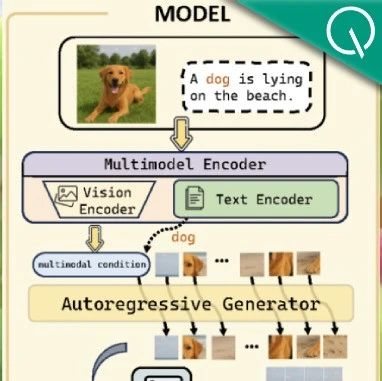
Core Viewpoint - The article discusses the limitations of Diffusion models in AI image generation, particularly in precise control, and introduces a new framework called MENTOR, which utilizes Autoregressive (AR) models for more efficient and controllable multimodal image generation [1][2][3]. Group 1: Challenges in Current Models - Diffusion models face challenges in precise visual control, balancing multimodal inputs, and high training costs [2][6]. - The inherent randomness of Diffusion models makes it difficult to achieve precise control in high-fidelity tasks like image reconstruction [6]. - Existing methods often exhibit modality imbalance, over-relying on either reference images or text instructions [6]. Group 2: Introduction of MENTOR - MENTOR is a novel AR framework that requires only one-tenth of the training data and suboptimal model components to outperform Diffusion methods like Emu2 and DreamEngine [2][3]. - The framework employs a unique two-stage training method to enable efficient multimodal image generation with pixel-level precision [3][8]. Group 3: MENTOR's Design and Training - MENTOR features a unified AR architecture consisting of a multimodal encoder and an autoregressive generator, allowing for token-level alignment between inputs and outputs [9]. - The two-stage training strategy includes: 1. Multimodal Alignment Pretraining: Focuses on understanding different input types and establishing pixel-level and semantic alignment [10]. 2. Multimodal Instruction Tuning: Enhances the model's ability to follow instructions and reason across modalities [12]. Group 4: Performance and Efficiency - MENTOR achieved competitive performance on DreamBench++, surpassing larger models like Emu2 (37 billion parameters) and DreamEngine (10.5 billion parameters) while maintaining a lower CP/PF ratio, indicating better balance between visual feature preservation and prompt following [15][17]. - The training process for MENTOR utilized approximately 3 million image-text pairs over 1.5 days, demonstrating significant efficiency compared to other baseline methods [18]. Group 5: Applications and Future Potential - MENTOR's framework is highly versatile, capable of handling various complex multimodal generation tasks with minimal adjustments [24]. - The article concludes that MENTOR opens a new path for controllable image generation tasks, showcasing the potential of AR models in visual generation, while acknowledging that there are still areas where it lags behind top-tier Diffusion models [26].