多模态统一模型

Search documents
从视觉出发统一多模态!颜水成团队最新研究:不再把图像编解码器塞进LLM|ICLR'2026
量子位· 2026-03-10 08:00
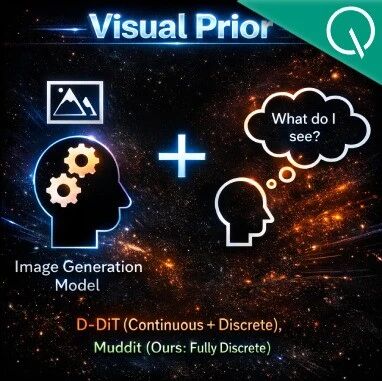
Core Viewpoint - The article discusses the emergence of a new unified discrete diffusion model called Muddit, which challenges the traditional language-first approach in multi-modal AI models by proposing a visual prior as the foundation for generating text and images [2][5][37]. Group 1: Paradigm Shift in AI Models - The AI industry has predominantly focused on a pre-training paradigm centered around next word prediction, which has been successful but is now being questioned [3][4]. - NVIDIA researcher Jim Fan suggests that AI is undergoing a second paradigm shift towards world modeling, emphasizing the prediction of physical states rather than just token relationships [5][7]. - This shift prompts a reevaluation of whether future foundational models should continue to prioritize language [7][17]. Group 2: Limitations of Current Multi-Modal Models - Many existing unified models remain fundamentally language-first, where visual inputs are processed through a language backbone, leading to inefficiencies in image generation and reasoning [8][10]. - The article critiques the notion that these models achieve true unification, as they often rely on separate mechanisms for text and image generation [11][19]. Group 3: Muddit's Approach - Muddit aims to redefine the foundation of unified models by starting from a strong visual prior rather than a language prior, allowing for a more natural integration of text and image generation [15][17]. - The model employs a fully discrete diffusion framework, treating both text and images as discrete tokens, which facilitates a shared generative process across different tasks [19][20]. - Muddit's architecture allows for task switching without changing internal mechanisms, emphasizing a unified generative syntax [22][23]. Group 4: Performance and Efficiency - Muddit demonstrates competitive performance in text-to-image generation, achieving an overall accuracy of 0.61 on the GenEval benchmark, surpassing several existing models [27]. - The model also excels in image understanding and image-to-text tasks, with notable scores in various benchmarks, indicating its effectiveness in unified training [28][29]. - Importantly, Muddit achieves these results with a relatively small dataset, highlighting the efficiency of its visual prior and unified modeling approach [30]. Group 5: Future Implications - The article posits that Muddit represents a potential shift in multi-modal foundational models, moving away from language-centric designs towards those that better reflect the structure of the world [33][34]. - This shift could influence future developments in AI, particularly in areas like video, 3D modeling, and embodied intelligence, where understanding spatial and dynamic relationships is crucial [33][35]. - Ultimately, Muddit challenges the prevailing notion that multi-modal models must be built on language, suggesting a rethinking of what should serve as the foundational basis for these systems [40][41].

LeCun、谢赛宁团队重磅论文:RAE能大规模文生图了,且比VAE更好
机器之心· 2026-01-24 01:53
Core Insights - The article discusses the emergence of Representation Autoencoders (RAE) as a significant advancement in the field of text-to-image diffusion models, challenging the dominance of Variational Autoencoders (VAE) [1][4][33] - The research led by notable scholars demonstrates that RAE can outperform VAE in various aspects, including training stability and convergence speed, while also suggesting a shift towards a unified multimodal model [2][4][33] Group 1: RAE vs. VAE - RAE has shown superior performance in pre-training and fine-tuning phases compared to VAE, particularly in high-quality data scenarios, where VAE suffers from catastrophic overfitting after just 64 epochs [4][25][28] - The architecture of RAE utilizes a pre-trained and frozen visual representation encoder, which allows for high-fidelity semantic starting points, contrasting with the lower-dimensional outputs of traditional VAE [6][11] Group 2: Data Composition and Training Strategies - The study highlights that merely increasing data volume is insufficient for RAE to excel in text-to-image tasks; the composition of the dataset is crucial, particularly the inclusion of targeted text rendering data [9][10] - RAE's architecture allows for significant simplifications in design as model sizes increase, demonstrating that complex structures become redundant in larger models [17][21] Group 3: Performance Metrics and Efficiency - RAE has achieved a convergence speed that is approximately four times faster than VAE, with significant improvements in evaluation metrics across various model sizes [23][25] - The robustness of RAE is evident as it maintains stable generation quality even after extensive fine-tuning, unlike VAE, which quickly memorizes training samples [28][29] Group 4: Future Implications - The success of RAE indicates a potential shift in the text-to-image technology stack, moving towards a more unified semantic modeling approach that integrates understanding and generation within the same representation space [29][34] - This advancement could lead to more efficient and effective multimodal models, enhancing the ability to generate images that align closely with textual prompts [36]
昆仑万维推出并开源Skywork UniPic
Zheng Quan Ri Bao Wang· 2025-07-30 07:14
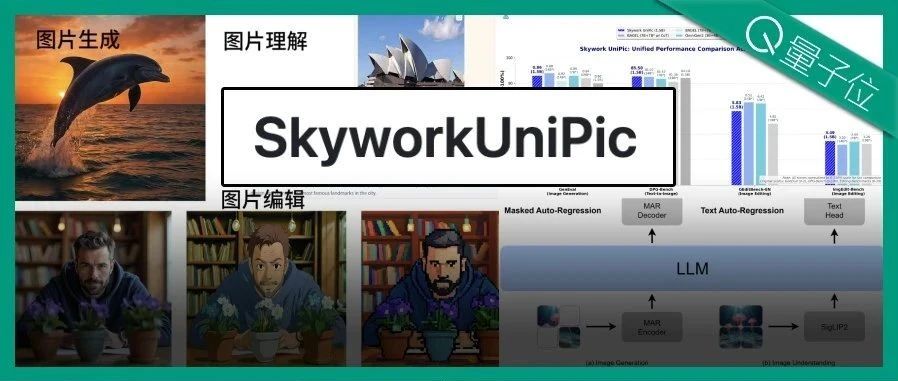
Core Insights - Kunlun Wanwei Technology Co., Ltd. has launched and open-sourced the Skywork UniPic model, which integrates image understanding, text-to-image generation, and image editing capabilities into a single framework [1][2] - The model is based on large-scale high-quality data for end-to-end pre-training, demonstrating strong generalization and transferability [1] Group 1: Model Architecture - Skywork UniPic features a unified multimodal model architecture that deeply integrates three core tasks: image understanding, text-to-image generation, and image editing [1] - Traditional multimodal models often rely on VQ or VAE encoders, which focus more on visual details than semantic information, potentially weakening image understanding capabilities [1] - The Skywork UniPic team has made key adjustments in representation methods, utilizing the MAR encoder for visual representation in the image generation path and introducing SigLIP2 as the backbone for the image understanding path [1] Group 2: Performance and Efficiency - The model completes an end-to-end optimization process, enabling collaborative training and mutual enhancement of the three core capabilities, overcoming technical bottlenecks in traditional methods [2] - Skywork UniPic maintains a compact parameter size of 1.5 billion, achieving state-of-the-art (SOTA) scores without the use of Chain of Thought (CoT), nearing the performance of larger models that utilize CoT [2] - The model has reached an industry SOTA score of 85.5 on the DPG-Bench complex instruction generation benchmark [2]

1.5B参数撬动“吉卜力级”全能体验,国产开源之光多模态统一模型,来了
量子位· 2025-07-30 04:48
Core Viewpoint - The article discusses the emergence of the Skywork UniPic model, which integrates multi-modal capabilities in AI, showcasing its performance and potential impact on the industry [1][2][4]. Group 1: Model Features and Performance - Skywork UniPic is a 1.5 billion parameter model that achieves performance comparable to larger models, demonstrating high "performance density" and can run smoothly on consumer-grade graphics cards [10][12]. - The model excels in various tasks, including image understanding, text-to-image generation, and image editing, with notable scores in GenEval and DPG-Bench benchmarks [25][26][27]. - Skywork UniPic utilizes an autoregressive model architecture, allowing for deep integration of image generation within a multi-modal framework, distinguishing it from mainstream diffusion models [30][33]. Group 2: Data and Training Strategies - The model's training is based on a refined dataset approach, utilizing high-quality image-text pairs for pre-training, which enhances its semantic representation capabilities [37][42]. - A progressive multi-task training strategy is employed, focusing on one task at a time to ensure stability and performance across understanding, generation, and editing tasks [53][60]. - The team implemented specialized reward models to ensure high-quality training data, significantly improving the model's performance in both image generation and editing tasks [48][50]. Group 3: Industry Implications and Trends - The rise of native multi-modal unified models like Skywork UniPic indicates a shift in the AI landscape, emphasizing efficiency and user experience over sheer scale [61][63]. - The open-source approach taken by companies like Kunlun Wanwei is fostering innovation and accessibility in AI technology, allowing broader participation in AI development [65][68]. - The article highlights the potential for a creative explosion in AI applications, driven by user-friendly tools that lower the barriers to entry for utilizing AI [69].