文生图

Search documents
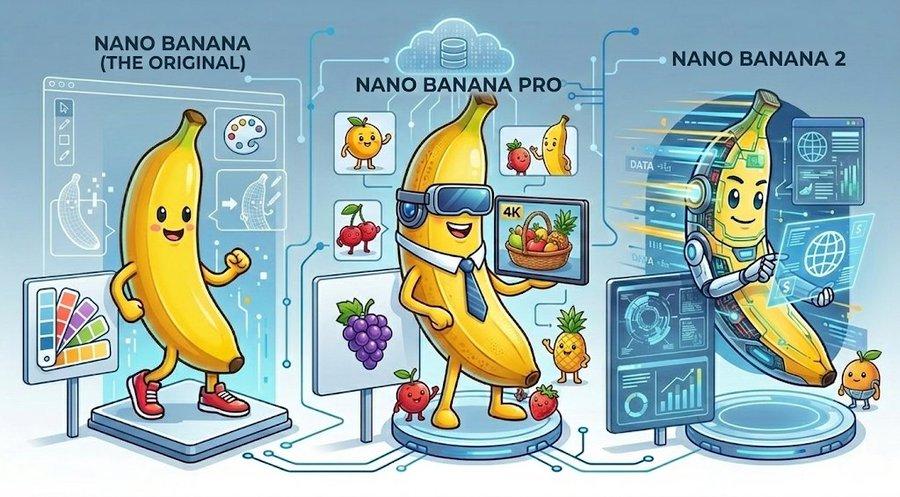
谷歌 Nano Banana 2 一夜补齐短板,各种图解都能画,价格才是 OpenAI 一半
3 6 Ke· 2026-02-27 04:10
Core Insights - Google has launched Nano Banana 2, which emphasizes "speedy experience" and "professional image quality," with a significant new feature of "real-time connectivity" that enhances its capabilities beyond mere image generation [1][10]. Group 1: Product Features - Nano Banana 2 integrates with Gemini's search capabilities, allowing the model to understand, retrieve, and generate images that are more aligned with real-world information structures [1]. - The model can generate detailed street scenes and character interactions that are nearly indistinguishable from real photographs, showcasing its advanced rendering capabilities [2][3]. - The "real-time connectivity" feature allows for precise generation of images based on real geographical and meteorological data, enhancing the model's utility in various contexts [5][41]. Group 2: Competitive Landscape - In the latest Artificial Analysis rankings, Nano Banana 2 secured the top position, with its image editing capabilities ranking third, while being priced at half of its closest competitor, OpenAI [8][9]. - The competition in the image generation sector has intensified, with leading models showing minimal score differences, indicating a close race among top players [9]. Group 3: User Experience and Applications - Users have reported that Nano Banana 2's ability to generate high-quality images with accurate text rendering has significant implications for marketing materials and global communication [45]. - The model's enhanced consistency in character design and scene elements allows for seamless storytelling in comics and branding [51]. - The ability to visualize complex concepts and data efficiently positions Nano Banana 2 as a transformative tool in education, research, and data analysis [43][42]. Group 4: Technical Upgrades - The model has improved text rendering and translation capabilities, allowing for natural integration of text within images, which is crucial for marketing and promotional content [45]. - It supports multiple resolutions, including a new 512px option optimized for low-latency scenarios, making it suitable for rapid prototyping and iteration [64]. - The visual quality of generated images has been upgraded, with more natural lighting, richer materials, and sharper details, making it a viable tool for professional use [66].


谷歌 Nano Banana 2 一夜补齐短板,各种图解都能画,价格才是 OpenAI 一半
AI前线· 2026-02-27 02:55
Core Insights - Google has launched Nano Banana 2, which emphasizes "ultra-fast experience" and "professional image quality," with a significant new feature of "real-time connectivity" that enhances its capabilities beyond mere image generation [3][4][8]. Group 1: Features and Capabilities - The model integrates real-time web search with high-fidelity image generation, allowing for more accurate and contextually relevant outputs [13]. - Nano Banana 2 can generate detailed images that closely resemble real-world scenarios, such as street scenes with visible signage and realistic character expressions [5][7]. - The model's ability to generate images based on real-time data, such as weather conditions, demonstrates its advanced understanding of the world [41][52]. Group 2: Competitive Landscape - In the latest rankings from Artificial Analysis, Nano Banana 2 has secured the top position, showcasing its superior image editing capabilities at a competitive price, which is half that of its closest competitor, OpenAI [14][16]. - The competition in the image generation sector has intensified, focusing not only on visual quality but also on speed, comprehension, and ecosystem integration [18]. Group 3: User Experience and Applications - Users have reported that the model's outputs are highly detailed and can be used for various applications, including visual design, educational materials, and scientific illustrations [20][51]. - The model's enhanced text rendering and translation capabilities allow for seamless integration of text within images, making it suitable for marketing and global communication [57][60]. - The ability to maintain character consistency across different images and scenarios is a significant improvement, enhancing usability for projects requiring coherent visual storytelling [60][62]. Group 4: Future Implications - The introduction of real-time connectivity is expected to create new application scenarios, transforming how knowledge is organized and expressed visually [52][53]. - The model's advancements could lead to more efficient communication in education, research, and data analysis, making complex information more accessible [53][55].
LeCun、谢赛宁团队重磅论文:RAE能大规模文生图了,且比VAE更好
机器之心· 2026-01-24 01:53
Core Insights - The article discusses the emergence of Representation Autoencoders (RAE) as a significant advancement in the field of text-to-image diffusion models, challenging the dominance of Variational Autoencoders (VAE) [1][4][33] - The research led by notable scholars demonstrates that RAE can outperform VAE in various aspects, including training stability and convergence speed, while also suggesting a shift towards a unified multimodal model [2][4][33] Group 1: RAE vs. VAE - RAE has shown superior performance in pre-training and fine-tuning phases compared to VAE, particularly in high-quality data scenarios, where VAE suffers from catastrophic overfitting after just 64 epochs [4][25][28] - The architecture of RAE utilizes a pre-trained and frozen visual representation encoder, which allows for high-fidelity semantic starting points, contrasting with the lower-dimensional outputs of traditional VAE [6][11] Group 2: Data Composition and Training Strategies - The study highlights that merely increasing data volume is insufficient for RAE to excel in text-to-image tasks; the composition of the dataset is crucial, particularly the inclusion of targeted text rendering data [9][10] - RAE's architecture allows for significant simplifications in design as model sizes increase, demonstrating that complex structures become redundant in larger models [17][21] Group 3: Performance Metrics and Efficiency - RAE has achieved a convergence speed that is approximately four times faster than VAE, with significant improvements in evaluation metrics across various model sizes [23][25] - The robustness of RAE is evident as it maintains stable generation quality even after extensive fine-tuning, unlike VAE, which quickly memorizes training samples [28][29] Group 4: Future Implications - The success of RAE indicates a potential shift in the text-to-image technology stack, moving towards a more unified semantic modeling approach that integrates understanding and generation within the same representation space [29][34] - This advancement could lead to more efficient and effective multimodal models, enhancing the ability to generate images that align closely with textual prompts [36]
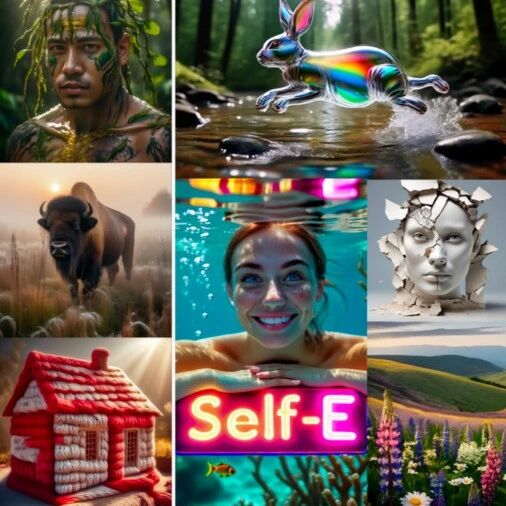
解锁任意步数文生图,港大&Adobe全新Self-E框架学会自我评估
机器之心· 2026-01-15 03:52
Core Viewpoint - The article discusses the introduction of Self-E, a novel text-to-image generation framework that eliminates the need for pre-trained teacher models and allows for any-step generation while maintaining high quality and semantic clarity [2][28]. Group 1: Introduction and Background - Traditional diffusion models and flow matching have improved text-to-image generation but require numerous iterations, limiting their real-time application [2]. - Existing methods often rely on knowledge distillation, which incurs additional training costs and leaves a gap between "from scratch" training and "few-step high quality" generation [2][28]. Group 2: Self-E Framework - Self-E represents a paradigm shift by focusing on "landing evaluation" rather than "trajectory matching," allowing the model to learn the quality of the final output rather than just the correctness of each step [7][28]. - The model operates in two modes: learning from real data and self-evaluating its generated samples, creating a self-feedback loop [12][13]. Group 3: Training Mechanism - Self-E employs two complementary training signals: one from data and the other from self-evaluation, enabling the model to learn local structures and assess its outputs simultaneously [14][19]. - The training process involves a long-distance jump to a landing point, where the model uses its current local estimates to generate feedback on how to improve the output [17][19]. Group 4: Inference and Performance - During inference, Self-E can maintain semantic and structural quality with very few steps, and as the number of steps increases, the quality continues to improve [22][23]. - In the GenEval benchmark, Self-E outperforms other methods across all step counts, showing a significant advantage in the few-step range, with a notable improvement of +0.12 in a 2-step setting compared to the best existing methods [24][25]. Group 5: Broader Implications - Self-E's approach aligns pre-training and feedback learning, creating a closed-loop system similar to reinforcement learning, which enhances the model's ability to generate high-quality outputs with fewer steps [26][29]. - The framework allows for dynamic step selection based on the application context, making it versatile for both real-time feedback and high-quality offline rendering [28].
ChatGPT引入PS 用一句话即可修图
Bei Jing Shang Bao· 2025-12-16 03:11
Group 1 - Adobe has launched integrations of Photoshop, Express, and Acrobat for ChatGPT users, allowing them to access these tools directly within the chatbot [1] - The integration aims to present Adobe's products to over 800 million active users of ChatGPT, enhancing user creativity through easy access [1] - Users can perform various editing tasks such as adjusting brightness, contrast, and saturation, as well as applying stylized effects directly in ChatGPT [1] Group 2 - The new "extension mode" in ChatGPT allows users to input commands for image editing, which Adobe Express will automatically generate drafts for, enabling real-time adjustments without re-entering commands [2] - Adobe emphasizes that its core generation capabilities are based on its proprietary Firefly models, ensuring that all generated content has commercial usage rights and copyright protection [2] - OpenAI's integration of third-party applications into ChatGPT is part of a broader strategy to position the platform as a digital service hub, with Adobe being one of the early adopters [2] Group 3 - OpenAI's GPT-4o has improved capabilities for image generation, allowing users to transform photos into artistic styles, which has gained significant popularity on social media [3] - The advancements in GPT-4o include better text integration, enhanced context understanding, and improved multi-object binding, making it suitable for various applications, including advertising [3] - The demand for AI-generated images highlights the importance of computational power, as OpenAI's GPUs faced challenges in meeting user needs for the new image generation features [3] Group 4 - The competitive landscape in image editing products shows minimal technological differences, with AI driving functional upgrades and user engagement being crucial for widespread adoption [4] - The success of new features relies not only on product maturity but also on effective marketing strategies that can spark user curiosity and encourage usage [4] Group 5 - The rise of AI is expected to enhance productivity in media applications, benefiting companies that produce quality content and those in digital marketing, e-commerce, and copyright protection sectors [5]

美团开源LongCat-Image模型,在文生图与图像编辑核心能力上逼近更大尺寸的头部模型
Xin Lang Cai Jing· 2025-12-08 07:24
Core Viewpoint - Meituan's LongCat team has announced the open-source release of its latest LongCat-Image model, which approaches the capabilities of larger models in text-to-image generation and image editing with a parameter scale of 6 billion [1] Group 1: Model Features - The LongCat-Image model features a high-performance architecture design and systematic training strategies, providing developers and the industry with a "high-performance, low-threshold, fully open" option [1] - The model utilizes a shared architecture for text-to-image generation and image editing, combined with a progressive learning strategy [1] Group 2: Performance Metrics - In objective benchmark tests, LongCat-Image achieved leading scores in image editing and Chinese rendering capabilities compared to other evaluated models [1] - The model demonstrated strong competitiveness in text-to-image tasks, as evidenced by its performance in GenEval and DPG-Bench, outperforming both leading open-source and closed-source models [1]

BFL 创立一年估值 32.5 亿美金,AI 原生版 Dropbox 来了
投资实习所· 2025-12-02 05:12
Core Insights - The effectiveness of images and videos in user engagement is high, but their long-term usage depends on whether they can become tools that genuinely help businesses or users generate revenue [1] Group 1: AI Product Performance - OpenAI's Sora experienced significant initial user engagement but has seen a recent decline in usage, indicating challenges in sustaining interest for standalone products [2] - Elevenlabs, a voice AI company, reported revenue of $193 million over the past 12 months, with approximately 50% coming from enterprise clients like Cisco and Twilio, and a profit margin of around 60% [2] Group 2: Company Valuation and Strategy - Black Forest Labs (BFL), an AI image generation startup, achieved a valuation of $3.25 billion after raising $300 million in Series B funding, demonstrating rapid growth since its establishment in August 2024 [3][4] - BFL's founders are key contributors to the Stable Diffusion models, which have significantly influenced the open-source image generation community and proprietary models like DALL-E [4] - BFL's strategy focuses on positioning itself as a model company rather than a direct consumer product provider, collaborating with major companies like Adobe and Microsoft through API integrations [6] Group 3: Technological Innovation - BFL's core model, FLUX.2, is released with open weights, allowing researchers and developers to utilize and customize it freely, enhancing its technical influence [6] - The company's focus on "visual intelligence" aims to unify perception, generation, memory, and reasoning, distinguishing it from competitors that only focus on text-to-image models [6] Group 4: Emerging Products - A new AI-native version of Dropbox is in development, which aims to transform file operations from storage-centric to understanding-centric, indicating a shift in product strategy [6][7]

让AI作画自己纠错!随机丢模块就能提升生成质量,告别塑料感废片
量子位· 2025-08-23 05:06
Core Viewpoint - The article discusses the introduction of a new method called S²-Guidance, developed by a research team from Tsinghua University, Alibaba AMAP, and the Chinese Academy of Sciences, which enhances the quality and coherence of AI-generated images and videos through a self-correcting mechanism [1][4]. Group 1: Methodology and Mechanism - S²-Guidance utilizes a technique called Stochastic Block-Dropping to dynamically construct "weak" sub-networks, allowing the AI to self-correct during the generation process [3][10]. - The method addresses the limitations of Classifier-Free Guidance (CFG), which often leads to distortion and lacks generalizability due to its linear extrapolation nature [5][8]. - By avoiding the need for external weak models and complex parameter tuning, S²-Guidance offers a universal and automated solution for self-optimization [12][11]. Group 2: Performance Improvements - S²-Guidance significantly enhances visual quality across multiple dimensions, including temporal dynamics, detail rendering, and artifact reduction, compared to previous methods like CFG and Autoguidance [19][21]. - The method demonstrates superior performance in generating coherent and aesthetically pleasing images, effectively avoiding common issues such as unnatural artifacts and distorted objects [22][24]. - In video generation, S²-Guidance resolves key challenges related to physical realism and complex instruction adherence, producing stable and visually rich scenes [25][26]. Group 3: Experimental Validation - The research team validated the effectiveness of S²-Guidance through rigorous experiments, showing that it balances guidance strength with distribution fidelity, outperforming CFG in capturing true data distributions [14][18]. - S²-Guidance achieved leading scores on authoritative benchmarks like HPSv2.1 and T2I-CompBench, surpassing all comparative methods in various quality dimensions [26][27].

Qwen-Image 模型上线基石智算,快来体验超强文本渲染能力
Sou Hu Cai Jing· 2025-08-14 15:48
Core Insights - Qwen-Image, the first text-to-image foundational model from the Qwen series, has been launched by Qiyun Technology's AI computing cloud, CoresHub, featuring 20 billion parameters and developed by Alibaba's Tongyi Qianwen team [1] - The model excels in complex text rendering, precise image editing, multi-line layout, paragraph-level generation, and detail depiction, making it particularly effective in poster design scenarios [1] Model Highlights - Exceptional text rendering capabilities: Qwen-Image demonstrates outstanding performance in complex text generation and rendering, supporting multi-line typesetting, paragraph-level layout, and fine-grained detail presentation in both English and Chinese [2] - Consistency in image editing: Leveraging enhanced multi-task training paradigms, Qwen-Image can accurately modify target areas during image editing while maintaining overall visual consistency and semantic coherence [2] - Industry-leading performance: Multiple public benchmark test results indicate that Qwen-Image has achieved state-of-the-art (SOTA) results in various image generation and editing tasks, validating its comprehensive strength [2] Usage Steps - Users can log into CoresHub, navigate to the model plaza, select the Qwen-Image model, and click on model deployment [3] - The model can be deployed by selecting a single card 4090D resource type, and after successful deployment, users can copy the external link to open in a browser [4] - Once the Comfy UI page loads successfully, users can select the Qwen-Image template and input their prompt [6] Effect Demonstration - Various prompts showcase the capabilities of Qwen-Image, including imaginative scenarios such as a Shiba Inu wearing a cowboy hat at a bar, a cotton candy castle in the clouds, and a retro arcade with a pixel-style game machine [9][11][12][13]

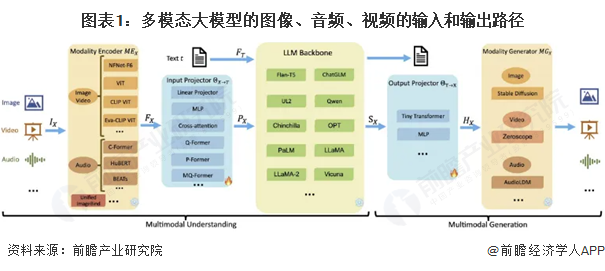
2025年中国多模态大模型行业模型现状 图像、视频、音频、3D模型等终将打通和融合【组图】
Qian Zhan Wang· 2025-06-01 05:09
Core Insights - The exploration of multimodal large models is making gradual progress, with a focus on breakthroughs in visual modalities, aiming for an "Any-to-Any" model that requires successful pathways across various modalities [1] - The industry is currently concentrating on enhancing perception and generation models in image, video, and 3D modalities, with the goal of achieving cross-modal integration and sharing [1] Multimodal Large Models in Image - Prior to the rise of LLMs in 2023, the industry had already established a solid foundation in image understanding and generation, resulting in models like CLIP, Stable Diffusion, and GAN, which led to applications such as Midjourney and DALL·E [2] - The industry is actively exploring the integration of Transformer models into image-related tasks, with significant outcomes including GLIP, SAM, and GPT-V [2] Multimodal Large Models in Video - Video generation is being approached by transferring image generation models to video, utilizing image data for training and aligning temporal dimensions to achieve text-to-video results [5] - Recent advancements include models like VideoLDM and Sora, which demonstrate significant breakthroughs in video generation using the Diffusion Transformer architecture [5] Multimodal Large Models in 3D - The generation of 3D models is being explored by extending 2D image generation methods, with key models such as 3D GAN, MeshDiffusion, and Instant3D emerging in the industry [8][9] - 3D data representation includes various formats like meshes, point clouds, and NeRF, with NeRF being a critical technology for 3D data representation [9] Multimodal Large Models in Audio - AI technologies related to audio have matured, with recent applications of Transformer models enhancing audio understanding and generation, exemplified by projects like Whisper large-v3 and VALL-E [11] - The evolution of speech technology is categorized into three stages, with a focus on enhancing generalization capabilities across multiple languages and tasks [11]