太空探源

Search documents
用科技“加速度”搭建“登天路” 中国探索太空奥秘的“长征”不停步
Yang Shi Wang· 2025-11-25 02:45
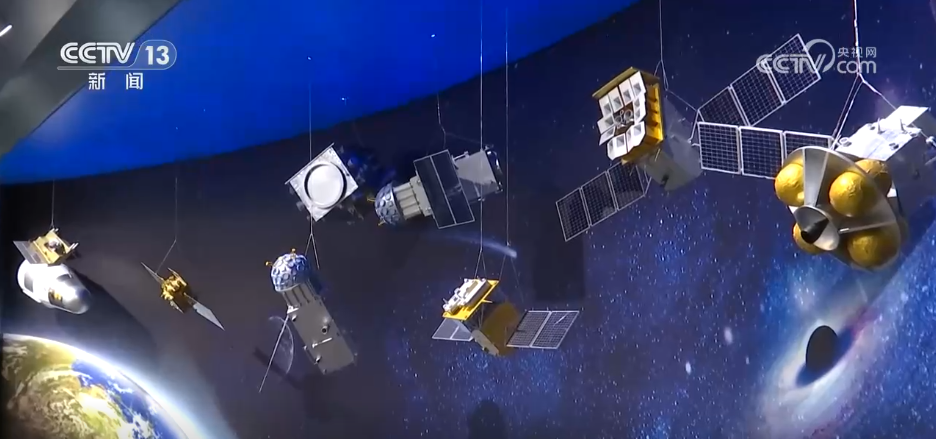
Core Insights - The Chinese Academy of Sciences announced significant scientific breakthroughs from space science satellite missions during the 14th Five-Year Plan period, with plans to implement the "Space Exploration Science Satellite Program" in the upcoming 14th Five-Year Plan [1][3]. Group 1: Space Science Satellite Missions - The program will involve the development and launch of four space science satellite missions aimed at exploring cosmic mysteries, including the "Hongmeng Plan" for detecting the cosmic dark age, "Kuafu-2" for direct imaging of the solar polar regions, an exoplanet survey mission to find "Earth 2.0," and an enhanced X-ray time-variable and polarization space observatory to study new physical laws under extreme cosmic conditions [3][5]. - The director of the National Space Science Center, Wang Chi, emphasized the goal of achieving original scientific breakthroughs in understanding the origins and evolution of the universe, space weather, and extraterrestrial life by 2035 [5]. Group 2: Achievements in Space Science - Since its inception in 2011, the space science pilot project has successfully developed and launched eight scientific satellite missions, including "Wukong," "Shijian-10," "Micius," "Huiyan," "Taiji-1," "Huairou-1," "Kuafu-1," and "Tianguan," leading to significant discoveries such as the first X-ray all-sky map and the most precise cosmic ray energy spectrum measurements [7]. - These missions have contributed to a rapid advancement in China's space science innovation, marking a significant milestone in the country's scientific capabilities [7]. Group 3: Lunar Research - Recent studies revealed that the lunar soil brought back by the Chang'e 6 mission from the far side of the moon has unique properties, being significantly drier than the Sahara Desert and exhibiting a sticky texture due to static electricity rather than water [8][10]. - The far side of the moon has undergone more intense meteorite impacts, resulting in finer and more angular soil particles, which contribute to its unique physical characteristics and implications for future lunar exploration and base construction [12].

中国将寻找第二颗地球
财联社· 2025-11-24 09:52
Core Viewpoint - The article discusses China's ambitious space exploration plans during the "14th Five-Year Plan" period, focusing on the launch of four scientific satellites aimed at uncovering the mysteries of the universe and the origins of life [1][3]. Group 1: Satellite Missions - The first satellite, the Hongmeng Plan, consists of a low-frequency radio telescope array made up of 10 satellites that will be deployed to the far side of the moon to capture faint signals from the universe, revealing secrets from the chaotic period before the first stars appeared [1]. - The second satellite, Kua Fu II, will be the first to orbit the sun's polar regions, aiming to understand the ultimate secrets of solar magnetic activity and improve predictions of solar storms that affect Earth [1]. - The third satellite, the Exoplanet Survey Satellite, is tasked with searching for Earth-like planets in habitable zones, potentially identifying a second home for humanity in the universe [1]. - The fourth satellite, the eXTP space observatory, will observe extreme environments such as black hole event horizons and neutron star surfaces, testing Einstein's predictions and exploring the boundaries of physics [2]. Group 2: Significance of the Missions - These satellites represent a significant step in humanity's quest to understand the universe, from its birth to the origins of life, and will contribute to writing a unique chapter in China's space exploration narrative [3].