存款利率市场化定价机制

Search documents
工行、农行、中行、建行、交行、邮储,集体停售
Mei Ri Jing Ji Xin Wen· 2025-11-27 14:27
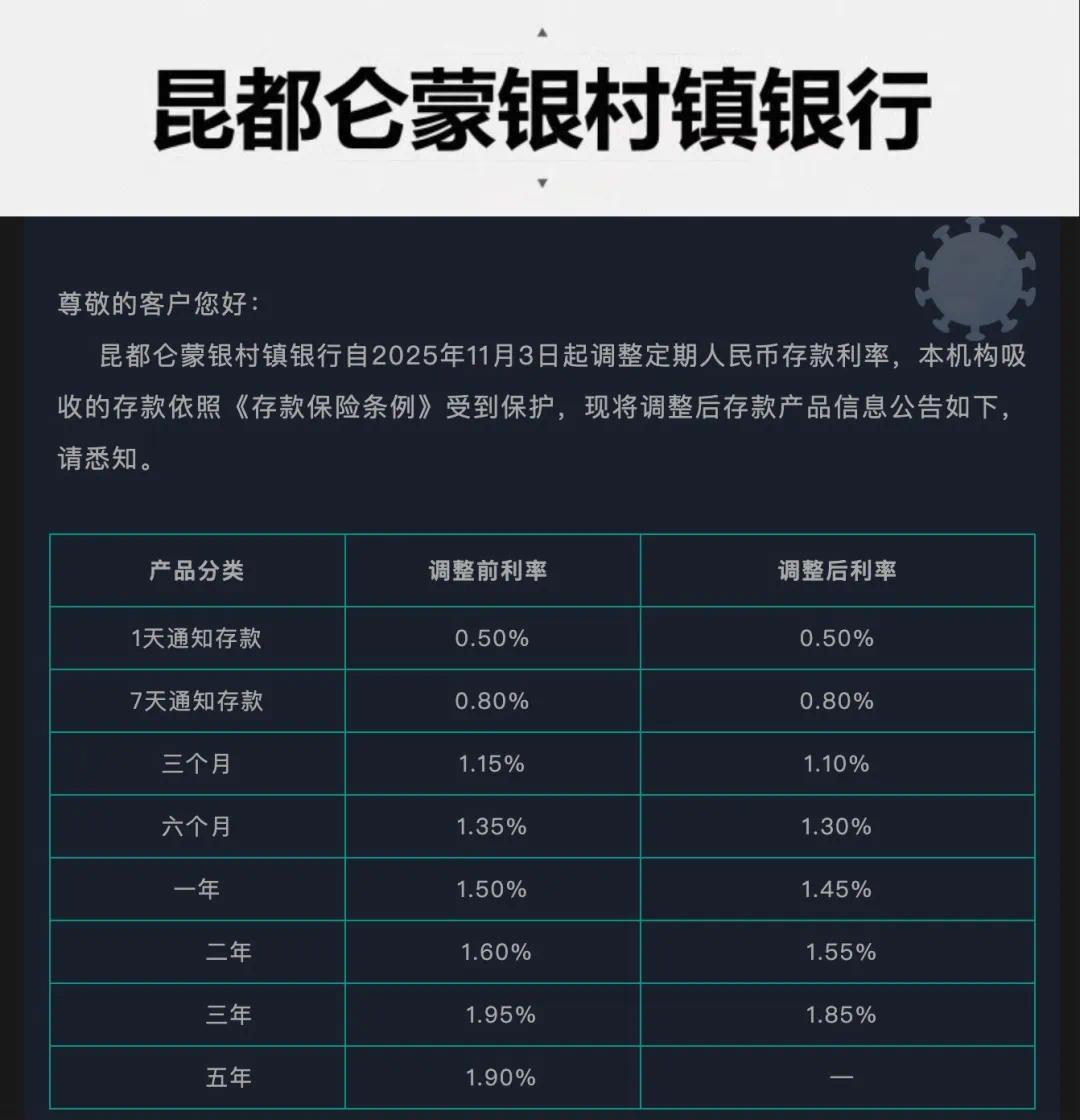
Core Viewpoint - The recent collective removal of five-year large denomination time deposits by six major state-owned banks indicates a significant shift in the banking industry towards reducing long-term deposit products due to pressure on net interest margins [1][4]. Group 1: Changes in Deposit Products - Six major state-owned banks have collectively removed five-year large denomination time deposits, with only three-year products remaining, and their interest rates have dropped to between 1.5% and 1.75% [1]. - The first bank to announce the cancellation of five-year fixed deposits was Tongyu County Mengyin Village Bank, which will eliminate this product starting November 5, 2025, and has also lowered interest rates for other terms [1][3]. - The adjustments include a reduction of 5 basis points for one-year and two-year deposits, bringing their rates to 1.45% and 1.55%, respectively, while the three-year deposit rate was reduced by 10 basis points to 1.85% [1][3]. Group 2: Industry Trends and Challenges - The banking industry is facing net interest margin pressure due to declining loan rates and high competition for deposits, leading to a need for banks to adjust their long-term high-interest deposit products [4][5]. - Private banks are more actively adjusting their products, with at least seven banks, including Meizhou Merchants Bank and Mybank, having removed five-year fixed deposits [3][4]. - According to the National Financial Regulatory Administration, private banks experienced a 0.08 percentage point decrease in net interest margins in Q3 2025, reflecting a broader industry challenge [3]. Group 3: Future Outlook - Industry insiders predict that while long-term deposits will not completely disappear, they will exhibit differentiated supply characteristics, with state-owned banks likely retaining five-year deposits as service tools but at potentially lower rates [5]. - Smaller banks are expected to shift towards one to three-year products or implement promotional strategies to manage their deposit scales [5]. - The reduction in deposit rates may lead to a "deposit migration" effect, where funds seek higher returns in capital markets, potentially benefiting direct financing markets [5].