三年期定期存款

Search documents
多家银行推出亲子产品 让压岁钱变身财商课
Xin Lang Cai Jing· 2026-02-26 23:52
Core Insights - The article discusses how banks are competing for children's New Year's money by offering attractive savings products and higher interest rates, emphasizing financial education for children [2][4]. Interest Rate Competition - Major banks, including state-owned and city commercial banks, have increased their medium to long-term deposit rates, particularly for three-year fixed deposits, which are now more appealing [2]. - The five major state-owned banks maintain a three-year deposit interest rate around 1.55%, while some joint-stock banks offer rates around 1.75% [2]. - City commercial banks have emerged as leaders in this interest rate competition, with three-year rates generally between 1.8% and 2.0%, with some banks like Jilin Bank and Fuxin Bank reaching 2.0% [2]. Product Innovation - Banks are focusing on the emotional and educational aspects of their products, with new offerings like the "Youth Version" savings account designed for children under 16, which can be opened by guardians [4]. - These children's accounts often come with additional features such as point systems that can be exchanged for educational materials, aiming to extend the savings process into a financial education journey [4]. Financial Guidance - Financial advisors suggest that parents open children's savings accounts to diversify asset allocation, which can help children understand basic financial concepts and create a substantial education fund over time [5]. - The approach not only serves as a financial gift but also instills a sense of family responsibility and emotional connection, making the New Year's money a valuable part of the child's growth [5].




门槛降低利率调升 银行揽储升温
Bei Jing Shang Bao· 2026-02-10 16:54
Core Viewpoint - The banking sector is experiencing a divergence in deposit strategies as the Chinese New Year approaches, with state-owned banks maintaining stable interest rates while some joint-stock and city commercial banks are actively raising rates and lowering deposit thresholds to attract customers [1][3][5]. Group 1: Deposit Rate Adjustments - State-owned banks like China Construction Bank and Industrial and Commercial Bank of China are offering fixed deposit rates of 1.1% for one year, 1.2% for two years, and 1.55% for three years, showing no changes in their deposit strategies [3][4]. - In contrast, joint-stock banks such as Industrial Bank are offering higher rates, with one-year fixed deposits at 1.3%, two-year at 1.4%, and three-year at 1.75%, which are above the rates offered by state-owned banks [3][4]. - City commercial banks are also increasing their deposit rates, with Huishang Bank offering a three-year fixed deposit rate of up to 1.95%, and recently lowering the minimum deposit requirement from 500,000 to 200,000 yuan [4][5]. Group 2: Marketing Activities and Promotions - Industrial Bank has launched a promotional campaign called "Xing Speed" that offers customers rewards such as WeChat discounts and paper gold for increasing their financial assets [4]. - Ningbo Bank is targeting new customers with a "New Year Red" deposit activity, offering a 1.95% interest rate for three-year fixed deposits with a minimum deposit of 200,000 yuan [4]. Group 3: Strategies of Smaller Banks - Local rural commercial banks are increasing deposit rates and introducing unique deposit products to capture market share, with Guangxi Zhaoping Rural Commercial Bank offering rates of 1.4% for one year and 1.9% for three years [7]. - Hunan Xinhui Rural Commercial Bank has raised its deposit rates to 1.3% for one year and 1.75% for three years, with a minimum deposit of 30,000 yuan [7]. Group 4: Customer Guidance and Recommendations - Analysts suggest that customers should prioritize safety by choosing banks that participate in deposit insurance, and then select products based on their financial needs and time horizons [9][10]. - For short-term funds, large banks' products are recommended for liquidity, while long-term funds should consider high-rate products from smaller banks to lock in current rates [10][11].

全面降息下的“存款搬家”
Di Yi Cai Jing Zi Xun· 2025-12-31 11:20
Core Insights - The article discusses the significant changes in the deposit market in China, highlighting a shift from traditional savings to diversified asset allocations due to a low-interest-rate environment [2][3][7]. Group 1: Deposit Market Changes - By the end of 2025, traditional high-interest three-year and five-year fixed deposits are becoming scarce, with rates generally dropping to the "1" range [2]. - A wave of interest rate cuts has been observed across various banks, with state-owned banks leading the way, followed by smaller banks that have implemented more frequent and larger cuts [3][5]. - The trend of "deposit migration" is accelerating, with residents moving funds from traditional deposits to wealth management, insurance, and gold [2][7]. Group 2: Interest Rate Trends - As of May 20, 2025, six major state-owned banks reduced their deposit rates, with three-year and five-year fixed deposit rates cut by 25 basis points [3]. - The net interest margin for commercial banks has narrowed, with the average net interest margin reported at 1.42% as of the end of Q3 2025, marking a historical low [5]. Group 3: Impact on Asset Allocation - Data shows that from January to November 2025, the growth of residents' fixed deposits has significantly slowed, leading to a decrease in their share of total financial assets [6]. - The interaction between non-bank institutions and residents' deposits has increased market activity, indicating a trend towards diversified asset allocation [6]. Group 4: Future Outlook - Industry experts predict that the adjustment in the deposit market will deepen in 2026, with the trend of "deposit migration" expected to continue [7]. - It is anticipated that approximately 2-4 trillion yuan will flow into non-fixed deposit investment areas in 2026, reflecting a shift in residents' savings behavior [7]. Group 5: Banking Strategies - Different banking institutions are expected to adopt varied strategies in 2026, with state-owned banks focusing on wealth management to offset net interest margin pressures, while smaller banks may be more sensitive to deposit rates [8]. - Banks are encouraged to innovate product designs and improve service levels to enhance the proportion of short-term deposits, while also implementing a differentiated pricing system based on customer contributions [8].
2026年起,三年期定存利率:建行、邮储、农商银行,哪个银行最高?
Sou Hu Cai Jing· 2025-12-27 10:13
Core Viewpoint - The choice of bank for three-year fixed deposits among China Construction Bank (CCB), Postal Savings Bank (PSB), and rural commercial banks (RCBs) depends on individual preferences for safety and yield, with RCBs currently offering the highest interest rates [1] Interest Rates Comparison - CCB and PSB both offer a three-year fixed deposit interest rate of 1.25%, resulting in a total interest income of 3,750 yuan for a deposit of 100,000 yuan over three years [4] - PSB provides an upgraded interest rate of 1.55% for deposits of 50,000 yuan or more, yielding 4,650 yuan for a 100,000 yuan deposit over three years, which is 900 yuan more than CCB [4] - Some RCBs offer a three-year fixed deposit interest rate of 1.70% and a rate of 1.75% for large deposits, leading to an interest income of 5,100 yuan for a 100,000 yuan deposit, which is 1,350 yuan more than CCB [6] Safety Considerations - The safety of deposits in CCB and PSB is significantly higher than that of RCBs, as they are part of the six major state-owned banks [6] - It is crucial for depositors to ensure that the RCB they choose participates in deposit insurance, which provides compensation in case of bank failure [8] - Depositors should limit their total deposits and interest in any RCB to 500,000 yuan to ensure full compensation in the event of a bank collapse [8] Alternative Investment Options - The current interest rates for three-year government bonds are 1.85% and 1.90% for five-year bonds, which exceed the rates offered by most three-year fixed deposits [8] - Government bonds also allow for interest calculation based on the nearest fixed deposit rate, providing flexibility for depositors who may need to access their funds early [8] Conclusion - RCBs offer the highest interest rates for three-year fixed deposits, but their safety is lower compared to CCB and PSB. Depositors should consider their risk tolerance and whether the RCB participates in deposit insurance before making a decision [10]

喜娜AI速递:今日财经热点要闻回顾|2025年12月23日
Xin Lang Cai Jing· 2025-12-23 11:57
Group 1 - The People's Bank of China has implemented a one-time credit repair policy to assist individuals in restoring their credit, allowing for the removal of overdue information for amounts not exceeding 10,000 yuan if debts are repaid by March 31, 2026 [2][7] - The A-share market has seen a significant increase, with major indices rising collectively, and the Shanghai Composite Index increasing by 0.69%, with a total market turnover of 1.88 trillion yuan, indicating a developing trend for the upcoming cross-year and spring market [2][7] - The precious metals market is experiencing a surge, with gold prices reaching $4,420.47 per ounce, marking a year-to-date increase of 68.05%, and silver prices also hitting historical highs, driven by expectations of interest rate cuts and geopolitical tensions [2][7] Group 2 - Kuaishou has faced automated attacks leading to the suspension of multiple live streams due to inappropriate content, prompting the platform to take immediate action and report to authorities [3][8] - Major state-owned banks have adjusted their medium- and long-term deposit products, with three-year product rates dropping to 1.5% - 1.75%, as a response to challenges in net interest margins, which may guide funds towards capital markets [3][8] - The legal situation surrounding the "Xiangyuan system" has escalated, with the actual controller being taken into criminal custody, while companies involved claim normal operations and unchanged control [3][8] Group 3 - The Nanjing Museum's management of cultural relics has come under scrutiny, leading to investigations by multiple departments, including the establishment of a working group by the National Cultural Heritage Administration [4][9] - Investor Dan Bin has shifted focus from liquor to AI, suggesting that investing in technology stocks like Google is more favorable, as he perceives challenges in the liquor sector's growth [4][10] - The recent closure policy in Hainan has stimulated consumer spending, with significant increases in sales at duty-free shops, including an 85% year-on-year growth in Sanya's duty-free city [4][10]
部分中小银行上浮存款利率 同步设置起存门槛
Zheng Quan Ri Bao· 2025-12-07 15:43
Core Viewpoint - Some small and medium-sized banks are raising deposit interest rates to attract deposits, despite major state-owned banks lowering rates to reduce funding costs [1][2][3] Group 1: Deposit Rate Adjustments - Small and medium-sized banks are increasing fixed deposit rates as year-end approaches to enhance product attractiveness and boost deposit gathering efforts [1][2] - For example, Shanghai Pudong Development Bank offers a three-year fixed deposit at a rate of 1.75%, up from 1.55% in November, with varying minimum deposit amounts [1] - Hangzhou Bank has introduced a three-year fixed deposit with rates of 1.65%, 1.70%, and 1.80%, depending on the minimum deposit amount, which has been increased by 5 to 10 basis points [2] Group 2: Strategic Motivations - The increase in deposit rates by some small and medium-sized banks is a strategic response to short-term pressures and aims to stabilize liabilities [2][3] - Experts suggest that these banks are using minimum deposit thresholds to attract deposits more precisely, compensating for their relative disadvantages in brand and distribution channels [2] - This behavior reflects a differentiated survival strategy among small banks in the competitive deposit market, although it is seen as a temporary measure [2][3] Group 3: Overall Market Trends - The net interest margin for commercial banks is currently low, standing at 1.42% as of the end of Q3, indicating a downward trend in deposit rates [3] - Future trends suggest that while deposit rates will generally decline, there may be variations among different banks, with state-owned banks likely leading the downward adjustment [3] - The long-term outlook indicates that competition in the banking sector will increasingly rely on comprehensive financial service capabilities rather than just price competition [3]
工行、农行、中行、建行、交行、邮储,集体停售
Mei Ri Jing Ji Xin Wen· 2025-11-27 14:27
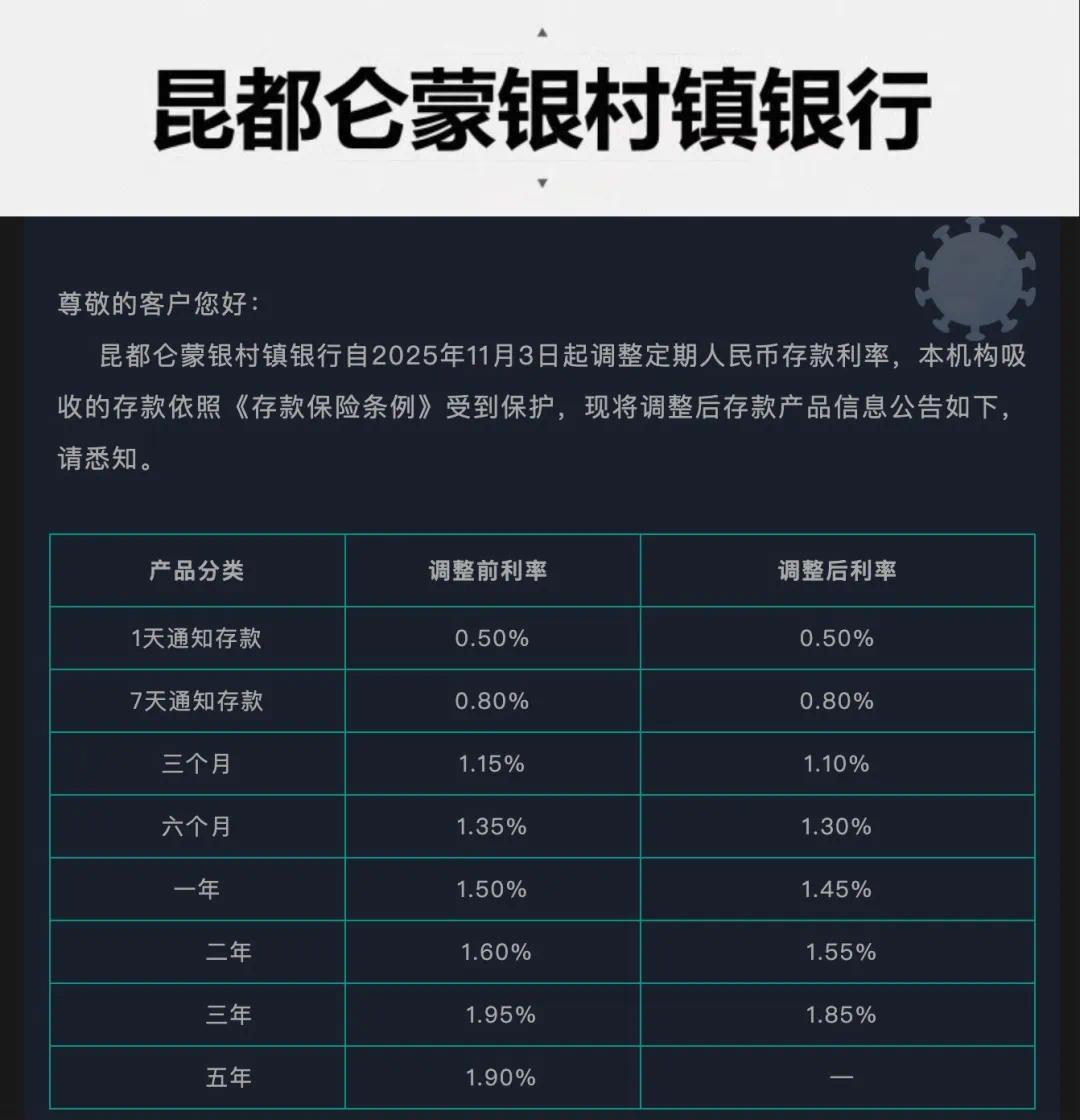
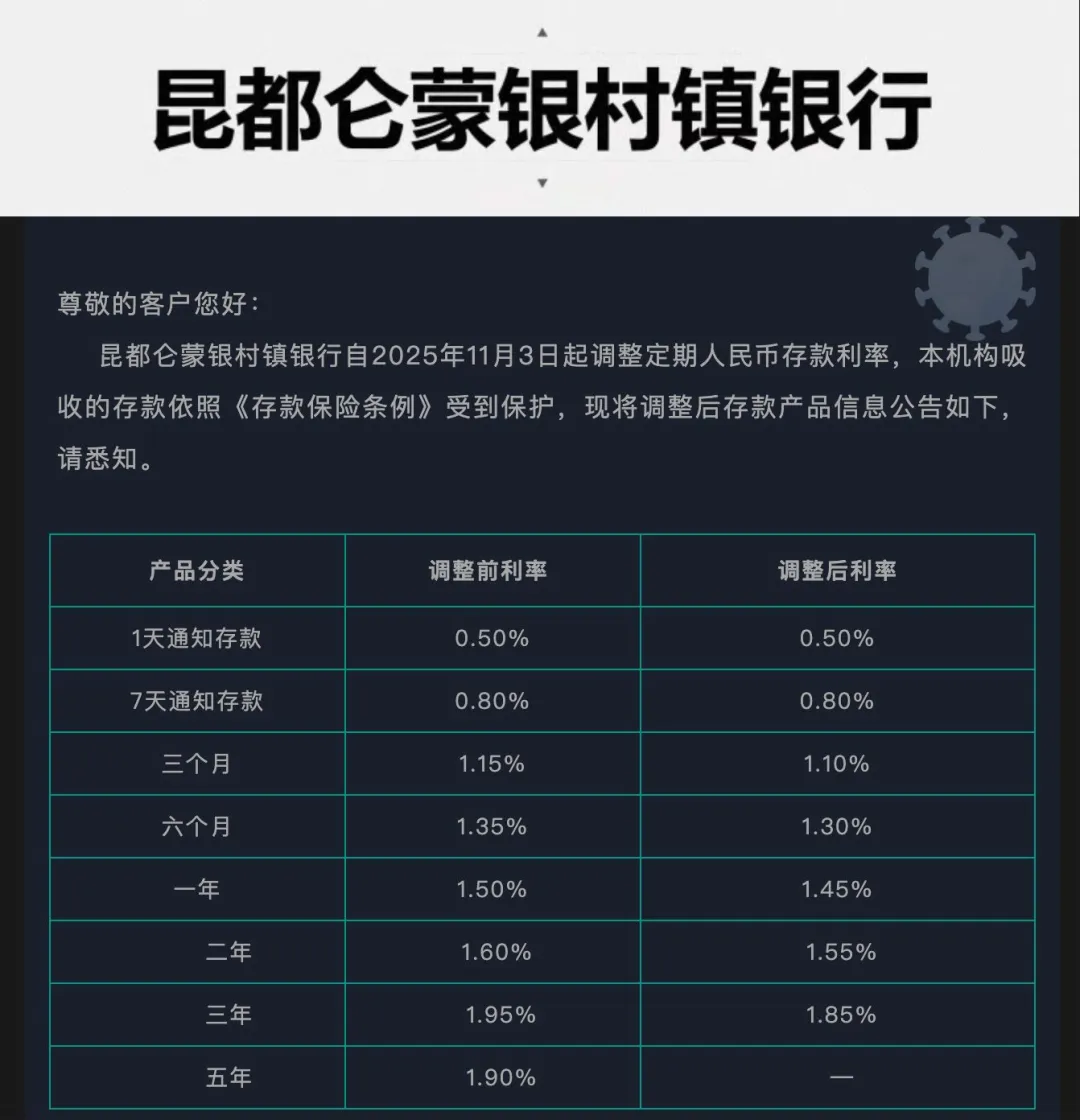
Core Viewpoint - The recent collective removal of five-year large denomination time deposits by six major state-owned banks indicates a significant shift in the banking industry towards reducing long-term deposit products due to pressure on net interest margins [1][4]. Group 1: Changes in Deposit Products - Six major state-owned banks have collectively removed five-year large denomination time deposits, with only three-year products remaining, and their interest rates have dropped to between 1.5% and 1.75% [1]. - The first bank to announce the cancellation of five-year fixed deposits was Tongyu County Mengyin Village Bank, which will eliminate this product starting November 5, 2025, and has also lowered interest rates for other terms [1][3]. - The adjustments include a reduction of 5 basis points for one-year and two-year deposits, bringing their rates to 1.45% and 1.55%, respectively, while the three-year deposit rate was reduced by 10 basis points to 1.85% [1][3]. Group 2: Industry Trends and Challenges - The banking industry is facing net interest margin pressure due to declining loan rates and high competition for deposits, leading to a need for banks to adjust their long-term high-interest deposit products [4][5]. - Private banks are more actively adjusting their products, with at least seven banks, including Meizhou Merchants Bank and Mybank, having removed five-year fixed deposits [3][4]. - According to the National Financial Regulatory Administration, private banks experienced a 0.08 percentage point decrease in net interest margins in Q3 2025, reflecting a broader industry challenge [3]. Group 3: Future Outlook - Industry insiders predict that while long-term deposits will not completely disappear, they will exhibit differentiated supply characteristics, with state-owned banks likely retaining five-year deposits as service tools but at potentially lower rates [5]. - Smaller banks are expected to shift towards one to three-year products or implement promotional strategies to manage their deposit scales [5]. - The reduction in deposit rates may lead to a "deposit migration" effect, where funds seek higher returns in capital markets, potentially benefiting direct financing markets [5].
工行、农行、中行、建行、交行、邮储,集体停售!
Mei Ri Jing Ji Xin Wen· 2025-11-27 13:40
Core Viewpoint - The major state-owned banks in China have collectively removed five-year large-denomination time deposits, indicating a trend of declining long-term deposit products in the banking industry [1][2][4] Group 1: Changes in Deposit Products - The six major state-owned banks have eliminated five-year large-denomination time deposits, with only three-year products remaining, which have seen interest rates drop to between 1.5% and 1.75% [1] - The first bank to announce the cancellation of five-year time deposits was Tongyu County Mengyin Village Bank, which will stop offering this product starting November 5, 2025 [1] - Other banks, including at least seven private banks, have also begun to remove five-year time deposits, reflecting a broader trend in the industry [3][4] Group 2: Interest Rate Adjustments - The interest rates for various deposit products have been adjusted downwards, with one-year and two-year rates reduced by 5 basis points to 1.45% and 1.55%, respectively, and the three-year rate decreased by 10 basis points to 1.85% [3] - The adjustments are a response to the pressure on net interest margins faced by banks, as the yield on assets (like loan rates) is declining while the cost of liabilities (like deposit rates) remains rigid [2][4] Group 3: Industry Context and Implications - The banking industry is experiencing a "two-sided squeeze" where declining loan rates and high competition for deposits are pressuring net interest margins, leading to the reduction of long-term high-interest deposit products [4] - A survey indicated that 62.3% of urban depositors prefer to save more, a slight decrease from the previous quarter, suggesting a shift in savings behavior due to lower interest rates [4] - Analysts predict that while long-term deposits will not completely disappear, they will exhibit differentiated supply characteristics, with state-owned banks likely retaining five-year deposits as service tools but at potentially lower rates [5]


五年期定期存款,“已下架”
Zhong Guo Zheng Quan Bao· 2025-11-26 11:51
Core Viewpoint - The announcement from Meizhou Commercial Bank indicates a trend among banks to discontinue five-year fixed deposit products due to policy adjustments and to manage funding costs in response to narrowing net interest margins [1][6]. Group 1: Bank Actions - Several small and medium-sized banks have begun to remove long-term deposit products, particularly five-year fixed deposits, from their offerings [2][5]. - Meizhou Commercial Bank has specifically stated that it will no longer provide automatic renewal services for five-year deposits, requiring customers to manually manage their funds upon maturity [1]. - Other banks, such as Anhui Xin'an Bank, have also confirmed the absence of five-year fixed deposits, with the longest available term being three years [2]. Group 2: Interest Rate Trends - There is a noticeable decline in interest rates for fixed deposits, with many banks offering lower rates than previously available; for instance, the highest rate for a five-year deposit has dropped from 4% to 1.80% [2][3]. - Some banks are experiencing an inverted interest rate scenario, where the interest rate for three-year deposits exceeds that of five-year deposits, as seen with Liaoning Zhenxing Bank [2][5]. Group 3: Industry Context - The overall strategy of banks to reduce funding costs is primarily driven by the pressure of narrowing net interest margins, prompting them to adjust their deposit product offerings [6]. - High-level executives from various banks have indicated a commitment to reducing high-cost deposits and adjusting the issuance plans for large-denomination certificates of deposit and fixed-term deposits [6].

手握存款的居民,建议提前做好三个方面准备,很多人还没有意识到
Sou Hu Cai Jing· 2025-11-23 23:41
Core Insights - The continuous decline in bank deposit interest rates in China has led to a significant increase in residents' savings, with new deposits reaching 11.09 trillion yuan from January to July this year [1][3] Group 1: Deposit Trends - The three-year deposit interest rate has fallen below 3%, marking the beginning of a "two-digit" era for domestic bank deposits [1] - Despite low interest rates, the demand for savings remains strong as residents view savings as a crucial buffer against uncertainties such as unemployment and unexpected medical expenses [3] Group 2: Investment Strategies - Residents are advised to pay attention to liquidity when choosing deposit terms, as locking funds in long-term deposits can lead to significant interest losses if early withdrawal is necessary [5] - A suggested strategy is to divide savings into three parts, investing in one-year, two-year, and three-year fixed deposits to ensure annual liquidity while maximizing interest [5] Group 3: Risk Management - It is recommended that depositors avoid concentrating all funds in a single bank, especially smaller banks that may offer higher rates but carry bankruptcy risks [7] - Depositors should diversify their savings across multiple banks, ensuring that no single bank holds more than 500,000 yuan to protect against potential losses [7] Group 4: Awareness of Financial Products - Caution is advised against purchasing high-risk financial products that may be misrepresented as innovative deposit options by bank staff [9] - Depositors should personally verify the nature of the products they are purchasing to avoid misunderstandings and potential financial losses [9] Group 5: Maximizing Returns - In addition to the above strategies, depositors should actively seek out opportunities for higher returns through large-denomination certificates of deposit or government bonds, which typically offer better rates than standard fixed deposits [10]