存量住房收储

Search documents
中金:房地产政策端和供给侧初现积极变化
Xin Lang Cai Jing· 2026-01-20 23:51
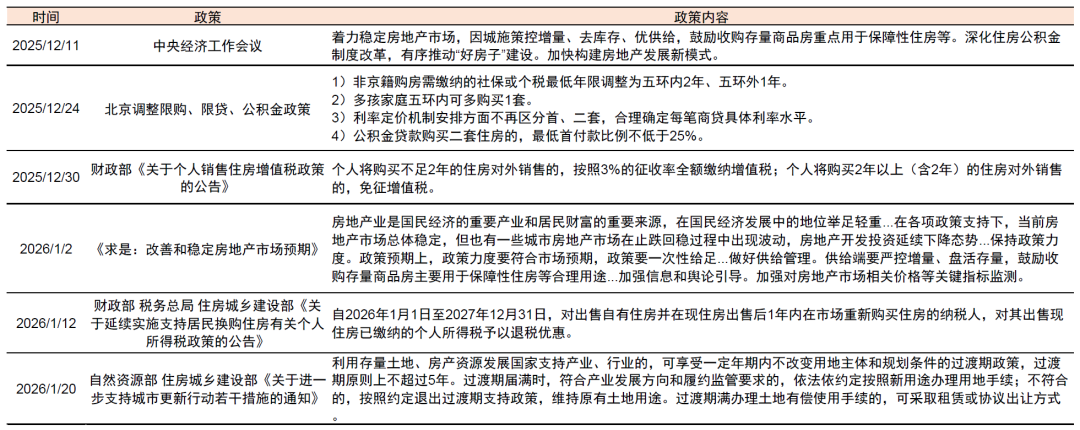
Core Viewpoint - The article emphasizes the importance of monitoring the progress of stock housing acquisition policies in 2026, highlighting recent policy changes aimed at stabilizing the real estate market and addressing inventory issues [1][15]. Group 1: Policy Developments - The recent notification enhances the feasibility of stock housing acquisition by establishing a transitional policy allowing for a maximum of five years without changing original planning conditions for stock land and property [1][15]. - The core task outlined in the December 2025 economic work conference is to "control increment and reduce inventory," with various policies being introduced, including adjustments to purchase restrictions and tax rates on second-hand housing [1][15]. - The frequency of recent real estate policies has significantly increased, indicating a proactive approach to managing the market [1][15]. Group 2: Market Conditions - In the first quarter, attention should be focused on the natural inventory changes on the supply side, as both new land supply and transaction volumes for first and second-hand homes have stabilized at low levels since the second half of 2025 [2][16]. - The supply side is showing some positive changes, with a decrease in the volume of new land supply and a decline in the number of listings in high-tier cities [2][16]. - The macroeconomic environment's impact on overall housing transaction volumes remains a critical factor, with expectations of a gradual narrowing of transaction volume declines [2][16]. Group 3: Investment Opportunities - Given the recent increase in real estate policies, there is a suggestion to raise attention to the real estate sector, particularly in light of natural inventory changes and the implementation of stock housing acquisition policies [2][16].

中金:房地产政策端和供给侧初现积极变化
中金点睛· 2026-01-20 23:37
Core Viewpoint - The article discusses the recent policy changes in urban renewal and housing stock management, emphasizing the importance of these measures in addressing the real estate market's challenges and the need for financing support to enhance the feasibility of housing stock acquisition [2][3]. Group 1: Policy Changes - The joint notification from the Ministry of Natural Resources and the Ministry of Housing and Urban-Rural Development introduces measures to support urban renewal, including a transitional policy allowing for a maximum five-year period where original planning conditions remain unchanged [2]. - The policy aims to enhance the feasibility of acquiring existing housing stock by potentially increasing acquisition prices, addressing previous pricing discrepancies between acquisition and market prices [2]. Group 2: Market Dynamics - Since the second half of 2025, the transaction volume of both new and second-hand homes has stabilized at a low level, with a notable decrease in the supply of new land and a reduction in the number of listings in high-tier cities [3]. - The article suggests that the upcoming period post-Spring Festival will be crucial for monitoring changes in natural inventory, which is vital for predicting future housing price trends [3]. Group 3: Investment Opportunities - Given the recent increase in real estate policies, there is a recommendation to raise attention towards the real estate sector, particularly in light of the positive changes in supply dynamics and the implementation of housing stock acquisition policies [3].