学历与就业

Search documents
全国每5人就有1人读过大学
21世纪经济报道· 2025-11-20 12:46
Core Insights - The overall educational attainment of China's population has significantly improved, with 21.72% of the population aged 6 and above holding a college degree or higher in 2024, up from 19.20% in 2023, indicating that one in five people has attended college [1][4] - The proportion of individuals with bachelor's and graduate degrees has also increased, reaching 10.08% and 1.12% respectively, compared to 8.57% and 0.95% in 2023 [1][4] - The growth in educational attainment is linked to the expansion of higher education and the increasing demand for higher qualifications in the job market [1][10] Educational Statistics - In 2024, the population with college diplomas, bachelor's degrees, and graduate degrees accounted for 10.53%, 10.08%, and 1.12% of the total population, respectively [3][4] - The total enrollment in various forms of higher education reached 48.46 million in 2024, an increase from 47.63 million in 2023 [4] - The number of graduate students has seen rapid growth, with 135.68 million enrolled in 2024, up from 91.65 million in 2019, marking a 62.6% increase in doctoral students and a 46.1% increase in master's students over five years [5][10] Regional Disparities - There are significant regional differences in educational attainment, with Beijing, Shanghai, and Tianjin having the highest proportions of individuals with college degrees or higher, at 50.83%, 40.93%, and 36.16% respectively [7][8] - The distribution of high-education populations varies across provinces, affecting graduates' employment choices and opportunities [8] Employment Trends - Companies are increasingly raising their educational requirements for job applicants, with many positions now requiring at least a bachelor's degree [10][11] - The job market is becoming more competitive, particularly for roles in research, design, and technical management, where graduate degrees are often preferred [10][11] - Employers are placing greater emphasis on practical skills and work experience, suggesting a shift towards valuing capabilities over formal educational qualifications [11][12] Educational Policy and Future Directions - The "14th Five-Year Plan" emphasizes improving the quality of higher education and expanding quality undergraduate education enrollment [1][2] - Experts suggest that while educational attainment is rising, there should be a balance between degree attainment and actual skill development to enhance workforce quality [10][12]


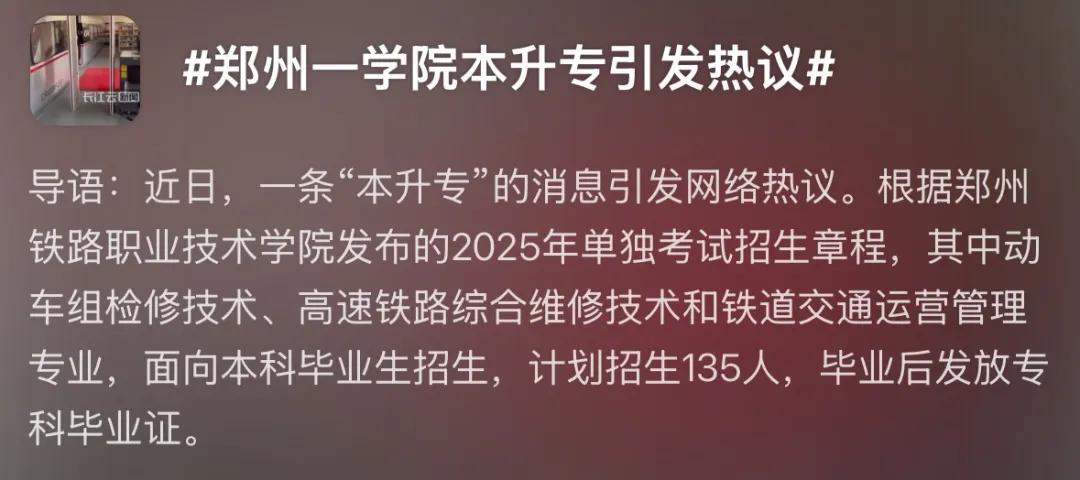
本科毕业读大专,年轻人开始“本升专”了?
Hu Xiu· 2025-08-23 11:02
Core Viewpoint - The article discusses the emerging trend among young people in China to pursue vocational education (specifically, returning to specialized colleges) after obtaining a bachelor's degree, highlighting a shift in attitudes towards education and employment opportunities [1][11][31]. Group 1: Educational Trends - Many young graduates are considering "reverse enrollment," where they opt to pursue vocational diplomas after completing their bachelor's degrees, indicating a change in the perceived value of different educational paths [2][11][31]. - Institutions like Zhengzhou Railway Vocational and Technical College have started enrolling bachelor's degree holders, reflecting a growing acceptance of this trend [4][6][31]. - Other vocational colleges, such as Guangdong Lingnan Vocational Technical College and Qingdao Technician College, are also offering programs specifically for bachelor's degree holders, further supporting this educational shift [6][7][31]. Group 2: Employment Opportunities - The article notes that many vocational graduates are finding lucrative job opportunities, sometimes earning more than their bachelor's degree counterparts, which challenges the traditional view of educational hierarchy [6][18][22]. - Young people are increasingly recognizing that practical skills can be more valuable than academic credentials in the job market, leading to a reevaluation of the importance of degrees [18][32]. - The trend of "reverse enrollment" is seen as a way to enhance employability, with many graduates believing that acquiring technical skills can provide a competitive edge in the job market [8][26][30]. Group 3: Changing Perceptions - There is a growing sentiment among young people that having a technical skill set is more beneficial than merely holding a degree, as they seek practical solutions to employment challenges [18][32]. - The article highlights a shift in mindset where young graduates are less concerned about the stigma of attending vocational schools, viewing it as a viable path to career success [20][31]. - The narrative around education is evolving, with many young individuals now seeing vocational training as a legitimate and effective route to achieving their career goals [32].