宇宙起源与演化

Search documents
最暗弱深空星系图绘制成功
Huan Qiu Wang Zi Xun· 2026-02-24 01:28
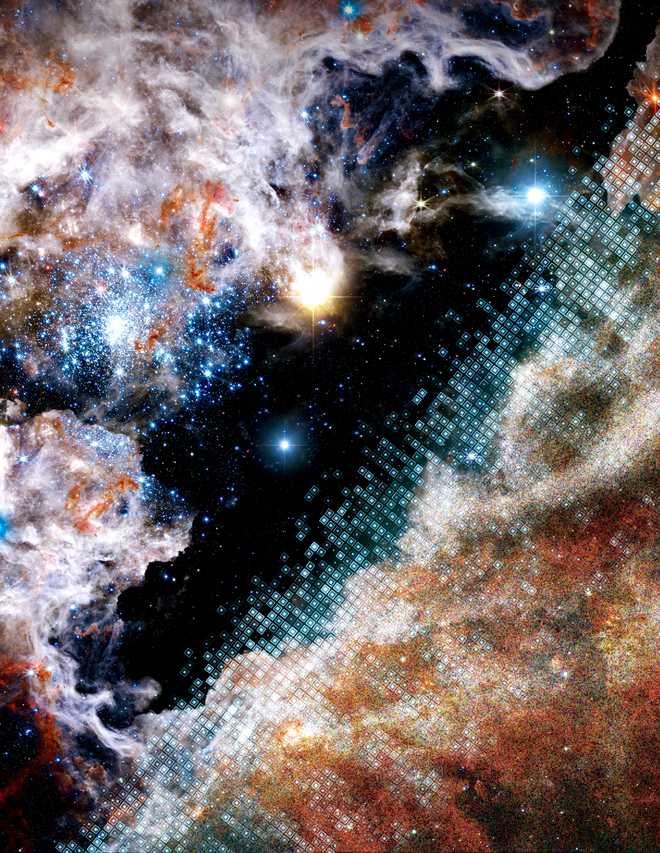
Core Viewpoint - The AI astronomical observation enhancement model "ASTERIS" has been developed, significantly improving the detection depth of the James Webb Space Telescope by 1 magnitude and identifying three times more extremely faint high-redshift candidate celestial bodies than previous studies, marking a breakthrough in deep space imaging [1][3]. Group 1: Technological Advancements - The "ASTERIS" model integrates optical principles with AI algorithms to interpret vast observational data multidimensionally, effectively reconstructing deep space images into a three-dimensional format [2]. - A unique photometric adaptive filtering mechanism allows "ASTERIS" to model noise fluctuations alongside the luminosity of celestial bodies, focusing on extracting and reconstructing faint signals [2]. - The model employs a "time median, all-time average" optimization strategy, enhancing the ability to detect faint signals while reducing the probability of false signals, thus ensuring the scientific integrity of astronomical data [3]. Group 2: Performance Metrics - "ASTERIS" has improved the completeness of detecting faint celestial bodies by 1.0 magnitude and the accuracy of detection by 1.6 magnitudes, significantly enhancing photon collection efficiency [3]. - The model has enabled the discovery of over 160 candidate high-redshift galaxies from the early universe, three times the number previously identified, providing new data for understanding the origins of the universe [3]. Group 3: Versatility and Application - "ASTERIS" is compatible with various observational platforms and detection wavelengths, having been successfully applied to both the James Webb Space Telescope and ground-based telescopes, covering a range from visible light (approximately 500 nm) to mid-infrared (5 microns) [4].
刷新深空探测极限!我国科学家用天文AI模型绘制“极致深空图”
Xin Hua She· 2026-02-20 09:01
Core Insights - The article discusses the development of an astronomical AI model named "Xingyan" by Chinese scientists, which enhances the detection of faint celestial bodies and provides significant advancements in deep space imaging [1][4]. Group 1: Technological Advancements - The "Xingyan" model utilizes computational optics and artificial intelligence algorithms to decode vast amounts of data from space telescopes, potentially serving as a universal platform for deep space data enhancement [4]. - The model extends the detection capabilities of the James Webb Space Telescope, increasing its depth by one magnitude and improving accuracy by 1.6 magnitudes, equivalent to enhancing the telescope's effective aperture from approximately 6 meters to nearly 10 meters [4]. Group 2: Scientific Contributions - The application of "Xingyan" has led to the discovery of over 160 candidate galaxies from the early universe, existing between 200 to 500 million years after the Big Bang, significantly surpassing the previous international count of over 50 such galaxies [4]. - The self-supervised spatiotemporal denoising technology of "Xingyan" focuses on extracting and reconstructing faint signals, ensuring both increased detection depth and accuracy through extensive observational data training [5]. Group 3: Future Implications - The technology developed through "Xingyan" is expected to assist in addressing major scientific questions related to dark energy, dark matter, the origin of the universe, and exoplanets, indicating its potential for broader applications in next-generation telescopes [5].