家庭储蓄向股票再配置

Search documents
瑞银关于A股十问十答:估值还有空间!
Datayes· 2026-01-27 12:09
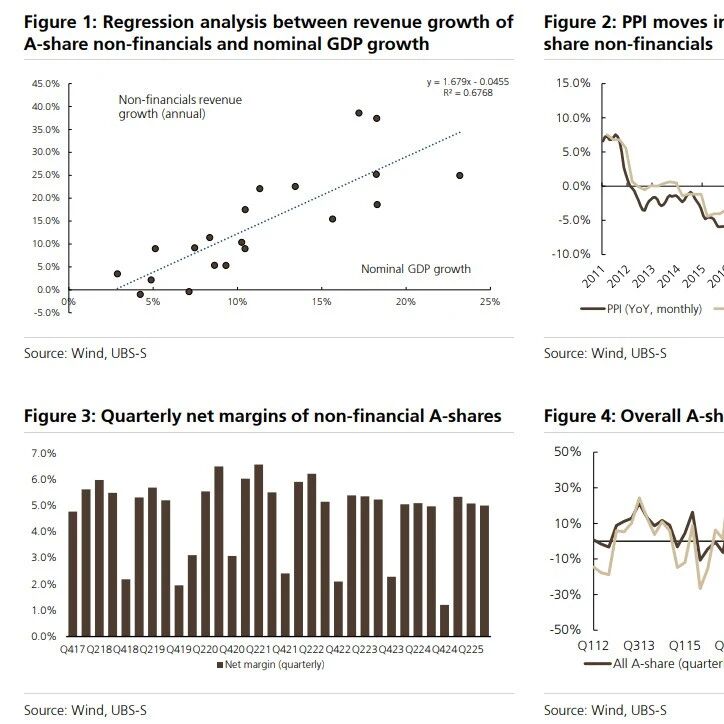
Group 1 - The overall A-share profit growth is expected to accelerate from 6% in 2025 to 8% in 2026, primarily driven by the non-financial sector [1] - The revenue growth of non-financial A-shares is closely related to China's nominal GDP growth and PPI inflation, with a projected nominal GDP growth of 4.3% in 2026 [1] - The net profit margin (NPM) of non-financial A-shares has rebounded in the first nine months of 2025, reversing a long-term downward trend since 2021 [1] Group 2 - The financial sector's profit growth is expected to remain stable, supported by solid asset quality in the banking sector and improved market sentiment [2] - The cumulative profit growth of industrial enterprises in China was only 0.1% in the first eleven months of 2025, but certain sectors like computer and electronic equipment manufacturing saw a 15% profit increase [2] - Investors should pay attention to potential revisions in profit growth expectations around April 2026, as historical data shows discrepancies in profit growth forecasts during that period [2] Group 3 - The current rolling P/E ratio of the Wind All A-share index has risen above the historical average, leading some investors to worry about overvaluation [13] - Despite concerns, the equity risk premium in the A-share market remains above historical averages, indicating potential for further revaluation [13][16] - Factors such as clearer fiscal support, accelerating profit growth, and increased household savings reallocating to stocks are expected to drive A-share growth in 2026 [16] Group 4 - The Chinese central bank plans to moderately expand the deficit and maintain stable credit pulses, which is expected to support A-share revaluation [17] - The anticipated reduction in policy rates and reserve requirement ratios by the central bank may further enhance liquidity in the market [17] - A moderate expansion in P/E ratios is expected as profit growth accelerates, with historical data showing a correlation between profit growth and P/E ratios [21] Group 5 - The ongoing market capitalization management reforms are changing investor perceptions, leading to increased focus on shareholder returns [27] - A-share cash dividends reached 2.06 trillion yuan in 2025, marking a significant increase, while stock buybacks have also risen [27] Group 6 - Daily trading volume in A-shares has significantly increased in 2026, driven by improved investor risk appetite, with average daily turnover reaching 3.03 trillion yuan [28] - Regulatory measures have been implemented to cool down excessive trading activity, with daily turnover ratios fluctuating [28][33] - The financing balance in A-shares reached a historical high of 2.7 trillion yuan, indicating increased leverage in the market [33] Group 7 - The trend of reallocating household savings towards stocks is evident, with a significant portion of household deposits still available for investment in A-shares [40] - Despite a recent uptick in the stock market, the influx of household funds into the market has not yet reached overheating levels [42][46] - The potential for further inflows into A-shares exists as investors may gradually shift from fixed-income products to equity investments [49] Group 8 - The issuance of active funds has been slow, but the performance of equity funds has improved, potentially leading to increased inflows as market conditions stabilize [53] - The ETF market has seen rapid growth, with A-share holdings in ETFs surpassing those in active equity funds for the first time [58] Group 9 - The "anti-involution" policies are expected to improve supply-demand dynamics and support price recovery, enhancing corporate profitability [64] - The narrowing and eventual recovery of PPI is crucial for the revenue growth of non-financial A-shares, which may lead to stock price revaluation [65] Group 10 - The growth style is expected to outperform the value style in the mid-term, with cyclical stocks likely to perform better than defensive stocks [66] - Tactical preferences lean towards sectors benefiting from innovation, ample liquidity, and narrowing PPI, such as electronics, telecommunications, and chemicals [66] Group 11 - Despite recent declines in financing balances and market turnover, the technology sector's fundamentals remain strong, with expectations for continued growth in 2026 [75] - Metrics for assessing trading congestion in technology stocks include the proportion of trading volume and financing balances relative to market capitalization [78]