家族式企业治理

Search documents
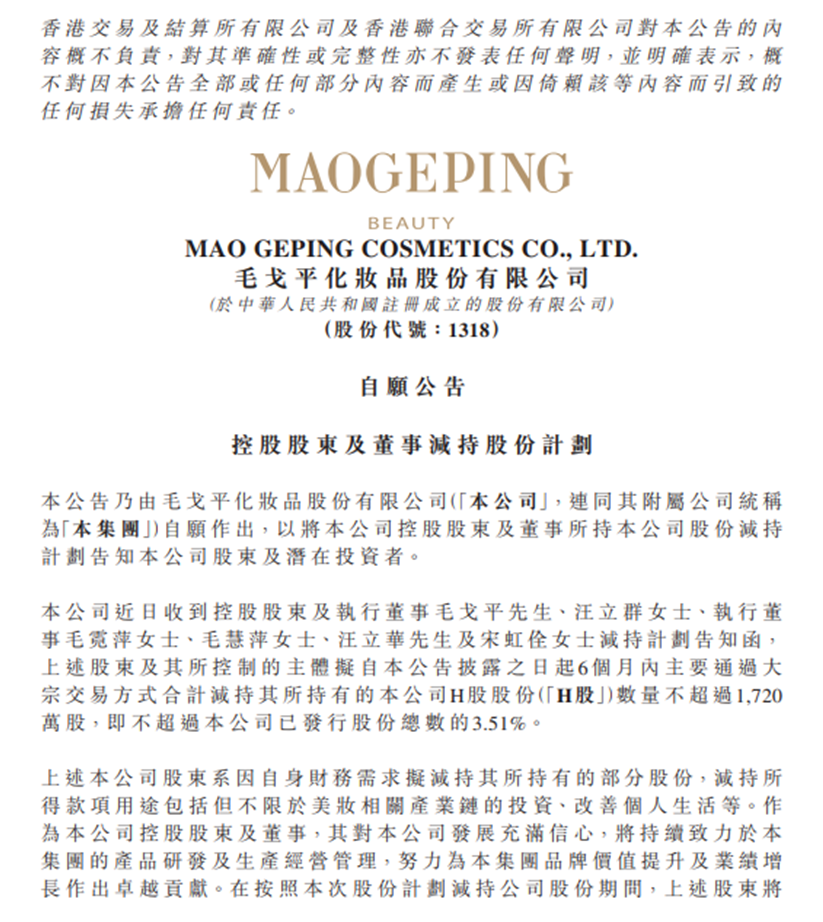
解禁期刚过,毛戈平家族集体减持套现14亿港元
Xin Lang Cai Jing· 2026-01-14 10:20
Core Viewpoint - The recent announcement of a collective share reduction by the founding family of Maogeping, just after the end of the lock-up period post-IPO, raises concerns about the company's future growth potential and investor confidence [1][4][5]. Group 1: Share Reduction Announcement - Maogeping's announcement on January 6 revealed that six core executives, including the founder and family members, plan to reduce their holdings by up to 17.2 million shares, representing 3.51% of the total share capital, potentially raising approximately HKD 1.41 billion at the closing price of HKD 82 per share [1][4]. - The family and concerted parties hold over 67% of the shares, and even after the reduction, their stake will remain around 63.5% [4]. Group 2: Financial Performance and Concerns - In 2024, Maogeping reported revenue of RMB 3.885 billion, a year-on-year increase of 34.61%, but this growth rate significantly declined from 57.8% in 2023, indicating potential issues with growth engines [7]. - The company's R&D expenditure was only RMB 15.257 million, accounting for just 0.59% of revenue, while sales and distribution expenses were RMB 1.169 billion, making up 45.2% of total revenue [7][9]. Group 3: Market Position and Competitive Landscape - The beauty industry is experiencing intense competition, with a trend of "price for volume" leading to a 7.2% decrease in average selling prices for color cosmetics in 2025, while sales volume increased by 14.5% [9][10]. - Maogeping's flagship brand relies heavily on the founder's personal brand, which poses risks as the founder approaches retirement age and faces changing consumer perceptions [12][14]. Group 4: Governance and Future Outlook - The family-centric governance structure raises concerns about talent retention and employee confidence, as the collective share reduction may signal a lack of faith in the company's long-term prospects [15]. - The company's reliance on a single IP for revenue and the underperformance of its second brand, "Zhi Ai Zhong Sheng," which has seen declining sales, highlight the challenges in diversifying its business model [12][14].