
寿险业转型

Search documents
华泰人寿B面:消费者信任,不该成为转型之痛
阿尔法工场研究院· 2026-03-19 04:06
Core Viewpoint - The article discusses the ongoing challenges in the insurance industry, particularly focusing on customer complaints and the disconnect between sales and service experiences, highlighting the need for improved communication and transparency in the sales process [4][5][12]. Group 1: Customer Complaints and Issues - The "315 Financial Complaint Blacklist" published by Sina Finance includes companies like Huatai Insurance, indicating significant customer dissatisfaction [5]. - Major complaint issues include misleading sales practices, such as non-standard car insurance posing as reputable companies and hidden clauses in internet insurance products [7][9]. - Complaints often stem from poor communication during the sales process, leading to misunderstandings about policy terms and conditions [10][12]. Group 2: Regulatory Actions and Company Performance - Huatai Life Insurance has faced regulatory penalties for misleading practices, including a fine of 150,000 yuan for providing benefits outside of the insurance contract and failing to properly manage sales personnel [14][15]. - Despite these issues, Huatai Life reported a 7% increase in insurance business revenue to 9.94 billion yuan in Q4 2025, with a 165% increase in net profit, indicating some operational improvements [16][21]. Group 3: Challenges in Customer Experience - The article emphasizes that improvements in financial performance do not necessarily correlate with enhanced customer experience, as trust must be rebuilt through better service [17][22]. - High cancellation rates for certain products, such as the eShengying annuity insurance with a 16.37% cancellation rate, reflect a gap between customer expectations and actual policy benefits [18][22]. - The transition to a new business model in the insurance industry is complicated by existing sales practices that prioritize volume over customer satisfaction [25][26]. Group 4: Governance and Management Changes - Recent management changes at Huatai Life, including the appointment of new executives, aim to improve governance and operational efficiency [23]. - The effectiveness of these governance changes in enhancing customer experience remains uncertain, as they must translate into tangible improvements at the customer interaction level [24][26].


平安人寿换帅!85后蔡霆代行董事长职责,曾被业内称为“火箭式晋升”
Sou Hu Cai Jing· 2026-02-25 07:14
Core Viewpoint - The insurance industry is experiencing significant leadership changes as Ping An Life Insurance announces the retirement and reappointment of Yang Zheng, with Cai Ting stepping in as acting chairman, reflecting a trend towards younger management teams in the sector [1][5][6]. Group 1: Leadership Changes - Yang Zheng, born in February 1964, is retiring after a long tenure at Ping An, having held various key positions since joining in 1994, including chairman and CEO [1]. - Cai Ting, born in October 1985, has rapidly ascended within the company, becoming the youngest core executive at Ping An Life, and is currently responsible for key strategic areas [3][5]. - The leadership transition at Ping An Life is part of a broader trend in the insurance industry, with many companies undergoing similar changes to bring in fresh talent and expertise [5][6]. Group 2: Company Performance - As of the end of Q3 2025, Ping An Life's total assets reached 5.85 trillion yuan, a 12.71% increase from the beginning of the year, while net assets grew by 26.9% to 429.84 billion yuan [7]. - The company reported insurance business revenue of 470.93 billion yuan for the first three quarters, reflecting an 11.67% year-on-year growth, and a net profit of 105.57 billion yuan, up 23% [7]. - New business value from the agency channel increased by 23.3%, with per capita new business value rising by 29.9%, and the bancassurance channel saw a remarkable 170.9% growth [7]. Group 3: Strategic Focus - Ping An Life is committed to strengthening its leadership team and advancing its strategic initiatives to achieve high-quality development, particularly in the context of digital transformation and organizational change [6]. - The company is actively working on the formal appointment of a new chairman and will fulfill its information disclosure obligations as required [6].

58家寿险公司上半年盈利1763亿元 国寿、平安、太保领跑
2 1 Shi Ji Jing Ji Bao Dao· 2025-11-24 10:37
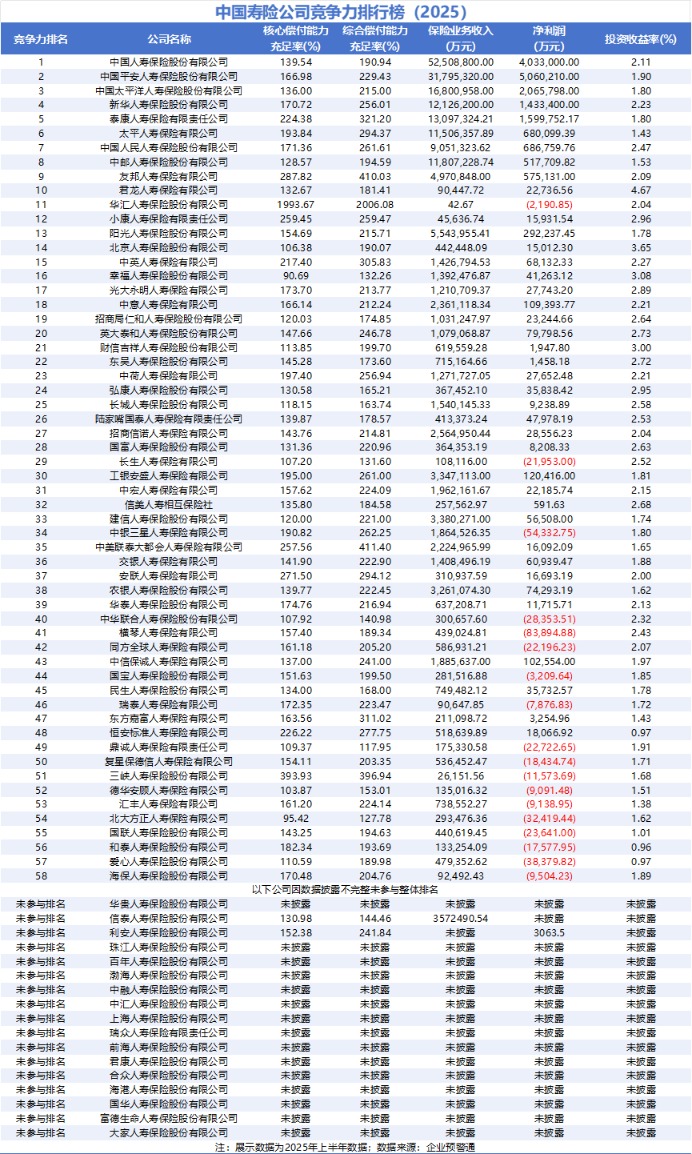
Core Insights - The report indicates a significant "stronger gets stronger" trend in China's life insurance industry, with the top ten companies accounting for 94.6% of the net profits in the first half of 2025 [1][5] - The top five life insurance companies achieved a combined premium income of 1.25 trillion yuan, showcasing their dominant market position [4][5] Group 1: Industry Overview - The report categorizes life insurance companies into four types: life insurance, property insurance, pension insurance, and health insurance, analyzing their competitiveness based on various dimensions [1] - In the first half of 2025, the life insurance sector's total profit reached 176.31 billion yuan, with 58 companies participating in the competitiveness ranking [1] Group 2: Top Companies Performance - The top five life insurance companies are China Life, Ping An Life, Taiping Life, New China Life, and TaiKang Life, all achieving net profits exceeding 10 billion yuan in the first half of 2025 [2][5] - China Life led with a premium income of 525.09 billion yuan and a net profit of 40.33 billion yuan, maintaining its market leadership [5] - Ping An Life reported a net profit of 50.60 billion yuan, the highest among life insurers [5] Group 3: Financial Metrics - The solvency ratios of the top companies remained robust, with TaiKang Life having a core solvency ratio of 224.38% and a comprehensive solvency ratio of 321.20% [5] - New China Life and Ping An Life also reported comprehensive solvency ratios exceeding 200% [5] Group 4: Investment Performance - New China Life achieved the highest investment return rate of 2.23% among the top five companies, followed by China Life at 2.11% [6] - Overall, the investment returns for the leading companies remained stable within a healthy range [6] Group 5: Market Dynamics - The report highlights a growing divide between large and small insurance companies, with 18 out of 58 companies reporting losses in the first half of 2025 [9] - Companies like Huahui Life, despite high solvency ratios, faced challenges due to low business income, indicating a need for operational revitalization [9] Group 6: Regulatory Impact - The insurance industry is transitioning from scale expansion to value creation, driven by regulatory changes such as the introduction of a dynamic adjustment mechanism for premium rates linked to market rates [10] - The report emphasizes that leading companies are focusing on cost control and risk management to adapt to the evolving market landscape [10]


民生人寿罚单频发背后:一季度净利骤降七成、股权转让遇冷
Nan Fang Du Shi Bao· 2025-07-22 14:17
Core Viewpoint - Minsheng Life Insurance is facing significant challenges, including regulatory penalties, declining profitability, and issues with product competitiveness, which may impact its future growth and stability [1][2][3][6]. Regulatory Issues - Minsheng Life Insurance has received multiple fines in 2025, with the Zhejiang branch fined 250,000 yuan for not using approved insurance terms and rates, marking the sixth penalty for the company this year [1][4]. - The same branch was penalized twice for the same violation within six months, indicating weaknesses in compliance and internal control [4]. Financial Performance - The company reported a 70% year-on-year decline in net profit for Q1 2025, with only 5.9 million yuan in profit, despite maintaining insurance business income of 4.127 billion yuan [2][3]. - Investment performance is lagging, with a Q1 2025 investment yield of 0.83%, below the industry average of 0.97% [2]. Product Competitiveness - The dividend realization rate for Minsheng's insurance products is underwhelming, with only one out of 43 products exceeding 100%, while many competitors have products surpassing this threshold [3]. - Consumer complaints have surged, with over half related to policy cancellations, suggesting dissatisfaction with product performance [3]. Shareholder Dynamics - The company has struggled with shareholder turnover, with 16 failed attempts to transfer equity since 2020, including the exit of its only state-owned shareholder [6][7]. - The current ownership structure is fragmented, with the top three shareholders holding over 68% of the shares, while many others hold less than 1% [6]. Industry Context - The insurance industry is undergoing a transformation, with stricter regulations and a shift towards core business operations, leading to increased caution among investors [7]. - Minsheng Life Insurance, once hailed as a pioneer in private insurance, now faces strategic challenges that will determine its ability to adapt and thrive in a changing market [7].