
小盘股反弹

Search documents
降息预期引爆小盘股狂欢!杰富瑞预警:资金出逃与盈利隐忧仍存
Zhi Tong Cai Jing· 2025-09-02 08:05
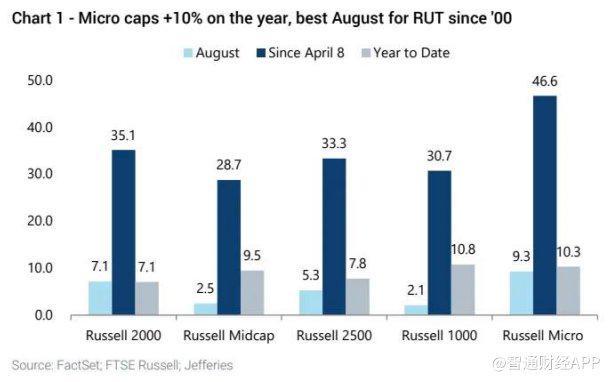
Core Viewpoint - Jefferies' latest U.S. stock strategy report highlights a strong performance of small-cap stocks in August, ending a period of underperformance compared to large-cap stocks, but warns of underlying risks [1][2]. Summary by Sections Small-Cap Stock Performance - The Russell 2000 index rose by 7% in August, marking its best performance for the month since 2000, and has rebounded 35% since the low on April 8, outperforming large-cap stocks by 441 basis points [1]. - Micro-cap stocks performed exceptionally well, increasing by 9.3% in August and 47% from their low [1]. Drivers of Small-Cap Stock Rebound - The rebound in small-cap stocks was primarily driven by low market capitalization, low-quality, and unprofitable companies, with low market cap stocks rising by 10.5% in August and 52.8% since April 8 [2]. - Unprofitable companies saw an 8.5% increase in August and a 52.4% rise from their low, while high-beta stocks rebounded by 63.8% from their low [2]. - Key factors for the small-cap stock rebound include rising expectations for Federal Reserve interest rate cuts and corporate earnings exceeding expectations [2]. Fund Flows and Earnings Outlook - Despite the strong short-term performance of small-cap stocks, there has been a continuous outflow from small-cap stock ETFs, totaling $11.4 billion since the market low [2]. - Analysts expect large-cap stock earnings growth to continue to outpace small-cap stocks in Q3, with Q4 being a critical period for crossing thresholds [2]. Stock Style Performance - Cyclical stocks showed robust performance, rising by 7.6% in August and 40.2% from their low, with a year-to-date increase of 10% [2]. - Long-term growth stocks increased by 6.8%, 33.1%, and 2.4% respectively [2]. - As the Russell 2000 index rebounded, bond proxy products lagged, rising by 17.7% from their low [2]. Active Management Fund Performance - Since early April, actively managed funds have generally underperformed benchmark indices, with only large-cap value funds outperforming [6]. - Among all funds tracked by Jefferies this year, only 28.4% have outperformed their benchmarks [6].

鲍威尔鸽声助力,美小盘股强势反弹!美银、瑞银加入看多阵营
贝塔投资智库· 2025-08-26 04:02
Group 1 - The core viewpoint of the articles is that small-cap stocks are experiencing a rotation of funds from large-cap technology stocks, supported by dovish signals from the Federal Reserve Chairman Jerome Powell, indicating potential interest rate cuts in the near future [1][2]. - The Russell 2000 index, which represents small-cap stocks, has outperformed the Nasdaq 100 index, with a cumulative increase of 9% over the past three weeks compared to a 3.2% increase for the Nasdaq 100 [1]. - Analysts from Bank of America and UBS believe that small-cap stocks may continue to outperform large-cap stocks in the short term, especially if there are no significant macroeconomic surprises [1][2]. Group 2 - Following Powell's dovish comments, the Russell 2000 index saw a single-day increase of 3.9%, marking its best performance since early April, and the inflow of funds into the iShares Russell 2000 ETF reached the highest level since November of the previous year [2]. - RBC Capital Markets noted that small-cap stocks have finally broken out of their consolidation phase, driven by investor repositioning and outflows from large-cap tech stocks [2]. - Despite the recent positive trends, there are concerns about the sustainability of small-cap stock performance, particularly if economic worries materialize, which could lead to a rapid end to the current rally [3]. Group 3 - Bank of America is closely monitoring the upcoming non-farm payroll report, which could provide further support for a potential rate cut in September, while the performance of small-cap stocks will depend on earnings, sales trends, and tariff risks [3]. - Truist Financial recently upgraded its rating on U.S. small-cap stocks from "attractive" to "neutral," citing valuation advantages and improving earnings trends [3]. - Despite recent gains, the S&P 600 small-cap index has underperformed large-cap stocks by approximately 13 percentage points over the past year, indicating a potential "catch-up opportunity" for investors [3].

鲍威尔鸽声助力,美小盘股强势反弹!美银、瑞银加入看多阵营
Zhi Tong Cai Jing· 2025-08-25 23:23
Group 1 - The core viewpoint is that small-cap stocks are experiencing a rotation of funds from large-cap technology stocks, supported by dovish signals from the Federal Reserve Chairman Jerome Powell, indicating potential interest rate cuts [1][2] - The Russell 2000 index, a benchmark for small-cap stocks, has outperformed the Nasdaq 100 index in recent weeks, with a 9% increase over three weeks compared to a 3.2% rise for the Nasdaq [1] - Following Powell's comments, the Russell 2000 index saw a single-day increase of 3.9%, marking its best performance since early April, and the inflow into the iShares Russell 2000 ETF reached the highest level since November of the previous year [2] Group 2 - Analysts from Bank of America and UBS believe that small-cap stocks may continue to outperform large-cap stocks in the near term, provided there are no significant macroeconomic surprises [1] - RBC Capital Markets noted that small-cap stocks have finally broken out of their consolidation phase, driven by investor repositioning and outflows from large-cap tech stocks [2] - Truist Financial raised its rating on U.S. small-cap stocks from "less attractive" to "neutral," citing valuation advantages and improving earnings trends [3]

