
小金属价格上涨

Search documents
A股小金属板块周三表现亮眼
Zhong Guo Xin Wen Wang· 2026-02-11 10:08
Core Viewpoint - The A-share market in China showed overall stability on February 11, with major indices experiencing mixed performance, while the small metals sector stood out with significant gains [1] Industry Performance - The small metals sector rose by 3.64%, leading all industry sectors in the A-share market [1] - Notable stocks in this sector, including Dongfang Tantalum Industry, Zhongtung High-tech, Xianglu Tungsten Industry, and Zhangyuan Tungsten Industry, reached their daily price limit with approximately 10% increases [1] Price Trends - Since 2026, as of February 6, prices for small metals such as tungsten, molybdenum, tin, and antimony have all increased [1] - Black tungsten concentrate saw the largest price increase, exceeding 47%, followed by ammonium paratungstate with over a 45% rise, and neodymium oxide with a price increase of over 20% [1] Market Indices - As of market close, the Shanghai Composite Index was at 4131 points, with a slight increase of 0.09%; the Shenzhen Component Index was at 14160 points, down by 0.35%; and the ChiNext Index was at 3284 points, declining by 1.08% [1] - The total trading volume in the Shanghai and Shenzhen markets was approximately 198.43 billion RMB, a decrease of about 121.3 billion RMB compared to the previous trading day [1]




流动性溢价或再次提振小金属估值弹性,近半年来逾20亿资金涌入稀有金属ETF(562800)
Mei Ri Jing Ji Xin Wen· 2025-12-19 07:38
Group 1 - The A-share market indices experienced a slight increase today, with strong performance in thematic concept stocks, particularly in the rare metals sector, where companies like Western Materials hit the daily limit, and China Steel Tianyuan and Guangsheng Nonferrous rose over 6% [1] - Since the beginning of this year, prices of minor metals have been on the rise, leading to a strong breakout in the rare metals sector. Notably, the rare metals ETF (562800) has seen a cumulative net inflow of over 2 billion yuan in the past six months [1] - Analysts from brokerage firms believe that the optimization of the supply-demand structure in the metal industry and liquidity premiums may further boost the prices and valuation elasticity of minor metal sectors. Historical data indicates that during the Federal Reserve's expansionary monetary policy cycles, minor metals have experienced average price increases ranging from 40% (tin) to 88% (rare earths) [1] Group 2 - The limited reserves of strategic minor metals, along with the challenges in mining and insufficient supply elasticity, are exacerbated by the rapid growth in downstream demand from sectors such as new energy, semiconductors, and military industries. This creates a supply-demand imbalance [2] - Given the ongoing scarcity of resources, the upgrading of demand structures, and policy adjustments, the prices of rare metals are expected to continue their upward trend. Companies with resource reserve advantages, technical barriers, and compliant export channels are likely to benefit [2] - The rare metals ETF (562800) tracks the CSI Rare Metals Theme Index, which selects no more than 50 listed companies involved in the mining, smelting, and processing of rare metals to reflect the overall performance of rare metals theme stocks [2]


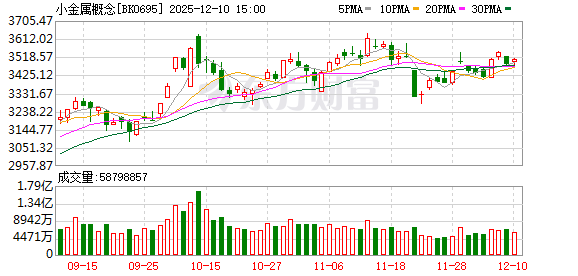
多重因素推动 小金属赛道多品种走强 两路资金大力加仓
Zheng Quan Shi Bao Wang· 2025-12-10 23:58
Core Viewpoint - The small metals sector in A-shares has shown a significant upward trend, with the sector index closing up by 0.79% on December 10, driven by notable price increases in various small metal varieties, particularly tungsten [2][3]. Price Movements - Tungsten prices have surged, with black tungsten concentrate (≥65%) priced at 363,000 yuan/ton, up 153.85% year-to-date; ammonium paratungstate (APT) at 535,000 yuan/ton, up 153.55%; and tungsten powder at 880 yuan/kg, up 178.48%, all reaching historical highs [3][5]. - Other small metals like cobalt and tin have also seen significant price increases, with cobalt averaging 408,000 yuan/ton (up 16.91% since October) and tin futures rising 15.74% since October [3][5]. Factors Driving Price Increases - The price increases are attributed to supply constraints, favorable macroeconomic conditions, and rising downstream demand. Supply-side constraints include strict mining quotas and environmental regulations for tungsten, and slow recovery of tin production in Myanmar [5]. - Macroeconomic factors include strong market expectations for a Federal Reserve interest rate cut, which typically weakens the dollar and supports commodity prices [5]. - Downstream demand is driven by growth in industries such as new energy, semiconductors, and military applications, enhancing the outlook for strategic small metals [5]. Capital Inflows - The small metals sector has seen substantial capital inflows, with a net inflow of 1.732 billion yuan on December 10, ranking high among secondary industries [7]. - Notable companies like Western Materials received a net inflow of 1.274 billion yuan, benefiting from their core supply roles in aerospace and marine engineering [7]. Company Performance - The small metals sector's overall performance has improved, with a total net profit of 13.589 billion yuan in the first three quarters, a year-on-year increase of 41.42% [8]. - Companies like Shenghe Resources and Northern Rare Earth have reported significant profit growth, with increases of 748.07% and 280.27% respectively [8]. Capacity Expansion - Shenghe Resources has disclosed plans for capacity expansion, with its subsidiary's high-performance rare earth polishing powder project progressing as scheduled, expected to be operational by the end of Q1 2026 [9].


小金属价格上行动力强劲,稀有金属ETF(562800)回调蓄势,近2周新增规模同类居首!
Sou Hu Cai Jing· 2025-09-23 05:46
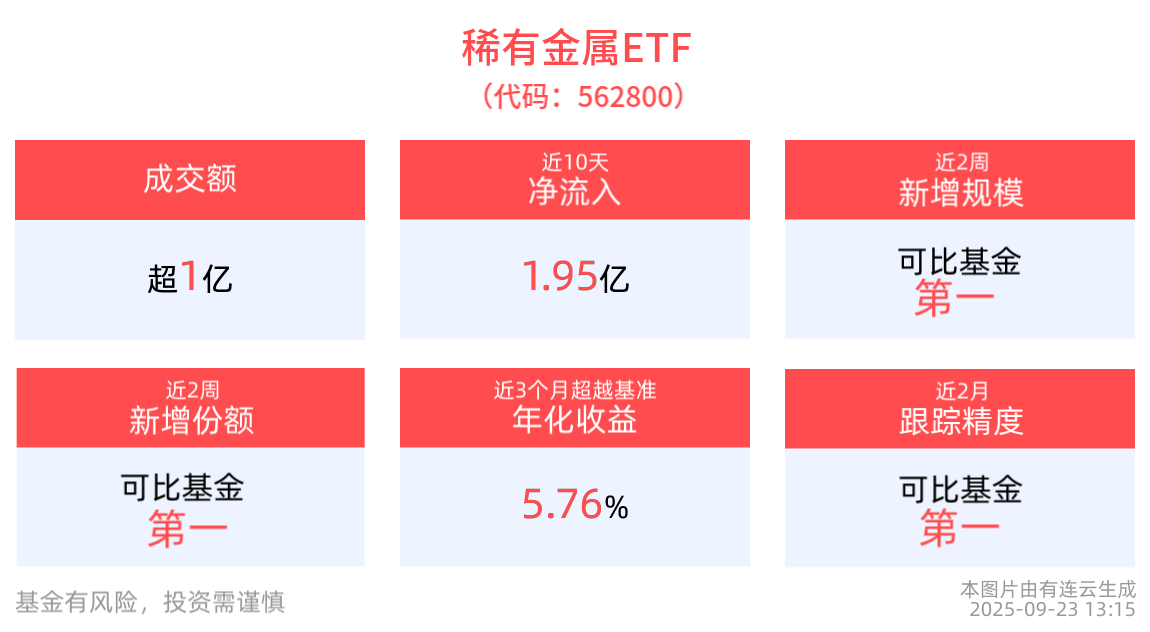
Group 1: Liquidity and Performance of Rare Metal ETFs - The rare metal ETF had an intraday turnover of 4.62%, with a transaction volume of 115 million yuan [1] - Over the past month, the average daily transaction volume of the rare metal ETF reached 218 million yuan, ranking first among comparable funds [1] - In the last two weeks, the rare metal ETF's scale increased by 53.46 million yuan, achieving significant growth and ranking first among comparable funds [1] - The ETF's shares grew by 13 million shares in the last two weeks, also ranking first among comparable funds [1] - In the last ten trading days, the rare metal ETF attracted a total of 195 million yuan in inflows [1] - As of September 22, 2025, the net value of the rare metal ETF increased by 86.19% over the past year [1] - The highest monthly return since inception was 24.02%, with the longest consecutive monthly gains being four months and a maximum increase of 58.56% [1] - The average return during the rising months was 8.77% [1] - The annualized return over the last three months exceeded the benchmark by 5.76% [1] Group 2: Market Dynamics and Policy Impact - The unique resource characteristics of minor metals lead to greater price elasticity, benefiting from high beta during market uptrends [2] - The Democratic Republic of Congo's cobalt export policy, effective September 21, extends the cobalt export ban until October 15, 2025, followed by a quota system [2] - The quota for October to December 2025 is set at 18,125 tons, with a total quota of 96,600 tons for 2026-2027, representing a 56% decrease from the 2024 production levels [2] - The Congolese government's firm pricing stance is expected to compel downstream companies to initiate large-scale inventory replenishment, driving cobalt prices upward [2] - As of August 29, 2025, the top ten weighted stocks in the China Rare Metal Theme Index accounted for 57.58% of the index, including companies like Northern Rare Earth, Luoyang Molybdenum, and Ganfeng Lithium [2] Group 3: Stock Performance Overview - The stock performance of key companies in the rare metals sector showed declines, with Northern Rare Earth down 4.79% and Ganfeng Lithium down 0.76% [4] - Other notable declines included Luoyang Molybdenum at -2.75% and Tianqi Lithium at -3.01% [4] - Investors can also participate in the rare metal sector through the rare metal ETF linked fund (014111) [4]



左手“商品” 右手“股票” 双维度演绎小金属红利
Zhong Guo Zheng Quan Bao· 2025-08-08 22:59
Core Viewpoint - The prices of minor metals such as cobalt, tungsten, antimony, and rare earths have been rising significantly this year, driven by supply changes and increasing demand, leading to strong performance in related A-share stocks [1][2][9]. Price Trends - As of August 8, 2023, the average prices for various minor metals have increased significantly compared to the beginning of the year: - Electrolytic cobalt: 265,000 CNY/ton (+55.43%) - Tungsten oxide: 317,500 CNY/ton (+32.02%) - Antimony ingot: 186,500 CNY/ton (+33.21%) - Molybdenum bar: 490 CNY/kg (+4.48%) - Bismuth: 118,500 CNY/ton (+61.22%) - Praseodymium-neodymium oxide: 521,500 CNY/ton (+31.03%) - Dysprosium oxide: 1,615,000 CNY/ton (+0.13%) - Terbium oxide: 7,020,000 CNY/ton (+25.13%) [2]. Company Performance - The non-ferrous metal sector has shown significant growth, with revenue and net profit for the sector increasing by 8.0% and 65.1% year-on-year in Q1 2025, respectively. Nearly 70% of listed companies in this sector have positive earnings forecasts for the first half of 2025 [3][4]. - Notable companies include: - Northern Rare Earth: Expected net profit growth of over 2000% year-on-year - Shenghe Resources: Expected net profit growth of over 600% year-on-year [3]. Market Performance - The non-ferrous metal sector has outperformed the broader market, with a cumulative increase of 32% this year, compared to the Shanghai Composite Index's 8.45% increase [4]. - Key stocks include Shenghe Resources and Guangsheng Nonferrous, both up over 120%, and several others showing significant gains [4]. Supply and Demand Dynamics - Changes in supply dynamics have been noted, particularly with cobalt, where the Democratic Republic of Congo has extended its export ban, leading to a significant decrease in imports of cobalt intermediate products in China [5][6]. - The global rare earth reserves are dominated by China, which holds 44 million tons, accounting for 40% of the total [6]. Future Demand Projections - The demand for rare earth materials, particularly neodymium-iron-boron magnets, is expected to grow significantly due to the rise of electric vehicles and renewable energy technologies. By 2026, the demand for high-performance neodymium-iron-boron materials is projected to reach 21.1 million tons, with a compound annual growth rate of approximately 14% [8][10]. - The commercialization of humanoid robots is anticipated to further increase demand for neodymium, with projections suggesting a growth rate of 75% from 2024 to 2035 [8]. Price Outlook - Analysts expect the upward price trend for minor metals to continue, driven by persistent demand expansion and supply disruptions. The price of antimony and cobalt is projected to rise due to supply constraints and increasing demand from sectors like electric vehicles [9][10].


左手“商品” 右手“股票”双维度演绎小金属红利
Zhong Guo Zheng Quan Bao· 2025-08-08 21:03
Core Viewpoint - The prices of minor metals such as cobalt, tungsten, antimony, and rare earths have been rising significantly this year, driven by supply changes and increasing demand, leading to strong performance in related A-share stocks [1][2][3] Price Trends - As of August 8, 2023, the average prices for various minor metals have increased significantly compared to the beginning of the year: - Electrolytic cobalt: 265,000 RMB/ton (+55.43%) - Tungsten oxide: 317,500 RMB/ton (+32.02%) - Antimony ingot: 186,500 RMB/ton (+33.21%) - Molybdenum bar: 490 RMB/kg (+4.48%) - Bismuth: 118,500 RMB/ton (+61.22%) - Praseodymium-neodymium oxide: 521,500 RMB/ton (+31.03%) - Dysprosium oxide: 1,615,000 RMB/ton (+0.13%) - Terbium oxide: 7,020,000 RMB/ton (+25.13%) [2] Company Performance - The non-ferrous metal sector has shown significant growth, with revenue and net profit for the first quarter of 2025 increasing by 8.0% and 65.1% year-on-year, respectively [3] - Nearly 70% of the listed companies in the non-ferrous metal sector have positive performance forecasts for the first half of 2025, with notable increases in net profit for companies like Northern Rare Earth and Shenghe Resources [3] Market Dynamics - The non-ferrous metal sector has outperformed the broader market, with an increase of 32% year-to-date, compared to the Shanghai Composite Index's 8.45% rise [4] - The supply-demand dynamics have shifted, particularly with cobalt, where export bans from the Democratic Republic of Congo have led to a significant decrease in imports and a bullish price outlook [5] Demand Drivers - Rare earths are critical for various high-tech applications, including electric vehicles and renewable energy, with projected demand for neodymium-iron-boron materials expected to reach 87,000 tons by 2026 due to the growth of the electric vehicle market [7][8] - The demand for minor metals is expected to continue rising, driven by sectors such as new energy, air conditioning, and consumer electronics, alongside the commercial development of humanoid robots [9] Future Outlook - Analysts predict that the price trends for minor metals will continue upward due to persistent demand expansion and supply disruptions caused by policy changes [9] - The ongoing growth in the electric vehicle sector and other high-performance applications is expected to sustain the demand for rare earth materials, with significant implications for pricing and supply dynamics in the coming years [9]