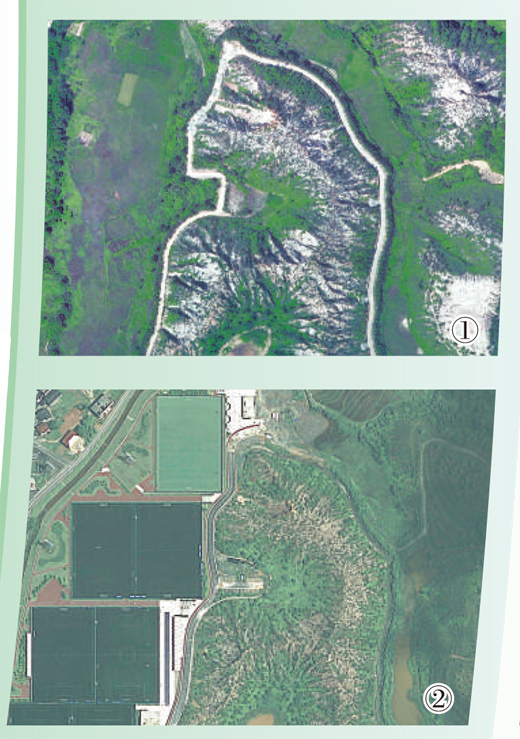
山水林田湖草沙一体化保护和修复工程

Search documents
促生态系统保护修复、明确资金奖补标准 新修订的管理办法公布
Yang Shi Xin Wen· 2026-01-15 03:47
Core Viewpoint - The Ministry of Finance has revised the "Management Measures for Key Ecological Protection and Restoration Funds," clarifying financial support policies for integrated protection and restoration projects during the 14th Five-Year Plan period, specifically for ecological restoration of historically abandoned mines [1][2]. Group 1: Financial Support Policies - The key ecological protection and restoration funds are transfer payment funds arranged by the central government through the general public budget, aimed at integrated protection and restoration of mountains, rivers, forests, fields, lakes, grasslands, and sands, as well as the ecological restoration of historically abandoned mines [1]. - For integrated protection and restoration projects, known as "mountain-water projects," the central financial subsidy ratio has been increased, with a maximum subsidy of 75% for regional projects, capped at 2 billion yuan, and 80% for cross-provincial projects, capped at 2.5 billion yuan [1]. Group 2: Project Eligibility and Restrictions - The central financial subsidy ratio for the ecological restoration of historically abandoned mines is set at 60%, with a maximum subsidy amount of 300 million yuan per project [2]. - The management measures specify that the ecological protection and restoration funds cannot be used for projects with clear restoration responsibility, projects that do not comply with national control requirements such as natural protected areas and ecological protection red lines, or expenditures on superficial landscape projects like squares and sculptures [2].
第三批“山水工程”典型案例公布
Xin Lang Cai Jing· 2026-01-09 09:24
Core Viewpoint - The Ministry of Finance, the Ministry of Natural Resources, and the Ministry of Ecology and Environment have selected 16 exemplary cases of integrated protection and restoration projects for mountains, rivers, forests, fields, lakes, grasslands, and deserts, enhancing ecological protection and restoration efforts nationwide [1][3]. Group 1: Project Characteristics - The selected exemplary cases exhibit diverse types, wide regional representation, and notable highlights, covering various ecological restoration types such as watershed management, desertification control, mining ecological restoration, wetland restoration, forest quality improvement, and biodiversity protection [1][3]. - The cases involve 14 provinces, showcasing practical experiences in ecological protection and restoration under different natural geographical conditions across eastern, central, and western regions of China [1][3]. Group 2: Financial Support and Future Plans - Since 2016, the central government has allocated a total of 103 billion yuan to support local implementation of 52 "mountain-water projects" across six batches [3]. - The central government will continue to support the implementation of "mountain-water projects" during the 14th Five-Year Plan period, promoting a comprehensive management framework from mountains to oceans [3][4].

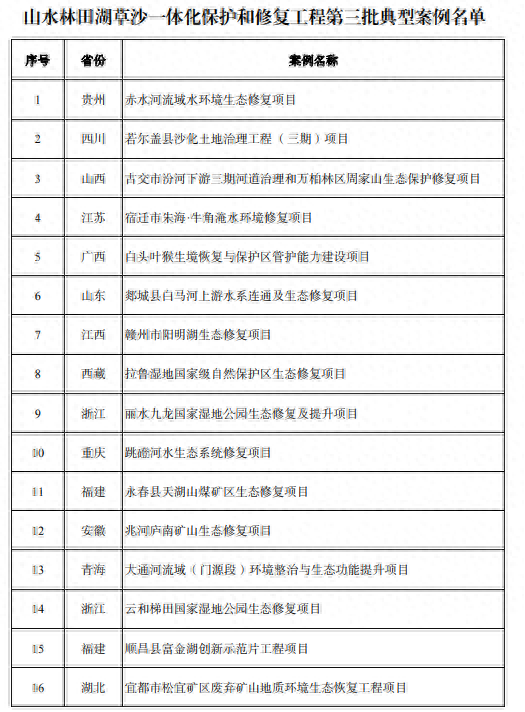
十年磨一剑!“山水工程”交出厚重生态账本 带动区域内村庄振兴、百姓增收
Yang Shi Wang· 2025-10-29 07:21
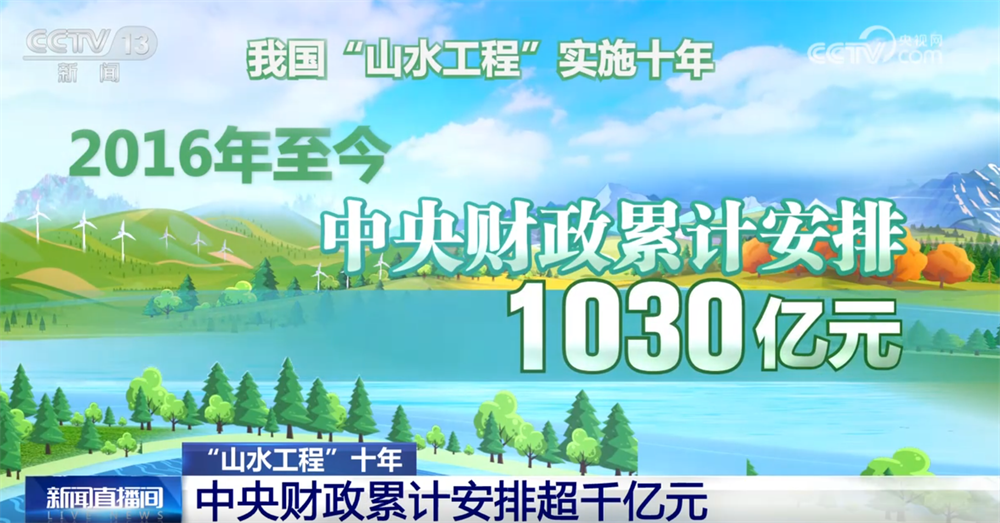
Core Insights - The "Mountain and Water Project" is a significant initiative in China aimed at integrated protection and restoration of ecosystems, reflecting the concept that "mountains, waters, forests, fields, lakes, grass, and sand are a community of life" [1][4] - Over the past decade, the central government has allocated over 103 billion yuan to support ecological and environmental development, implementing 52 projects across 29 provinces, benefiting over 12 million acres of critical ecosystems [1][4] Financial Investment - A total of 1,030 billion yuan has been allocated since 2016, with 500 billion yuan invested during the "13th Five-Year Plan" and 530 billion yuan during the "14th Five-Year Plan" [1] - The investment has focused on key ecological safety barriers such as the Yangtze River and Yellow River [1] Ecological Achievements - The project has led to significant ecological improvements, including the restoration of 4,600 square kilometers of land, 1,000 square kilometers of mining areas, and 3,200 square kilometers of water environments [4] - The project has also contributed to the protection and restoration of 26,100 square kilometers of forests and grasslands, and the management of soil erosion over 13,100 square kilometers [4] Global Recognition - The "Mountain and Water Project" was recognized as one of the first ten flagship projects for global ecological restoration by the United Nations, highlighting its potential as a model for biodiversity protection [7] - The United Nations Environment Programme praised the project as one of the most promising and ambitious large-scale ecological restoration examples worldwide [7] Local Impact - In the Guilin region, the project has transformed previously barren areas into productive agricultural lands, significantly increasing local incomes [8] - The construction of water conservation projects has improved water supply for over 1,000 villagers and 200 acres of farmland [12] Project Completion and Results - There are 83 similar protection and restoration projects along the Li River, with a total investment of 5.491 billion yuan, and 63 projects have been completed, achieving 99.6% of the ecological restoration area [14] - The ecological restoration efforts have led to improved water quality and air quality in Guilin, with rare bird species returning to the area [16] International Awards - The Zhejiang Yunhe Terraced Fields project under the "Mountain and Water Project" received an international award from the Food and Agriculture Organization for best practices in integrated management of land, soil, and water resources [19]
走近山水工程,看我们的地球这样变美(美丽中国·世界地球日特别报道)
Ren Min Ri Bao· 2025-04-21 22:21
Core Viewpoint - The article emphasizes the importance of integrated ecological protection and restoration projects in China, particularly the "Mountain-Water Project," which aims to address ecological issues such as soil erosion, agricultural pollution, and wetland degradation, thereby enhancing the overall health of the environment [8]. Summary by Sections Ecological Restoration Efforts - The "Mountain-Water Project" has implemented 52 projects across 29 provinces, with a total central government funding of 100.65 billion yuan, focusing on comprehensive protection and systematic restoration [8]. - As of the end of 2024, over 8.3 million hectares have been restored, including 2.55 million hectares of forest and grassland, 1.3 million hectares of eroded land, and 107,000 hectares of mined land [8]. Global Recognition - The "Mountain-Water Project" has been recognized as one of the first ten flagship ecological restoration projects by the United Nations and is praised for its ambitious and inspiring scale [8]. Specific Case Studies - In Jiangxi, measures such as afforestation and wastewater treatment have significantly reduced soil erosion and improved water quality, leading to enhanced biodiversity [10][12]. - In Hubei, the adoption of ecological farming practices has decreased the use of chemical fertilizers and pesticides, improving soil quality and agricultural resilience [12]. - In Inner Mongolia, the introduction of social capital for ecological governance has led to improved water quality and biodiversity in the Uliang Lake area [13]. - In Gansu, restoration efforts have enhanced water conservation capabilities and stabilized the ecological community in the Yellow River wetlands [14]. Overall Impact - The projects collectively contribute to a healthier ecosystem, demonstrating China's commitment to environmental stewardship and sustainable development [8].