市场非理性

Search documents
A股冰火两重天!当宽基指数估值超过100倍,该如何选择?
券商中国· 2026-01-17 23:50
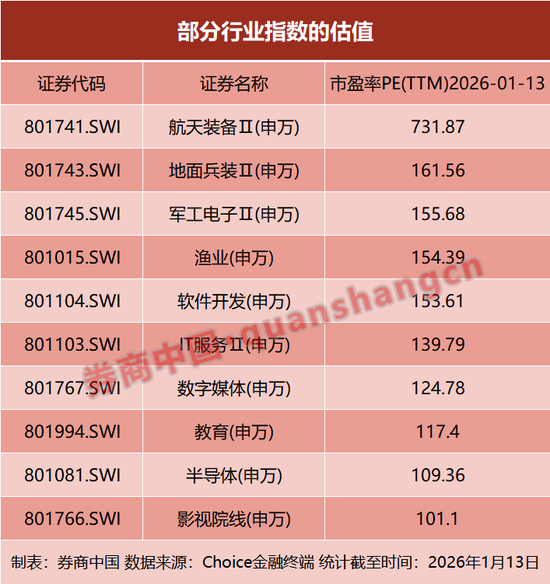
Core Viewpoint - The article emphasizes the current high valuations of certain indices, warning that when broad market indices exceed a price-to-earnings (P/E) ratio of 100, it signals potential market risks and unsustainable conditions [1][5]. Group 1: Market Valuation Insights - Recent indices such as the Sci-Tech 100, Sci-Tech 50, and CSI 2000 have P/E ratios exceeding 150, with the Sci-Tech 100 and Sci-Tech 50 at 217 and 172 respectively, indicating a significant increase in valuations [3][9]. - Historical data shows that when broad market indices like the Nikkei 225 and NASDAQ reached high P/E ratios (over 100), they subsequently experienced substantial declines, highlighting the risks of current market conditions [1][5]. - Despite the high valuations of certain indices, large-cap stocks in A-shares remain undervalued, with P/E ratios below 15 for major indices like the CSI 300 and SSE 50 [1][3]. Group 2: Investment Strategy and Market Behavior - The article suggests a cautious investment approach, advocating for greed when valuations are low (below 10) and fear when they are high (above 100) [2]. - It is noted that 70% of the time, the stock market behaves rationally, with undervalued stocks rising and overvalued stocks falling, but there are periods of irrationality where the opposite occurs [5]. - The article warns that the current market's non-rational behavior is unlikely to last, as historically, high valuations have led to corrections [5][6]. Group 3: Sector-Specific Valuations - Certain sectors exhibit extreme valuations, with some stocks in the aerospace and military sectors showing P/E ratios as high as 731.87, indicating a speculative bubble [8]. - The micro-cap stock index has seen a dramatic increase, with a rise of 3.1 times since February 2024, despite a significant portion of these stocks being unprofitable [3][9].


A股冰火两重天!当宽基指数估值超过100倍,该如何选择?
Xin Lang Cai Jing· 2026-01-17 23:35
Core Viewpoint - The current market shows a significant disparity in valuations, with certain indices exceeding 100 times earnings, indicating potential risks for investors as historical patterns suggest that such high valuations are unsustainable [1][10]. Group 1: Market Valuation Insights - The valuations of the Sci-Tech 100, Sci-Tech 50, and CSI 2000 indices have surpassed 150 times earnings, with the Sci-Tech 100 and Sci-Tech 50 at 217 times and 172 times respectively, and the CSI 2000 at 164 times as of January 13, 2026 [3][10][16]. - Historical data indicates that when broad market indices exceed 100 times earnings, it often leads to significant market corrections, as seen with the Nikkei 225 and Nasdaq indices in previous decades [10][12]. - The current A-share market presents a dichotomy, with large-cap value and dividend indices showing earnings multiples below 10 times, suggesting that these stocks are undervalued compared to the high-flying indices [10][11]. Group 2: Investment Strategy and Market Behavior - Investors are advised to adopt a cautious approach when market valuations exceed 100 times, as this is a signal to be wary of potential downturns [2][10]. - The phenomenon of irrational market behavior is noted, where undervalued stocks may decline further while overvalued stocks can continue to rise temporarily, but such conditions are not sustainable in the long run [12][5]. - The concept of a valuation anchor is emphasized, suggesting that most stocks should ideally be valued around 20 times earnings, which can help investors gauge market temperature [4][11]. Group 3: Sector-Specific Valuations - Certain sectors are experiencing extreme valuations, with some industry indices showing earnings multiples exceeding 100 times, such as aerospace equipment at 731.87 times and military electronics at 155.68 times [8][14]. - The micro-cap stock index has seen substantial growth, with a rise of 3.1 times since February 2024, despite a significant portion of its constituents being loss-making [11][16].