市政基础设施资产管理

Search documents
全国首个!青岛市出台市级市政基础设施资产管理办法
Qi Lu Wan Bao· 2025-12-02 02:01
Core Viewpoint - The Qingdao Municipal Finance Bureau, in collaboration with multiple departments, has issued the "Qingdao Municipal Infrastructure Asset Management Measures (Trial)" to address key challenges in municipal infrastructure asset management, aiming for a clear, actionable, and quantifiable framework [1] Group 1: Key Highlights of the Measures - The Measures consist of 9 chapters and 58 articles, focusing on three main highlights: clarifying management responsibilities, standardizing management processes, and addressing asset transfer challenges [2][3] - A structured management system is established, delineating responsibilities among financial departments, supervisory bodies, construction units, and maintenance units, ensuring each entity performs its designated role [2] - The management process is standardized, with clear approval authority for the entire lifecycle of municipal infrastructure assets, enhancing efficiency in routine disposals while ensuring compliance for significant transactions [2] Group 2: Addressing Challenges - The Measures tackle the longstanding issue of transferring in-progress construction projects by establishing a closed-loop management path, detailing the transfer process, responsible parties, and timelines [3] - The Qingdao Municipal Finance Bureau plans to promote policy implementation and strengthen institutional support through training and policy interpretation, aiming for comprehensive adherence to the Measures [3] - A focus on asset inventory will be emphasized, aiming to achieve a dual clarity on both the physical and value aspects of municipal infrastructure assets, thereby enhancing overall management levels [3]
市政基础设施归谁管?八部门定责
Qi Lu Wan Bao· 2025-12-01 16:22
Core Viewpoint - The Qingdao Municipal Finance Bureau, in collaboration with multiple departments, has issued the "Qingdao Municipal Level Municipal Infrastructure Asset Management Measures" (Trial), marking the first municipal-level asset management guideline in the country, aimed at addressing key challenges in municipal infrastructure asset management [1][2]. Group 1: Key Highlights of the Measures - The measures establish a tiered and categorized asset management system, clarifying responsibilities among the finance department, supervisory departments, construction units, and maintenance units for municipal infrastructure asset management [2]. - The measures specify that the approval for external use and disposal of municipal infrastructure assets is the responsibility of the supervisory departments, enhancing the efficiency of routine disposal while ensuring compliance for significant disposal matters [2]. - The measures address the long-standing issue of transferring in-progress projects by creating a closed-loop management path, detailing the transfer process, responsible parties, and timelines, thereby facilitating asset value accounting and subsequent maintenance [2].
青岛:严禁为没有收益或收益不足的市政基础设施资产违法违规举债
Sou Hu Cai Jing· 2025-12-01 08:40
Core Viewpoint - The Qingdao Municipal Finance Bureau and nine other departments have issued the "Qingdao Municipal Level Municipal Infrastructure Asset Management Measures (Trial)" to regulate the management of municipal infrastructure assets, emphasizing strict adherence to construction approval procedures, funding sources, and budget constraints to prevent government debt risks [1][9]. Summary by Sections General Principles - The measures aim to standardize the management of municipal infrastructure assets to enhance public service functions and urban governance modernization [2]. - Applicable to municipal-level administrative units managing municipal infrastructure assets [2]. - Municipal infrastructure assets are defined as facilities that meet urban residents' needs and promote sustainable urban development, categorized into various types such as transportation, water supply and drainage, energy, sanitation, landscaping, and communication facilities [2][3]. Management Structure - A hierarchical and categorized management system is established, with responsibilities divided among finance departments, industry supervisors, construction units, and management units [3][4]. - Specific departments are designated to manage different types of infrastructure assets, such as the Housing and Urban-Rural Development Bureau for transportation facilities and the Water Management Bureau for water supply facilities [4]. Asset Configuration Management - Funding sources for municipal infrastructure include fiscal allocations, bond funds, and self-raised funds, with construction methods including new builds, renovations, and acquisitions [8][9]. - Strict adherence to construction approval processes and budget constraints is mandated to prevent illegal debt for non-revenue-generating assets [9]. Maintenance and Usage Management - Management units are responsible for the daily maintenance and operational status of municipal infrastructure assets, ensuring they are in normal operating condition [10][11]. - Revenue generated from the use of infrastructure assets must be prioritized for repaying corresponding project bonds and cannot be diverted for other uses [11]. Disposal Management - Disposal methods for municipal infrastructure assets include scrapping, loss write-off, and transfer, with specific conditions outlined for when assets should be disposed of [12][13][14]. Basic Management - Management units must register municipal infrastructure assets promptly and cannot allow off-the-books assets [16][17]. - The process for asset handover from construction units to management units is detailed, ensuring proper documentation and compliance with regulations [19][20]. Information Management - The finance department is tasked with establishing an integrated asset management system to enhance the efficiency and accuracy of municipal infrastructure asset management [21][22]. Asset Reporting - The management of municipal infrastructure assets is included in the annual report of state-owned assets, requiring comprehensive reporting on asset types, values, and management practices [46][49][50]. Supervision and Inspection - The finance department and supervisory bodies can conduct special inspections of municipal infrastructure asset management, with penalties for misconduct [52][53]. Implementation - The measures take effect immediately upon issuance, with provisions for local adaptations based on specific municipal conditions [28][57].
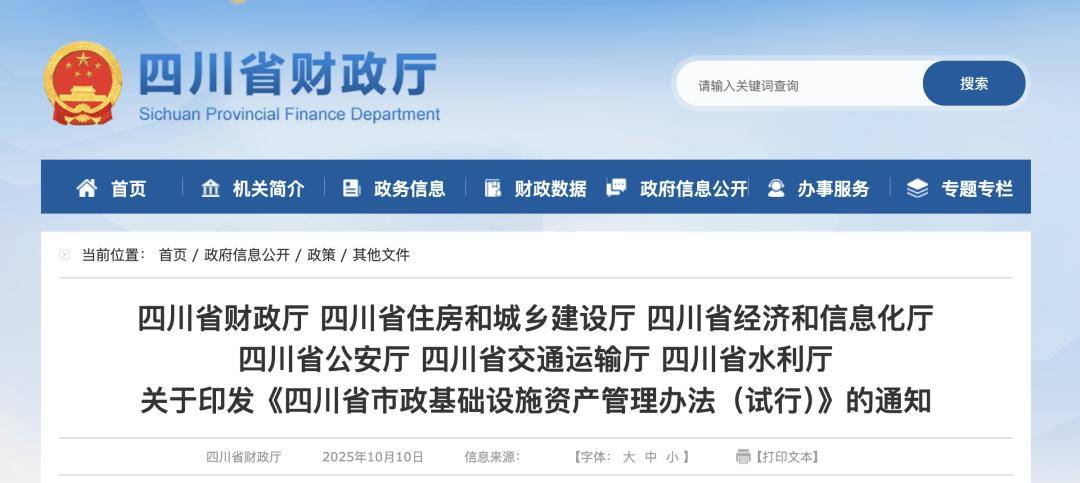
《四川省市政基础设施资产管理办法(试行)》:严禁为没有收益或收益不足的市政基础设施资产违法违规举债,不得增加隐性债务
Sou Hu Cai Jing· 2025-10-14 08:38
Core Viewpoint - The document outlines the "Sichuan Province Municipal Infrastructure Asset Management Measures (Trial)" aimed at standardizing and enhancing the management of municipal infrastructure assets to better serve public needs and ensure sustainable urban development [4][6]. Summary by Sections General Principles - The measures are established based on various regulations, including the "Regulations on the Management of State-owned Assets in Administrative Institutions" and the "Municipal Infrastructure Asset Management Measures (Trial)" [6][8]. - The management of municipal infrastructure assets is categorized by function and characteristics, including transportation, water supply and drainage, energy, sanitation, landscaping, and information communication facilities [9][10]. Management Structure - A hierarchical and categorized management system is implemented, involving fiscal departments, industry supervisors, construction units, and maintenance units, each with defined responsibilities [10][11]. - The fiscal department collaborates with relevant supervisory departments to create a comprehensive management system for municipal infrastructure assets [11][12]. Asset Configuration Management - Asset configuration methods include construction, purchase, transfer, and donation, with funding sources from fiscal allocations, bond funds, and self-raised funds [17][18]. - The supervisory department is responsible for scientifically configuring municipal infrastructure assets based on urban development plans and fiscal capabilities [19]. Maintenance and Usage Management - Maintenance units must establish a responsibility system for asset management, ensuring regular inspections and maintenance to keep assets operational [23][24]. - The supervisory department and maintenance units are tasked with optimizing the utilization of municipal infrastructure assets [24]. Disposal Management - Disposal methods for municipal infrastructure assets include scrapping, loss write-off, transfer, and replacement [25]. - Maintenance units must promptly report assets that need to be scrapped or written off based on specific criteria [26]. Revenue and Expenditure Management - Revenue from asset disposal and usage must be submitted to the treasury after deducting relevant taxes [30][31]. - Expenditures related to the construction, maintenance, and management of assets must comply with budget management regulations [31]. Basic Management - Asset management should be integrated into a dynamic budget management system, with the establishment of an asset information database [28][32]. - Maintenance units are responsible for timely recording and updating asset information to ensure accuracy and completeness [32][34]. Performance Management - A comprehensive performance management system for municipal infrastructure assets is to be established, with regular evaluations and assessments [37][38]. - Performance results will influence budget allocations and funding for new projects [39]. Asset Reporting - The management of municipal infrastructure assets must be included in the annual report of state-owned assets, detailing asset types, values, and management practices [40][41]. - Supervisory departments are responsible for compiling and submitting asset management reports to higher authorities [42][43].