广告即服务

Search documents
ChatGPT“广告即服务”,能改变数字广告格局吗?
3 6 Ke· 2026-02-04 11:02
Core Insights - OpenAI plans to test ChatGPT advertising in the U.S. targeting free users and ChatGPT Plus subscribers, who represent 95% of total users but contribute little to revenue, indicating a survival strategy amid financial pressures [1] - The advertising cost for ChatGPT is set at $60 CPM, significantly higher than Meta's average of under $20 CPM, raising concerns about the feasibility of attracting brands to this untested advertising channel [1][2] - The advertising model aims to leverage real-time user data for targeted ads, but faces skepticism due to high costs and untested effectiveness, leading to a cautious approach from advertisers [4][5] Advertising Challenges - ChatGPT faces a similar challenge to early internet advertising, where convincing brands to shift budgets from traditional media to digital platforms was difficult, compounded by the current high stakes of AI advertising [2] - The platform's ability to provide personalized recommendations based on user interactions could enhance ad effectiveness, but requires extensive training data to avoid errors that could alienate users [4][5] - The current digital advertising landscape is saturated, with established channels still effective, making it harder for ChatGPT to prove its value to advertisers [6][7] Potential Advantages - ChatGPT's advertising model could transform traditional advertising by responding to explicit user needs rather than predicting them, potentially leading to higher conversion rates [9][11] - The integration of ads into user interactions could create a seamless experience, turning advertisements into useful information rather than interruptions [9][10] - OpenAI could develop a comprehensive ecosystem around advertising, enhancing its AI's capabilities through user feedback and data, but this requires significant investment from advertisers [10][12] Future Outlook - While ChatGPT's advertising model presents challenges, it also offers a unique opportunity to redefine advertising logic from attention-based to intent-based, focusing on solving user problems rather than merely capturing attention [11][12] - The success of this model hinges on overcoming existing hurdles and proving its effectiveness to advertisers, which may take time to validate [12]


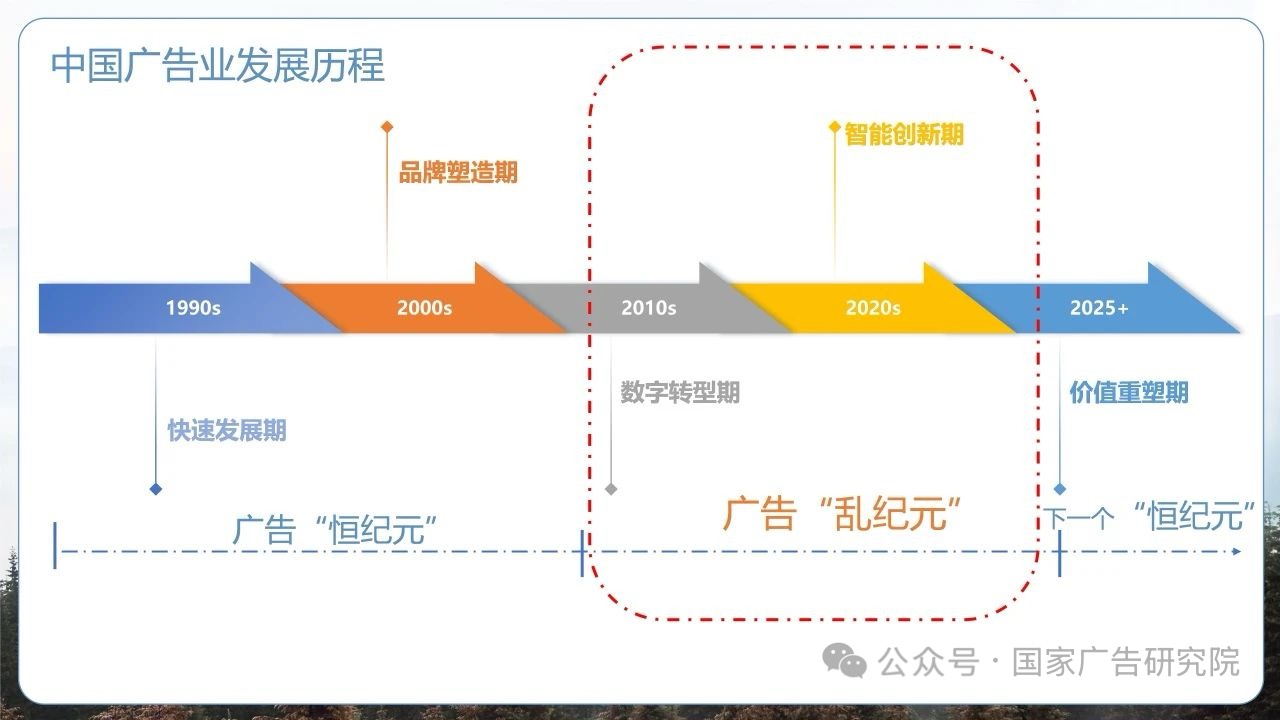
从广告“乱纪元”到下一个“恒纪元”——新质生产力驱动中国广告产业升级
Jing Ji Guan Cha Wang· 2025-07-16 06:58
Core Viewpoint - The Chinese advertising industry is transitioning from a "chaotic era" characterized by rapid changes and uncertainties to a new "constant era" driven by new productive forces, emphasizing the need for strategic repositioning and value reassessment within the industry [1][5][17] Industry Transformation - The advertising industry has undergone significant transformations over the past 20 years, including digitalization, integration, precision, content creation, scenario-based marketing, and intelligence, leading to increased pressure and anxiety among practitioners [3][6] - The transition from traditional advertising to digital and intelligent advertising has resulted in three major shifts: from "place media" to "scene media," from "coverage rate" to "conversion rate," and from "demand instillation" to "community linking" [6] New Driving Forces - The evolution of the advertising industry is driven by three new productive forces: intelligent technology, scenario mentality, and social governance [8] - Intelligent technology, particularly the widespread application of AIGC, enhances creativity, strategy, and efficiency in advertising [8] - Scenario mentality emphasizes the emotional connection between advertising and consumers, focusing on behavior segmentation [8] - Social governance requires the integration of advertising activities with societal governance for deeper brand construction and value transmission [8] Value Restructuring Trends - The advertising industry is experiencing five key trends in value restructuring as it moves towards the next "constant era": 1. Advertising as a Service, integrating user experience and creating value loops [10] 2. Expansion of advertising scenarios through the metaverse and virtual reality technologies [10] 3. Establishment of AI-driven creative decision-making systems, leading to the emergence of "algorithmic creatives" [10] 4. Core competitiveness shifting towards brand social value communication, emphasizing sustainability and cultural identity [10] 5. Evolution towards a platform-based, modular, and collaborative advertising ecosystem [10] Theoretical Innovations - Future advertising theory innovations will focus on three main directions: 1. Transitioning from communication paradigms to systemic ecological paradigms, integrating diverse disciplinary knowledge [12] 2. Shifting from brand communication to brand relationship management, emphasizing long-term emotional connections and trust [12] 3. Extending from advertising ethics to advertising governance, focusing on data security and privacy protection [15]