应用分发

Search documents
AI公司,怎么越来越像NBA了
创业邦· 2025-11-25 05:08
Core Insights - Silicon Valley is experiencing a "talent explosion," with a shift in focus from hardware competition to a race for top talent in AI [5][8] - AI companies are increasingly resembling sports teams, where top-tier talent commands salaries comparable to professional athletes, with some earning billions [8][9] - The competition for talent has become a significant barrier to entry in the AI industry, akin to the luxury tax in the NBA, where only wealthy companies can afford to pay top salaries [12][14] Talent Costs and Market Dynamics - The high salaries for AI talent have led to a "starification" of the industry, where elite researchers are treated as franchise players [7][11] - AI employment agreements are characterized by short-term contracts, leading to high employee mobility and a dynamic talent market [16][17] - The AI sector's talent market is highly volatile, with top researchers frequently moving between companies, creating a "free agent" culture [18][20] Strategic Implications for AI Companies - Companies are shifting from broad talent recruitment to forming specialized teams of top researchers, akin to building a championship sports team [23][24] - The focus on assembling "big three" teams of complementary experts is crucial for achieving breakthroughs in AI [24] - The ultimate competition in AI will extend beyond talent acquisition to establishing data flywheels and application distribution networks, which are essential for long-term success [26][27] Long-term Competitive Advantages - AI companies must prioritize building unique data ecosystems and distribution channels to sustain their competitive edge [29][30] - The reliance on high-cost talent is a temporary strategy; companies need to develop robust systems that do not depend solely on individual researchers [30] - The future of AI companies will hinge on their ability to integrate AI capabilities deeply into industry workflows, creating a sustainable business model [29][30]


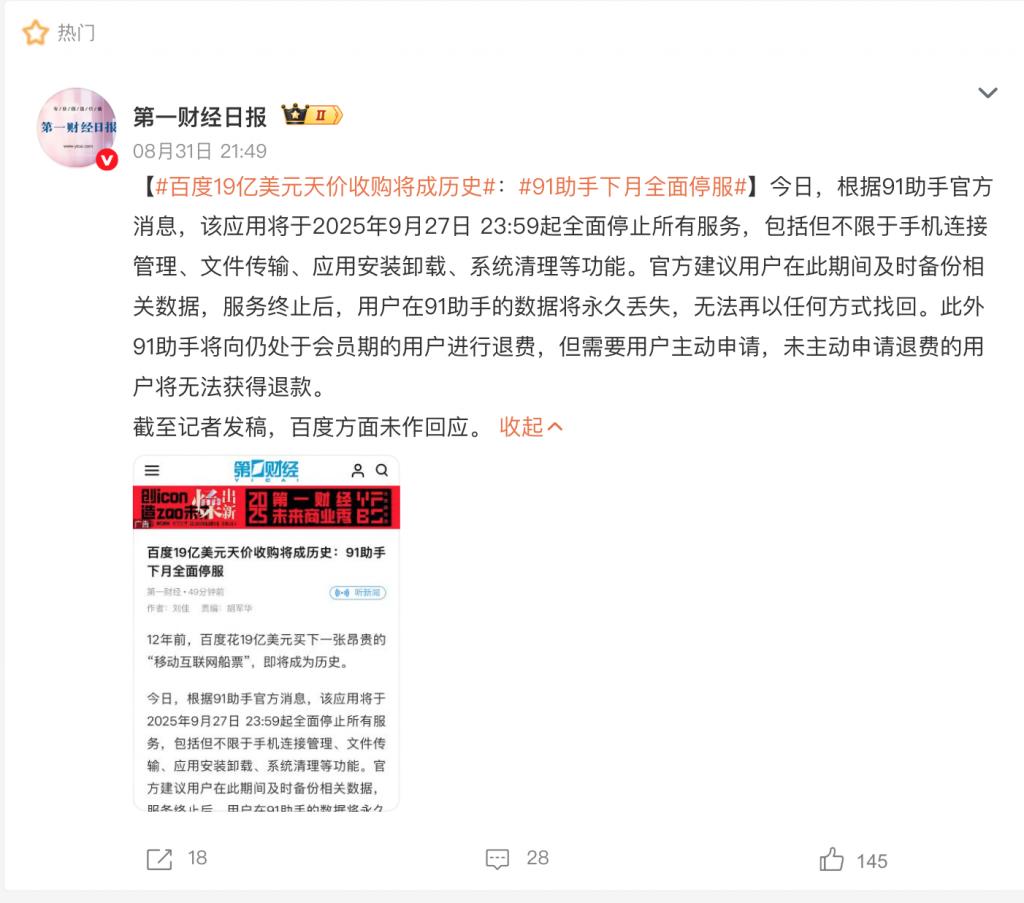
19 亿美元的 91 助手死了,但「手机助手」已经秽土转生
3 6 Ke· 2025-09-01 11:37
Core Insights - The decline of mobile assistant applications, exemplified by the shutdown of 91 Assistant, highlights the obsolescence of once-popular tools in the smartphone ecosystem [1][16][27] - The mobile assistant market, once thriving, has diminished due to the evolution of smartphone technology and user behavior, leading to a shift towards integrated solutions and cloud services [18][21][23] Group 1: Historical Context - Mobile assistants like 91 Assistant, iTools, and others were once essential for managing smartphones, especially in the early days of iOS and Android [4][9][11] - The acquisition of 91 Wireless by Baidu for $1.9 billion in 2013 marked a significant moment in the mobile assistant landscape, but ultimately, the sector did not evolve as expected [11][13] Group 2: Market Dynamics - The rise of cloud services and improved smartphone capabilities reduced the need for desktop-based management tools, leading to a decline in the relevance of mobile assistants [18][21] - Users have shifted towards paying for quality applications, diminishing the appeal of mobile assistants that facilitated piracy and sideloading [20][21] Group 3: Current Landscape - While many mobile assistants have ceased operations, some have adapted, such as Aisi Assistant, which now focuses on providing verification reports for second-hand devices [24][30] - The transition of Coolapk from an app market to a digital community illustrates how some players have successfully pivoted in response to market changes [25][27]