延安作风

Search documents
文化之约 | 回望延安 汲取自我革命的力量
Zhong Yang Ji Wei Guo Jia Jian Wei Wang Zhan· 2026-01-16 00:24
Core Viewpoint - The article reflects on the historical significance of the Yan'an period in the Chinese Communist Party's development, emphasizing the importance of self-revolution and discipline in governance, as well as the need for continuous engagement with the populace to ensure accountability and integrity in leadership [5][10][15]. Group 1: Historical Context - The Yan'an period is characterized by the Communist Party's focus on self-reform and ideological education, particularly through the Yan'an Rectification Movement, which aimed to strengthen party unity and discipline [7][9]. - Mao Zedong's dialogue with Huang Yanpei in 1945 highlighted the necessity for the people to supervise the government, a principle that remains relevant today [5][6]. Group 2: Party Discipline and Education - The article discusses the emphasis on discipline within the party, noting that the establishment of political discipline was crucial for the party's ability to lead effectively [10][12]. - The Yan'an Rectification Movement involved widespread self-criticism and reflection among party members, fostering a culture of accountability and collective responsibility [8][11]. Group 3: Leadership and Governance - Key leaders, including Mao Zedong, Zhu De, and Liu Shaoqi, exemplified the values of hard work and simplicity, which helped to cultivate a strong connection with the masses and build trust [14][15]. - The article highlights the "Ten No's" of the Yan'an period, which served as a moral compass for the party, promoting integrity and self-reliance among its members [14][15]. Group 4: Legacy and Modern Implications - The legacy of the Yan'an period continues to influence the Communist Party's approach to governance, with a focus on innovation, reform, and addressing the needs of the people in contemporary China [16]. - The article concludes by asserting that the principles established during the Yan'an period remain vital for the party's ongoing mission to serve the people and respond to their expectations [16].

学习手记丨共产党人拥有人格力量才能赢得民心
Xin Hua She· 2025-07-01 14:48
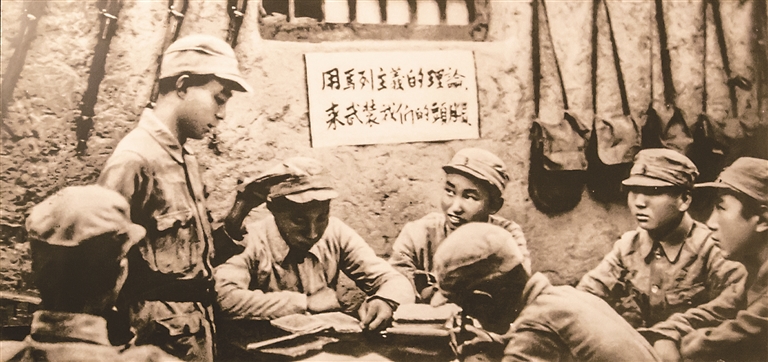
Core Viewpoint - The article emphasizes the importance of both truth and personality power for the Communist Party of China (CPC) to win the hearts of the people, highlighting that strong character and good conduct are essential for gaining public trust [4][5]. Group 1: Historical Context - During the difficult times of the Anti-Japanese War, patriot Chen Jiageng was inspired by Mao Zedong's humble lifestyle in Yan'an, which he believed represented the hope for China [5]. - The "Yan'an spirit" is presented as a clear manifestation of the CPC's personality power, establishing a deep connection with the masses during times of material scarcity [5]. Group 2: Leadership and Conduct - Xi Jinping has consistently advocated for frugality and simplicity in public service, as demonstrated by his practice of serving local delicacies during official receptions to avoid extravagance [6]. - The article notes that small details in conduct reflect a leader's character and the party's image, emphasizing that every action can influence public perception [6]. Group 3: Modern Relevance - The article asserts that contemporary CPC members must harness their personality charm to manage themselves and unite both party and public sentiment, ensuring they live up to their titles and earn the people's praise [7].