开源软件运动

Search documents
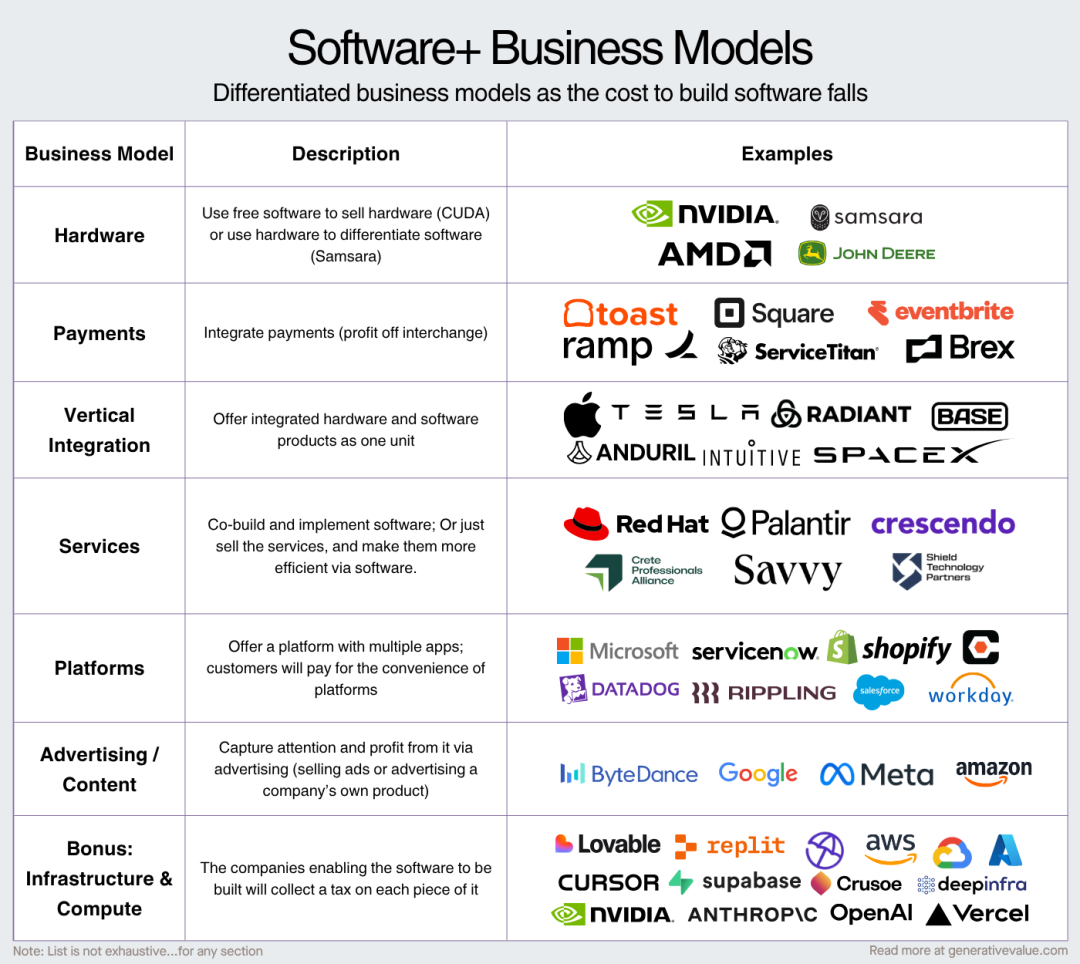
当AI时代软件成本趋于零时,商业模式会有哪些变化?
Hu Xiu· 2025-09-04 00:26
Group 1 - The software business model is undergoing a significant transformation, with AI tools drastically reducing software development costs, leading to a fundamental restructuring of the software industry's commercial logic [1][3][36] - As software creation costs approach zero, traditional software sales models become unsustainable, necessitating differentiation in other areas [1][3][36] - Historical parallels are drawn, indicating that the current shift resembles the free software movement of the 1990s, which began with companies like Red Hat [5][48] Group 2 - The decline in software development costs will impact the distribution of value within the industry, making it harder to create and maintain technological differentiation [3][41] - Companies are likely to adopt various business models, including hardware differentiation, vertical integration, and service-oriented approaches, to adapt to the changing landscape [2][10][12] Group 3 - Hardware is becoming a core differentiator in the new software landscape, with companies like Nvidia successfully using free software to enhance their hardware offerings [7][9] - The trend of vertical integration is expected to rise, allowing companies to control user experiences more effectively and innovate within their sectors [10][12] Group 4 - Service models are evolving, with companies needing to ensure software adoption and optimal usage through human labor integration [13][16] - The payment model is highlighted as a way to integrate software into existing financial infrastructures, allowing companies to profit without charging directly for software [19][20] Group 5 - Platform strategies are gaining importance, as companies seek to provide integrated solutions that simplify user experiences and reduce the management burden of multiple software tools [23][28] - Advertising models are also emerging, where companies leverage software to capture attention and monetize it, similar to Google and Facebook [29][30] Group 6 - The infrastructure model is becoming crucial, as companies providing the foundational services for software development will capture significant value in the AI era [32][34] - The shift towards free software may lead to a dual-track market, where low-risk applications dominate with free models, while high-risk, complex applications retain traditional pricing structures [45][46] Group 7 - The implications of these changes extend to talent needs and organizational structures, requiring companies to build multidisciplinary teams and adapt to new roles [51][53] - Investors and entrepreneurs must rethink traditional metrics for evaluating software companies, as new business models may not align with conventional SaaS indicators [55][59] Group 8 - The future of the software industry will depend on understanding user needs and building sustainable business models, rather than merely focusing on coding skills [60][61] - The barriers to software development are diminishing, allowing more individuals to create software and businesses, which will intensify competition in the market [61][62]


将人文与科创融为一体的“跨界者”——读《谁是斯图尔特·布兰德》
Shang Hai Zheng Quan Bao· 2025-03-30 19:21
《谁是斯图尔特·布兰德》 (美) 约翰·马尔科夫 著 方兴东 孔祥雯 译 浙江科学技术出版社/湛庐 2024年7月出版 ◎王宙洁 在旧金山湾区潮湿的晨雾中,一位年轻人裹紧毛毯坐在屋顶,想象自己的身体飘升到整个湾区上空,脑 海中始终萦绕着这个问题:"为什么我们还没有看到一张整个地球的照片?"这个充满矛盾张力的画面, 恰如其分地勾勒出斯图尔特·布兰德的精神肖像。 作为《全球概览》的创办人、网络论坛WELL的奠基者、生物技术伦理讨论的推动者,布兰德的人生履 历如同一个跨学科的工具箱,始终在科技与自然、乌托邦与现实主义的交汇处探索前行。他以独特的方 式,将这些元素编织成一幅面向未来的图景。 《谁是斯图尔特·布兰德》一书的作者是普利策奖得主约翰·马尔科夫。作为《纽约时报》的资深科技记 者,他凭借对硅谷历史的深刻洞察以及与布兰德本人的长期交往,为读者勾勒出一个复杂而多面的思想 者形象。书中揭示了技术革命背后的思想张力:工具理性与人文主义的碰撞,以及个体如何在时代洪流 中以"无限游戏"的姿态重塑未来。这部作品不仅是一部个人传记,更是一部记录数字时代文化基因变迁 的史诗。 本书试图回答两个关键问题:布兰德的思想何以塑造了今天 ...