强权逻辑

Search documents
俄罗斯乐坏了,普京几十年都没做到的事,特朗普上台一年就干成了
Sou Hu Cai Jing· 2026-01-24 03:11
Core Viewpoint - The article discusses the geopolitical implications of Trump's attempt to buy Greenland, highlighting the use of tariffs as leverage against allies and the resulting tensions within transatlantic relations [1][2][18]. Group 1: Trump's Strategy - Trump's approach combines territorial issues with trade penalties, pressuring Europe to choose between principles and economic benefits [3][11]. - The announcement of additional tariffs on Denmark and other countries, starting at 10% and potentially rising to 25%, is a direct economic tactic to force negotiations over Greenland [2][18]. Group 2: European Response - Denmark and Greenland's leadership firmly state that the future of Greenland is a matter for its people and Denmark, rejecting any external negotiations on sovereignty [5][6]. - The EU supports Denmark's stance against coercive negotiations, emphasizing the importance of maintaining sovereignty and unity among member states [6][11]. Group 3: Internal Divisions in Europe - Despite a unified front in public statements, European countries face internal divisions regarding their reliance on the U.S. for security and trade, complicating their response to U.S. tariffs [8][9]. - The potential for economic repercussions from tariffs creates a dilemma for European nations, balancing principled stances with practical economic interests [11][18]. Group 4: NATO and Global Implications - The erosion of trust within NATO due to U.S. actions could weaken the alliance's cohesion, making it more challenging to present a united front against external threats [13][14]. - Russia benefits from the discord among Western allies, as internal divisions may hinder a unified response to its actions [14][16]. Group 5: Broader Trends - The situation illustrates a trend where countries may prioritize hard tactics over established rules and agreements when faced with national interests, raising concerns about the rise of "power logic" in international relations [16][18].

欧洲民众反对美国威胁得到格陵兰岛
Xin Lang Cai Jing· 2026-01-10 09:09
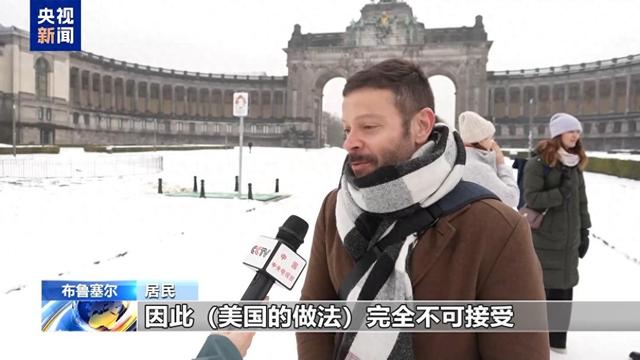
Core Viewpoint - The article discusses the widespread opposition from European citizens and scholars regarding U.S. President Trump's threats to acquire Greenland, emphasizing the importance of respecting international law and national sovereignty [1][3][6]. Group 1: Public Sentiment in Brussels - Residents in Brussels express that the notion of the U.S. claiming another territory is unacceptable, warning of severe consequences if such actions are normalized [1]. - There is a strong belief that international law and national borders must be respected, highlighting a lack of mutual respect in current international relations [3]. - Concerns are raised about the potential for NATO member states to become divided, undermining shared values and security partnerships [5]. Group 2: Public Sentiment in Poland - Polish citizens and scholars voice their worries about U.S. statements, asserting that international law and order should be upheld [7]. - There is a sentiment that any attempt to control Greenland would be seen as interference and an attempt to occupy land that does not belong to the U.S. [9]. - The motivations behind U.S. interest in Greenland are questioned, with some suggesting it is driven by the desire for mineral resources rather than genuine geopolitical concerns [11]. Group 3: Academic Perspectives - Academics in Poland argue that U.S. rhetoric regarding Greenland undermines global order and questions the principles established post-World War II [12]. - European leaders, including those from NATO, have publicly supported Denmark and Greenland's right to self-determination, opposing U.S. interference in Danish internal affairs [12]. - The dependency of Europe on U.S. military and technological support is highlighted, suggesting that the Greenland issue may prompt a reevaluation of this reliance [14].
牛弹琴:全世界要小心了
Xin Lang Cai Jing· 2026-01-07 00:01
Core Viewpoint - The article highlights a significant shift in the global role of the United States, emphasizing a more aggressive and imperialistic approach under the Trump administration, as articulated by White House Chief of Staff Mick Mulvaney [3][5][35]. Group 1: U.S. Global Actions - The U.S. is described as engaging in unprecedented military actions in the Western Hemisphere, particularly the intervention in Venezuela, which is seen as a precursor to further aggressive actions [6][35]. - Trump has issued threats against several countries, including Colombia, Cuba, Mexico, and Iran, indicating a broader strategy of intimidation [7][36]. - The U.S. has expressed a strong interest in Greenland, citing national defense concerns and framing it as a necessary acquisition to counter perceived threats from Russia and China [8][37]. Group 2: Reactions from Allies and Global Implications - The aggressive stance of the U.S. has caused alarm among its allies, with Denmark's Prime Minister warning that any military action against a NATO country would have severe consequences for the alliance [13][42]. - The article notes that the U.S. actions are undermining the post-World War II international order, which was built on principles of sovereignty and mutual respect among nations [14][43]. - A coalition of eight European countries issued a statement asserting Greenland's sovereignty, but the response is characterized as weak and lacking in condemnation of U.S. actions [18][47]. Group 3: Broader Global Context - The article suggests that the greatest threat to NATO is not Russia, but rather the United States itself, as it reasserts its imperial ambitions [22][51]. - The narrative indicates a growing fear among nations that the U.S. may target any country deemed strategically important, leading to a potential escalation of conflicts [21][52]. - The article concludes with a call for nations to be cautious and prepared for a world where U.S. imperialism is a dominant force, suggesting various strategies for response [28][57].