征信修复灰产

Search documents
对信用体系金融市场带来系统性危害
Xin Lang Cai Jing· 2026-02-08 17:26
Core Viewpoint - The existence of the "credit repair" gray industry chain is primarily due to borrowers' lack of understanding of policies and their opportunistic mindset, which may increase compliance costs for financial institutions [1] Group 1: Impact on Financial Institutions - Gray market activities related to "credit repair" lead to distorted credit data, resulting in a surge of credit dispute applications at some banks, forcing them to delay loan approvals or adopt other measures to strengthen risk management, thereby affecting normal credit issuance [1] - The potential systemic risks posed by these activities to the credit system and financial markets are alarming [1] Group 2: Consequences of Gray Market Activities - If gray market practices become widespread, they can obscure genuine default records and distort credit scores, directly interfering with financial institutions' risk assessments [1] - A "cleaned" client may be heavily indebted but misclassified as a high-quality customer by the system, leading to loans exceeding their repayment capacity, which undoubtedly increases the overall bad debt risk in the financial system [1] Group 3: Governance and Regulation - Addressing the gray market of bad credit repair is not only about maintaining financial order but also about safeguarding societal integrity [2] - Future governance should combine both "blocking" and "unblocking" strategies, with a focus on precise strikes and source governance [2] - Multiple departments, including public security, market regulation, and central banks, must collaborate to combat fraudulent activities involving forged materials [2] - Financial institutions need to build defenses and establish models to identify malicious repeated dispute claims while enhancing risk information sharing within the industry [2] Group 4: Public Education and Trust - Strengthening public education is essential, as many individuals seek intermediaries due to a lack of understanding or trust in official channels [2] - Relevant departments should repeatedly promote that no institution has the privilege to delete accurate overdue records [2] - Ultimately, addressing the gray market is about preserving financial order and protecting the precious integrity of every individual, emphasizing the importance of valuing credit [2]
花钱就能“洗白”逾期记录?起底征信修复灰色产业链:商家声称花几千元就可处理小额逾期
Xin Lang Cai Jing· 2026-02-08 00:58
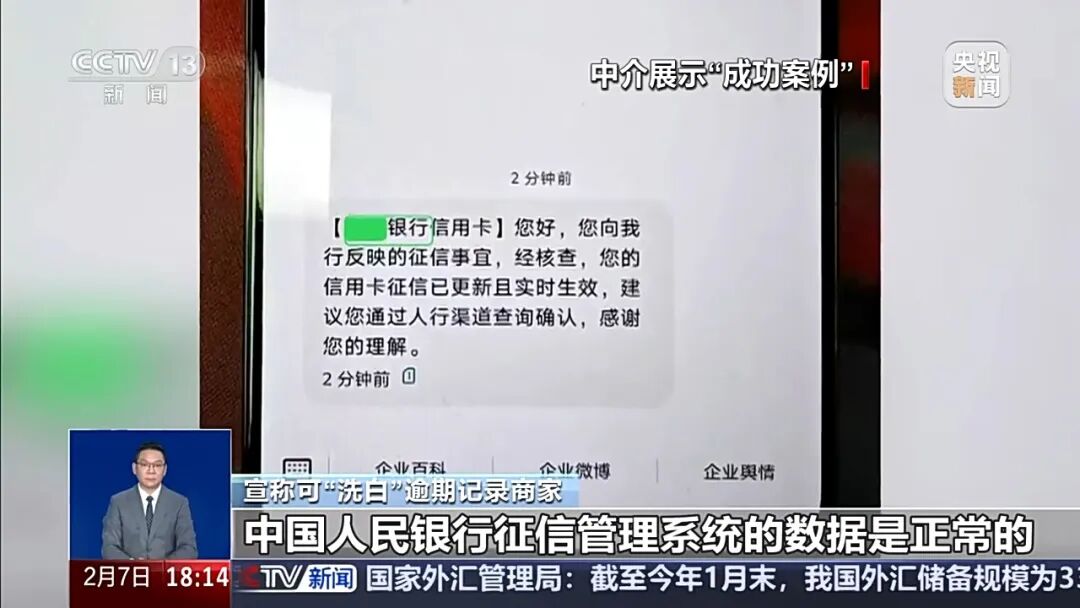
Core Viewpoint - The article discusses the emergence of fraudulent credit repair services in China, exploiting a new policy by the People's Bank of China that allows certain overdue debts under 10,000 yuan to be removed from credit reports after repayment under specific conditions. This has led to a rise in scams where intermediaries falsely claim they can erase overdue records for a fee [1][12]. Group 1: Fraudulent Practices - Numerous intermediaries are advertising services that claim to eliminate overdue credit records, including those over 10,000 yuan, by exploiting "loopholes" in the rules [2][4]. - These businesses often present themselves as legal consultants, misleading consumers into believing they can effectively remove negative credit records [6][11]. - The so-called "credit repair" services often require personal information and charge fees ranging from 5,000 to 8,000 yuan, with an average around 6,000 yuan [8][9]. Group 2: Legal and Ethical Concerns - The article highlights that legitimate credit dispute processes are free and accessible, and that many of these fraudulent services are essentially exploiting the complaint channels of banks and regulatory bodies [12][14]. - Experts warn that engaging with these fraudulent services can lead to legal risks, including potential criminal charges for document forgery or fraud [14][20]. - The fraudulent practices not only mislead individuals but also pose systemic risks to the financial market by distorting credit data and affecting risk assessments by financial institutions [20][21]. Group 3: Regulatory Response and Recommendations - Experts suggest a multi-faceted approach to combat these fraudulent credit repair schemes, including stricter enforcement against fraudulent activities and enhancing public awareness of legitimate credit repair processes [21][23]. - There is a call for collaboration among various regulatory bodies to strengthen the integrity of the credit system and protect consumers from scams [23].