
战略佯攻

Search documents
历史学大佬:特朗普“明抢格陵兰”,是为了“暗度伊朗和乌克兰”
Hua Er Jie Jian Wen· 2026-01-25 02:48
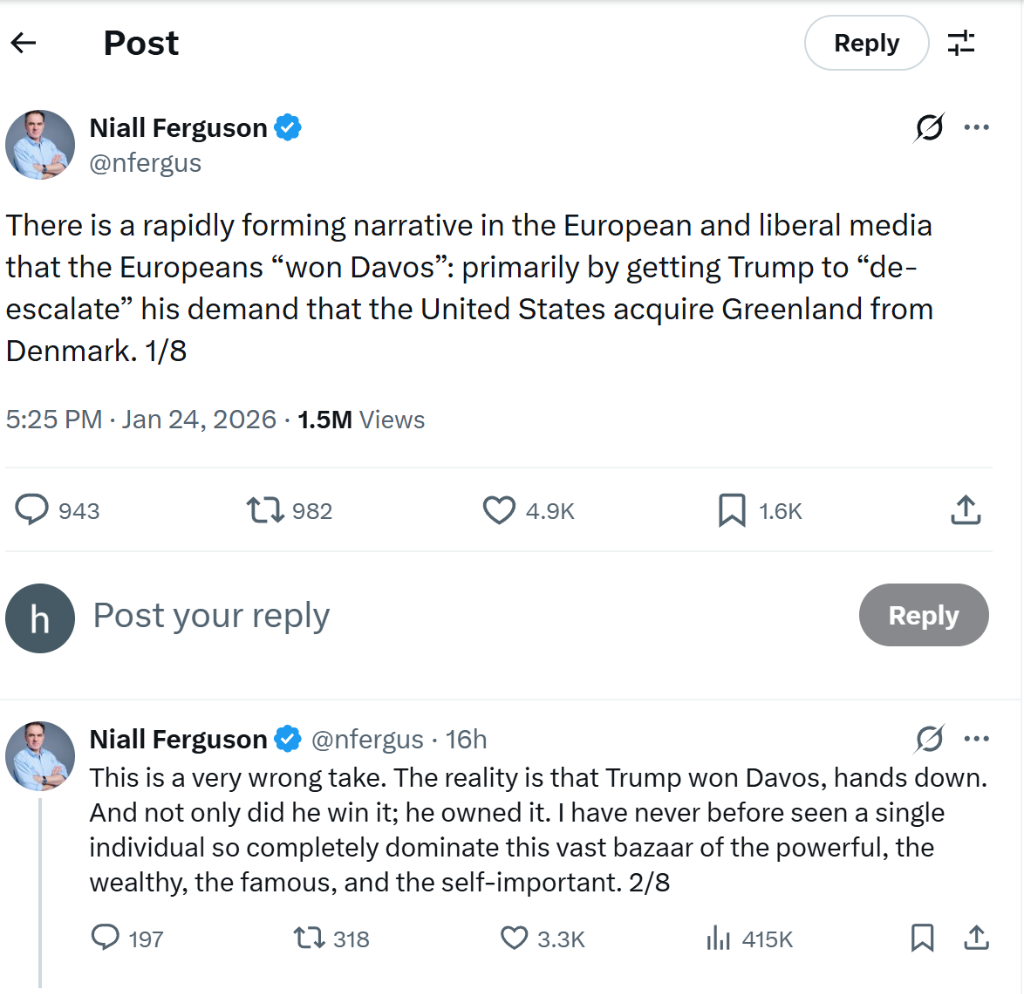
Core Viewpoint - Niall Ferguson argues that Trump's recent focus on the "purchase of Greenland" at the Davos Forum is a strategic diversion aimed at shifting European leaders' attention away from U.S. policies on Iran and Ukraine, indicating a significant geopolitical shift and a deliberate marginalization of traditional European diplomatic influence [1][6]. Group 1: Trump's Strategy - Ferguson suggests that Trump's actions are a classic example of a "strategic diversion," using sensational headlines to obscure real intentions and facilitate U.S. policy agendas in the Middle East and Eastern Europe without interference from European allies [9]. - The narrative that Europeans "won Davos" by getting Trump to de-escalate his Greenland acquisition demand is seen as a misinterpretation; Ferguson asserts that Trump effectively dominated the forum [2][3]. Group 2: Diplomatic Maneuvers - Secret diplomatic efforts are underway, with U.S. envoys Steve Witkoff and Jared Kushner engaging in talks with Russian President Putin regarding the Ukraine conflict, indicating a preference for U.S.-led negotiations without European involvement [6][7]. - Witkoff has expressed optimism that peace negotiations between Russia and Ukraine are nearing completion, with only one key issue remaining, likely related to territorial concessions [7]. Group 3: Military Posture - The U.S. military is ramping up its presence in the Persian Gulf, with the USS Abraham Lincoln carrier strike group moving into the region, signaling a shift from verbal threats to tangible military preparations against Iran [7]. - This military posture aligns with the U.S. strategy of "doing more and saying less" regarding Iran and Ukraine, reflecting a decisive approach to these geopolitical crises [7]. Group 4: Marginalization of Europe - Ferguson highlights the fundamental disagreements between the U.S. and Europe on handling the Iran and Ukraine crises, suggesting that European calls for de-escalation conflict with U.S. military strategies [8]. - By focusing on the Greenland issue, Trump effectively draws European attention away from critical discussions on Iran and Ukraine, allowing U.S. negotiators to operate without European interference [8].

万里“大逃杀”!油轮火线“入籍”俄罗斯,已被美军追了18天
Mei Ri Jing Ji Xin Wen· 2026-01-07 05:51
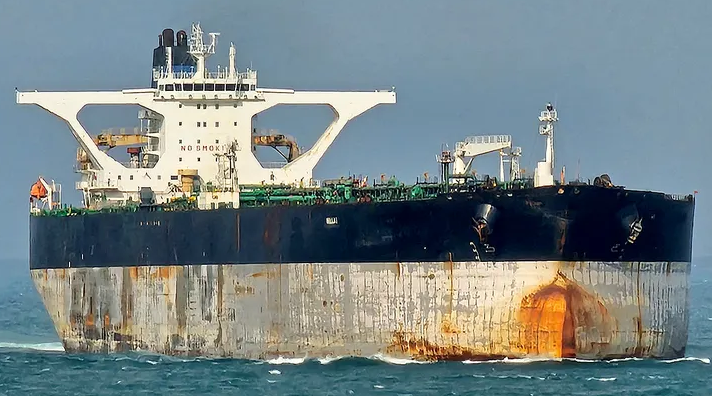
Group 1 - A Russian submarine and naval forces have been deployed to escort an oil tanker that was intercepted by the US military near Venezuela [1] - The tanker, originally named "Bella 1," was renamed "Mariner" and registered under the Russian flag after evading US forces for 18 days [2][4] - The oil tanker was initially intended to load oil in Venezuela but remains empty due to US sanctions and blockades [2][4] Group 2 - The US military has been actively pursuing the tanker, with naval vessels and aircraft from both the US and Ireland involved in monitoring its movements [4][5] - The deployment of significant military assets, including special operations forces and heavy artillery, raises questions about the true intent behind the operation, suggesting a potential strategic diversion [5][7] - US intelligence indicates that the tanker may be carrying portable air defense missiles and possibly crewed by disguised military personnel, necessitating the use of elite forces for engagement [8]
万里“大逃杀”!油轮火线“入籍”俄罗斯,已被美军追了18天,俄方派潜艇等海军护航!美海空军大举出动,为抓油轮还是“声东击西”?
Mei Ri Jing Ji Xin Wen· 2026-01-07 05:48
Core Viewpoint - The article discusses the ongoing pursuit of a Russian-flagged oil tanker, originally named "Bella 1," by the U.S. military, highlighting the geopolitical tensions surrounding oil transportation and military presence in the Caribbean region [1][2][3]. Group 1: Oil Tanker Situation - The oil tanker, now renamed "Mariner," was intercepted by the U.S. Coast Guard while attempting to load oil in Venezuela and has been pursued for 18 days, evading capture [2][3]. - The tanker has changed its registration to Russia and is currently sailing in the Atlantic Ocean, approximately 480 kilometers south of Iceland [2][3]. - The U.S. believes the tanker is part of a "shadow fleet" transporting oil for Russia, Iran, and Venezuela, and it was previously sanctioned for its involvement in Iranian oil transactions [3]. Group 2: U.S. Military Response - The U.S. military has deployed significant resources, including naval vessels and air support, to monitor and pursue the tanker, with reports of close encounters between U.S. forces and the vessel [4][5]. - The involvement of the U.S. Air Force and the deployment of specialized units, such as the 160th Special Operations Aviation Regiment, suggest a high level of military readiness, raising speculation about potential broader military objectives beyond just capturing the tanker [5][8]. - Analysts have drawn parallels between the current military mobilization and past operations, indicating that this could be a strategic maneuver rather than solely focused on the tanker [8].
