
地缘政治变动

Search documents
历史学大佬:特朗普“明抢格陵兰”,是为了“暗度伊朗和乌克兰”
Hua Er Jie Jian Wen· 2026-01-25 02:48
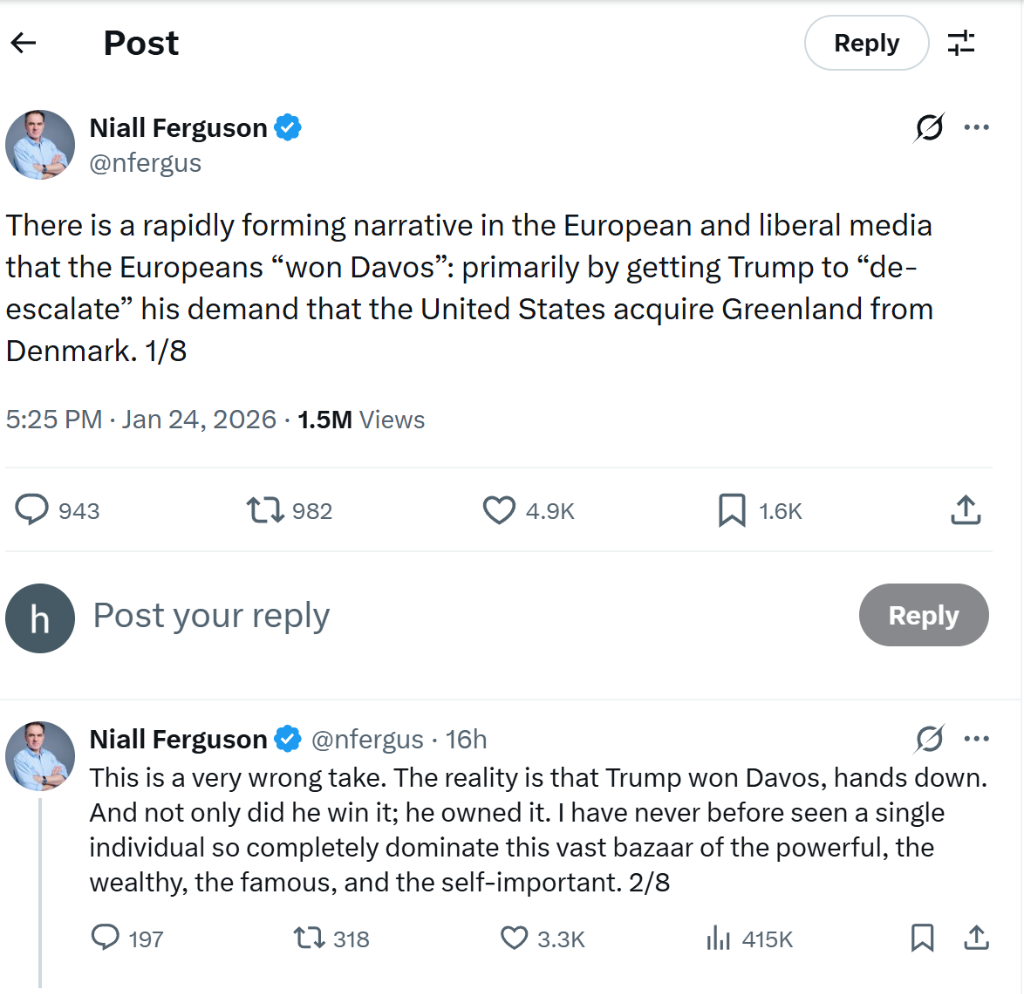
Core Viewpoint - Niall Ferguson argues that Trump's recent focus on the "purchase of Greenland" at the Davos Forum is a strategic diversion aimed at shifting European leaders' attention away from U.S. policies on Iran and Ukraine, indicating a significant geopolitical shift and a deliberate marginalization of traditional European diplomatic influence [1][6]. Group 1: Trump's Strategy - Ferguson suggests that Trump's actions are a classic example of a "strategic diversion," using sensational headlines to obscure real intentions and facilitate U.S. policy agendas in the Middle East and Eastern Europe without interference from European allies [9]. - The narrative that Europeans "won Davos" by getting Trump to de-escalate his Greenland acquisition demand is seen as a misinterpretation; Ferguson asserts that Trump effectively dominated the forum [2][3]. Group 2: Diplomatic Maneuvers - Secret diplomatic efforts are underway, with U.S. envoys Steve Witkoff and Jared Kushner engaging in talks with Russian President Putin regarding the Ukraine conflict, indicating a preference for U.S.-led negotiations without European involvement [6][7]. - Witkoff has expressed optimism that peace negotiations between Russia and Ukraine are nearing completion, with only one key issue remaining, likely related to territorial concessions [7]. Group 3: Military Posture - The U.S. military is ramping up its presence in the Persian Gulf, with the USS Abraham Lincoln carrier strike group moving into the region, signaling a shift from verbal threats to tangible military preparations against Iran [7]. - This military posture aligns with the U.S. strategy of "doing more and saying less" regarding Iran and Ukraine, reflecting a decisive approach to these geopolitical crises [7]. Group 4: Marginalization of Europe - Ferguson highlights the fundamental disagreements between the U.S. and Europe on handling the Iran and Ukraine crises, suggesting that European calls for de-escalation conflict with U.S. military strategies [8]. - By focusing on the Greenland issue, Trump effectively draws European attention away from critical discussions on Iran and Ukraine, allowing U.S. negotiators to operate without European interference [8].

沈建光:人民币汇率形势与前景
Xin Lang Cai Jing· 2026-01-23 07:04
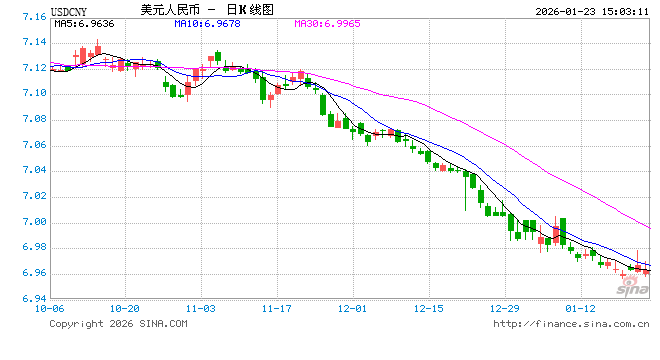
Core Viewpoint - The recent trends in the RMB exchange rate are influenced by multiple internal and external factors, and it is expected that the RMB will not experience significant appreciation in 2026 [2][9]. Group 1: Economic Indicators - The current account balance of China is expected to reach a historical high in 2025, with a trade surplus exceeding $1 trillion for the first time and a current account surplus of $492.8 billion in the first three quarters of 2025, a significant increase from $241.3 billion in the same period of 2024 [3][11]. - The Chinese government has implemented various measures to boost the economy, including allocating 500 billion yuan for local government financial support and investing another 500 billion yuan in new policy financial tools for project construction [3][11]. - The manufacturing PMI in December 2025 reached 50.1, exceeding market expectations, which has improved market confidence in the Chinese economy [3][11]. Group 2: Currency Dynamics - The recent depreciation of the US dollar has positively impacted the RMB exchange rate, with the dollar index declining since late November 2025 due to weak non-farm employment data and concerns over high valuations in the US stock market [3][11]. - The Balassa-Samuelson effect suggests that long-term factors do not support significant appreciation of the RMB, as the growth of labor productivity in China has slowed down in recent years [4][12]. - The average annual growth rate of overall labor productivity in China dropped from 9.5% (2005-2014) to 5.8% (2015-2024), indicating a change in the long-term trend of the RMB exchange rate [5][13]. Group 3: External Factors - Geopolitical changes have negatively impacted China's external demand, with the share of the US market in China's exports declining from 18.8% in 2017 to 11.8% in the first eleven months of 2025 [6][14]. - The importance of non-US markets has increased, with Latin America’s share in China's exports rising from 5.8% in 2017 to 7.9% in 2025 [6][14]. - Maintaining the price competitiveness of Chinese export products in international markets is crucial, as excessive appreciation of the RMB could hinder exports [6][14]. Group 4: Future Outlook - Overall, the RMB is not expected to appreciate significantly in 2026, with the central bank aiming to maintain the exchange rate at a reasonable and balanced level [7][14].
降了!降了!网友:“我刚买,你就跌!”
Sou Hu Cai Jing· 2025-10-23 04:38
Core Viewpoint - The international gold price experienced a significant drop of over 5% on October 21, marking the largest single-day decline in five years, primarily due to profit-taking by investors and easing concerns over international trade tensions [1]. Group 1: Price Movement - On October 21, the international spot gold price fell approximately 5.3% to $4,123.85 per ounce, with an intraday drop of 6.3%, the largest decline in over a decade [1]. - Since late August, gold prices surged from around $3,300 per ounce to over $4,000, driven by geopolitical changes, global economic uncertainty, and actions by central banks [1]. - Year-to-date, international gold prices have increased by about 60% [1]. Group 2: Market Influences - The recent decline in gold prices is attributed to several factors, including profit-taking by investors, a recovery in risk appetite, and reduced concerns over international trade tensions [1]. - Analysts believe that the long-term driving factors behind the recent surge in gold prices remain intact, suggesting a potential recovery in gold prices in the coming months [1].
年内涨约50%!金价为何一路高歌?
Sou Hu Cai Jing· 2025-10-12 19:11
Core Insights - International gold prices have surged over 51% this year, marking 2025 as potentially the year with the highest price increase since 1979 [1][2] - Domestic gold prices have also risen, with brands like Chow Tai Fook reporting prices around 1168 RMB per gram, an increase of 45 RMB since the end of September [1] Price Trends - After an 8-day market closure, gold trading resumed on October 9, with prices on the Shanghai Gold Exchange reaching 911.5 RMB per gram, up over 4.5% from September 30 [1] - The international gold price has increased from approximately 3300 USD per ounce to 4000 USD, a rise of over 20% since late August [1] Contributing Factors - Multiple factors are driving the rise in gold prices, including geopolitical changes, global economic uncertainty, Federal Reserve interest rate cuts, and increased gold purchases by central banks [3] - The recent U.S. government shutdown has heightened concerns over dollar credibility and U.S. sovereign debt, further pushing up gold prices [3] Investment Behavior - There is a noticeable shift in consumer behavior, with physical gold sales showing weakness while investment in gold bars is strong, indicating a market driven by investment rather than consumption [5] - During the recent holiday period, the market saw a higher proportion of out-of-town customers, primarily seeking to allocate assets [6] Future Outlook - Experts suggest that while there is medium to long-term support for gold prices, the rapid short-term increases may exceed expectations, leading to potential volatility [7] - Gold is viewed as a long-term asset allocation tool rather than a short-term speculative investment, emphasizing the need for investors to understand the risks associated with different gold-related products [7]
财经聚焦|年内涨约50%!金价为何一路高歌?
Sou Hu Cai Jing· 2025-10-10 10:03
Core Viewpoint - International gold prices have surged significantly in 2023, with an increase of over 51%, marking it as potentially the largest annual gain since 1979 [1][5][6]. Price Movement - After an 8-day market closure for the National Day and Mid-Autumn Festival, gold prices in Shanghai rose sharply, with AU99.99 closing at 911.5 yuan per gram, up more than 4.5% from September 30 [1][5]. - Domestic gold prices have also increased, with brands like Chow Tai Fook reporting prices around 1168 yuan per gram, a rise of 45 yuan since the end of September [1][5]. Factors Driving Gold Prices - Multiple factors are contributing to the rise in gold prices, including geopolitical changes, global economic uncertainty, Federal Reserve interest rate cuts, and increased gold purchases by central banks [6][7]. - The recent U.S. government shutdown has heightened concerns over the dollar's credibility and U.S. sovereign debt, further pushing up gold prices [7]. Market Dynamics - There is a noticeable shift in consumer behavior, with a decline in gold jewelry sales but a surge in investment in gold bars, indicating a market driven by investment rather than consumption [8][9]. - The gold buyback business has been sluggish during the holiday period, attributed to the lack of signs of price stabilization or a peak [10]. Future Outlook - Experts suggest that while there is medium to long-term support for gold prices, the rapid short-term increases may exceed expectations, indicating potential volatility [15]. - Gold is viewed as a long-term asset allocation tool rather than a short-term speculative investment, emphasizing the need for investors to understand the risks associated with different gold investment products [15].

黄金白银价格均冲高回落后反弹,还能继续涨吗
第一财经· 2025-10-10 05:18
Core Viewpoint - The article discusses the recent volatility in gold and silver prices, highlighting the impact of geopolitical tensions, U.S. government shutdown, and inflation expectations on precious metals markets. It emphasizes the long-term bullish outlook for gold and silver despite short-term fluctuations [3][5][6]. Gold Market Analysis - On October 9, gold prices experienced a dramatic reversal, with COMEX December gold futures reaching nearly $4,078 before dropping to below $3,958, reflecting a daily decline of approximately 2.8% [5]. - The recent surge in gold prices is attributed to the U.S. government entering a technical shutdown and delayed economic data releases, which heightened market anxiety and increased demand for safe-haven assets like gold and Bitcoin [5][6]. - The World Gold Council reported that central banks purchased a total of 415 tons of gold in the first half of 2025, contributing to the upward pressure on gold prices [6][7]. - UBS forecasts that gold prices could rise to $4,200 per ounce in the coming months, driven by fundamental and momentum factors [7]. Silver Market Analysis - Silver prices followed a similar trajectory to gold, with COMEX December silver futures reaching $49.965 before falling to $46.89, marking a daily decline of 4.3% [10]. - The dual logic behind silver's price increase includes its financial attributes benefiting from U.S. monetary policy and its industrial applications, particularly in electronics and renewable energy [10][11]. - Silver has seen a cumulative increase of over 67% since the beginning of the year, the largest gain for the metal since 1979, outpacing gold's approximately 54% increase during the same period [11]. - Analysts caution that silver's smaller market size makes it more susceptible to volatility compared to gold, suggesting that while silver may offer speculative opportunities, gold is better suited for portfolio diversification [11][12].

斯塔默访印,移民问题这根“刺”难拔
Huan Qiu Shi Bao· 2025-10-08 22:48
Group 1 - UK Prime Minister Starmer's visit to India marks his first official trip since taking office, accompanied by a delegation of 125 members, including representatives from UK universities and business leaders [1] - The focus of discussions between Starmer and Indian Prime Minister Modi will include fintech, trade, and defense, with an emphasis on enhancing cooperation in transportation and emerging technologies [1] - The UK-India free trade agreement, signed during Modi's visit to Europe in July, is highlighted as the largest free trade agreement signed by the UK post-Brexit, and Starmer aims to expedite its implementation [1] Group 2 - Immigration issues remain a contentious point in UK-India relations, with Starmer indicating that he will not accommodate requests from businesses to allow more skilled Indian workers into the UK [2] - The free trade agreement will not address visa matters, and the UK government will not be increasing visa availability for Indian workers [2]