
战略备库

Search documents
有色金属周报:电解铝逆势上涨,关键金属首推稀土钨钼
SINOLINK SECURITIES· 2026-03-09 00:24
Group 1: Copper - LME copper price decreased by 3.21% to $12,869.0 per ton, while Shanghai copper fell by 2.76% to ¥101,100 per ton [1] - Domestic copper inventory increased by 8.56% week-on-week, with a year-on-year increase of 20,920 tons [1] - Major cable enterprises' operating rate rose by 33.17 percentage points to 60.90%, indicating a recovery in production [1] Group 2: Aluminum - LME aluminum price increased by 9.22% to $3,431.0 per ton, and Shanghai aluminum rose by 3.69% to ¥24,700 per ton [2] - Domestic aluminum rod inventory was reported at 398,000 tons, showing a trend of first increasing and then decreasing [2] - The operating rate of downstream aluminum processing enterprises increased by 2.5 percentage points to 59.5% [2] Group 3: Precious Metals - COMEX gold price decreased by 2.90% to $5,181.3 per ounce, with SPDR gold holdings dropping by 28.01 tons to 1,073.32 tons [3] - Geopolitical risks influenced the gold market, leading to a strong fluctuation pattern [3] - The 10-year TIPS rose by 0.04 percentage points to 1.80% [3] Group 4: Rare Earths - The price of praseodymium and neodymium oxide decreased by 4.54% this week [4] - The price center has been rising since the beginning of the year, likely related to upcoming supply-side documents for 2024-2025 [4] - The rare earth sector is expected to see a resonance in supply and demand due to ongoing supply reforms and more relaxed export expectations [4] Group 5: Tungsten - Tungsten price increased by 16.72% this week, indicating a strong demand outlook [4] - Recent actions against illegal mining in Ganzhou may support tungsten prices [4] - The priority of tungsten is expected to be high due to increased strategic stockpiling overseas [4] Group 6: Lithium - The average price of lithium carbonate decreased by 3.0% to ¥159,800 per ton, while lithium hydroxide fell by 0.6% to ¥161,000 per ton [4] - Total lithium carbonate production increased to 22,600 tons, reflecting a slight rise [4] - The market is experiencing a strong purchasing intention from downstream material manufacturers despite price declines [4] Group 7: Cobalt - Cobalt price decreased by 1.7% to ¥431,500 per ton, while cobalt intermediate prices saw a slight increase [4] - The supply side remains tight due to slow export progress from the Democratic Republic of Congo [4] - The market is currently in a phase of inventory digestion, with potential upward price movement expected as demand clarifies [4] Group 8: Nickel - LME nickel price decreased by 1.4% to $17,500 per ton, while Shanghai nickel fell by 2.9% to ¥136,300 per ton [4] - Nickel inventory at LME decreased by 0.04 million tons to 287,600 tons [4] - The market is currently constrained by weak demand and high inventory levels, but strong bottom support is noted [4]


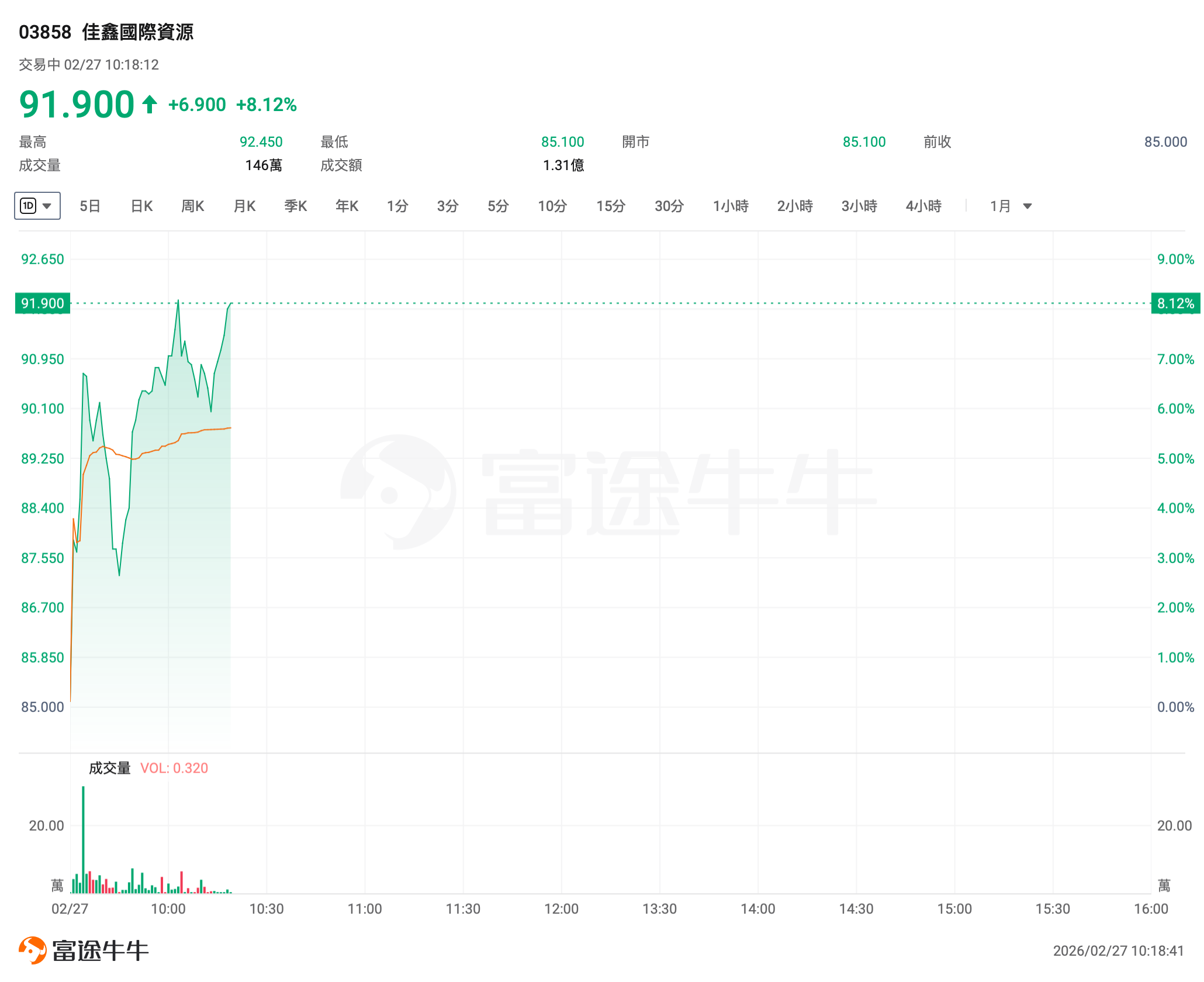
佳鑫国际资源续涨,节后钨企续提长单,海外或延续高备库支撑钨价进一步上行
Zhi Tong Cai Jing· 2026-02-27 04:10
Core Viewpoint - The domestic tungsten market in China has strengthened post-holiday, with leading companies like Zhangyuan Tungsten and Xianglu Tungsten raising long-term prices, reinforcing bullish market expectations and driving the average price of black tungsten concentrate to a record high of 733,500 yuan per standard ton on February 25, marking a year-to-date increase of 61.74% [3] Group 1: Price Movements - The average price of black tungsten concentrate reached a record high of 733,500 yuan per standard ton, with a year-to-date increase of 61.74% [3] - Ammonium paratungstate (APT) prices also rose, recording a year-to-date increase of 61.94% [3] Group 2: Market Dynamics - European tungsten market is experiencing a shortage of downstream inventory, leading to strong price increases during the Spring Festival holiday, contributing to a global price rise in tungsten [3] - Recent proposals from U.S. lawmakers to establish a $2.5 billion "strategic resilience reserve" may elevate tungsten's priority in overseas strategic stockpiling efforts [3] Group 3: Regulatory Environment - China has announced measures to strengthen export controls on dual-use items to Japan, which may impact the tungsten supply chain [3] - U.S. President Trump has proposed increasing the military budget to $1.5 trillion for the fiscal year 2027, potentially sustaining high stockpiling levels overseas and further supporting price increases [3]



有色金属周报:节前市场波动加剧,坚定看好有色牛市
SINOLINK SECURITIES· 2026-02-08 10:24
Investment Rating - The report does not explicitly provide an investment rating for the industry Core Insights - The copper price on LME decreased by 1.65% to $12,855.0 per ton, while the Shanghai copper price fell by 3.45% to ¥100,100 per ton. The copper inventory in major regions increased by 4.03% week-on-week, and total inventory rose by 6,270 tons year-on-year [1][14] - The aluminum price on LME dropped by 3.49% to $3,026.00 per ton, and the Shanghai aluminum price decreased by 5.07% to ¥23,300 per ton. The aluminum processing industry showed a comprehensive operating rate of 57.9%, down by 1.5% week-on-week [2][15] - The gold price on COMEX increased by 6.57% to $4,988.6 per ounce, influenced by geopolitical risks and rising expectations of interest rate cuts [3][16] - The rare earth sector saw a price increase for praseodymium and neodymium oxide by 1.20%, with expectations of improved demand due to relaxed export policies [4][35] - Tungsten prices rose by 11.98% due to tight supply conditions, while tin prices fell by 15.81% amid inventory depletion [4][38] Summary by Sections Copper - LME copper price decreased by 1.65% to $12,855.0 per ton, and Shanghai copper price fell by 3.45% to ¥100,100 per ton. The processing fee index dropped to -$52.37 per ton. Copper inventory increased by 4.03% week-on-week [1][14] - The operating rate of copper cable enterprises was 60.15%, with an increase of 0.69% week-on-week. The industry maintained stable production due to new orders from State Grid [1][14] Aluminum - LME aluminum price decreased by 3.49% to $3,026.00 per ton, and Shanghai aluminum price fell by 5.07% to ¥23,300 per ton. The aluminum processing industry showed a comprehensive operating rate of 57.9%, down by 1.5% week-on-week [2][15] - The operating rate for primary aluminum alloy dropped to 57.9% due to holiday impacts and high aluminum prices [2][15] Precious Metals - COMEX gold price increased by 6.57% to $4,988.6 per ounce, driven by geopolitical risks and expectations of interest rate cuts [3][16] - SPDR gold holdings decreased by 10.87 tons to 1,076.23 tons [3][16] Rare Earths - Praseodymium and neodymium oxide prices increased by 1.20%. December exports of rare earth permanent magnets showed a year-on-year increase of 7% [4][35] - The sector is expected to benefit from relaxed export policies and increased demand [4][36] Tungsten and Tin - Tungsten prices rose by 11.98% due to tight supply conditions, while tin prices fell by 15.81% amid inventory depletion [4][38] - The supply of tin is expected to remain tight due to lower-than-expected production from Indonesia and Myanmar [4][38] Lithium and Cobalt - Lithium carbonate price decreased by 13.3% to ¥148,000 per ton, while lithium hydroxide price fell by 11.6% to ¥150,000 per ton. The total lithium production was 20,700 tons, down slightly [4][53] - Cobalt price decreased by 5.6% to ¥420,000 per ton, with stable prices for cobalt intermediates [5][54]


有色金属周报:美联储主席更替,贵金属波动放大-20260201
SINOLINK SECURITIES· 2026-02-01 14:57
Investment Rating - The report indicates a positive outlook for copper and aluminum sectors, with expectations of stable production and demand recovery in the near term [2][3][13]. Core Insights - Copper prices increased by 3.98% to $13,650.5 per ton on LME, while domestic prices rose by 2.31% to 103,700 CNY per ton. The overall production stability in the copper industry is noted, with a slight decrease in operating rates expected due to seasonal demand fluctuations [2][14]. - Aluminum prices saw a 1.75% increase to $3,229.0 per ton on LME, with domestic prices at 24,600 CNY per ton. The report highlights a seasonal decline in aluminum processing rates, indicating a shift towards the off-peak season [3][15]. - Gold prices surged by 8.58% to $5,410.8 per ounce, driven by geopolitical risks and market volatility. The report emphasizes the impact of U.S. monetary policy on gold prices [4][16]. - The rare earth sector shows a positive trend, with prices for praseodymium and neodymium oxide rising by 11.30%. The report anticipates a favorable demand outlook due to easing export restrictions [5][32][34]. Summary by Sections Copper - LME copper price increased by 3.98% to $13,650.5 per ton, with domestic prices at 103,700 CNY per ton. Copper inventory decreased by 2.24% week-on-week, while total inventory increased by 4.97% year-on-year [2][14]. - The operating rate for copper cable enterprises rose to 59.46%, indicating stable production driven by prior orders [2][14]. Aluminum - LME aluminum price rose by 1.75% to $3,229.0 per ton, with domestic prices at 24,600 CNY per ton. The overall aluminum processing rate recorded a decline to 59.4% [3][15]. - Domestic aluminum oxide production capacity remains high, but the operating rate decreased by 1.66% to 77.31% [3][15]. Precious Metals - Gold prices increased significantly due to geopolitical tensions, with a notable rise in SPDR gold holdings remaining stable at 1,086.53 tons [4][16]. - The report discusses the implications of U.S. monetary policy on gold price fluctuations, particularly in light of recent geopolitical developments [4][16]. Rare Earths - The price of praseodymium and neodymium oxide rose to 748,700 CNY per ton, reflecting a strong demand outlook. The report notes a 7% year-on-year increase in rare earth permanent magnet exports [5][32][34]. - The report suggests that the rare earth sector is poised for growth, driven by easing export restrictions and increased global demand [5][32][34]. Tungsten - Tungsten prices increased by 12.99%, with strategic reserves being a focus in the U.S. market, indicating a potential for continued price support [5][36]. Tin - Tin prices showed a slight decrease of 0.03%, but the report maintains a positive long-term outlook due to supply constraints from Indonesia and Myanmar [5][37]. Lithium - Lithium carbonate prices increased by 7.15% to 171,000 CNY per ton, with production slightly declining. The report highlights a robust demand outlook despite recent price fluctuations [5][57]. Cobalt - Cobalt prices increased by 1.8% to 445,000 CNY per ton, with supply constraints expected to support price stability in the near term [5][58].
港股异动 | 佳鑫国际资源(03858)涨超4%再创新高 钨市场供需紧张 钨价中枢有望稳步抬升
智通财经网· 2026-01-27 02:03
Core Viewpoint - Jaxin International Resources (03858) has seen its stock price rise over 4%, reaching a new high since its listing, with a current price of 87.8 HKD and a trading volume of 35.04 million HKD [1] Group 1: Market Conditions - As of January 26, tungsten concentrate prices are approaching 550,000 RMB per ton, ammonium paratungstate prices have surpassed 800,000 RMB per ton, and tungsten powder prices have exceeded 1,300,000 RMB per ton [1] - The supply of tungsten remains tight due to the lack of indicators being issued and a recent clearance of scrap tungsten before the holiday, which has strengthened price support [1] Group 2: Strategic Developments - Recent proposals from U.S. bipartisan lawmakers to establish a "Strategic Resilience Reserve" with a scale of 2.5 billion USD may increase the priority of tungsten in overseas strategic stockpiling [1] Group 3: Company Positioning - First Shanghai indicates that the company is a rare pure tungsten mining target in the market, with its current stock price offering high safety margins and attractiveness [1] - CICC's research report highlights the company's focus on the Bakuta tungsten mine in Kazakhstan, expressing strong confidence in the company due to the expected tight global tungsten supply-demand balance and the potential for steady price increases [1] - The company is positioned to become a leading player in the mining industry in Central Asia, supported by four core advantages [1]
再推-钨-价格更高看一眼
2026-01-13 05:39
Summary of Tungsten Market Insights Industry Overview - The tungsten market is significantly influenced by military demand expansion and strategic stockpiling, with historical precedence showing tungsten prices surpassing gold during wartime [1][2] - Current U.S. military budget increases are driving global strategic tungsten stockpiling, directly boosting procurement demand, particularly in military applications where tungsten accounts for approximately 10%-15% of usage [2] Key Insights and Arguments - Global tungsten inventory is at a low level, and China's export controls are contributing to rising tungsten prices domestically and internationally [1] - The primary driver for tungsten price increases before Q4 2025 is expected to be supply reduction and overseas stockpiling, a trend anticipated to continue and amplify [1][4] - Post-Q4 2025, civilian demand is projected to significantly contribute to tungsten price increases, with successful price hikes from tool manufacturers addressing profit issues in processing despite rising ore prices [4] - The expected decline in domestic tungsten production in 2026, alongside a slight increase in overseas production, will keep overall supply growth restrained at about 2%-3% [5] Market Dynamics - December PMI data exceeded expectations, reaching above 50, indicating strong growth in end products like CNC machine tools and excavators, which could lead to substantial growth in civilian demand for tungsten [5] - Historical annual growth rates for China's hard alloy production between 2016-2018 and 2020-2022 were between 10%-20%, suggesting a potential continuation of this trend [5] Investment Opportunities - Current tungsten concentrate prices are around 450,000 CNY per ton, with many related stocks still valued at low levels [3][6] - Downstream stocks typically have valuations under 15 times earnings, while midstream stocks are around 20 times, with companies like Jiaxing International, Xinjin Road, and Beijete showing even lower valuations, indicating significant investment potential [3][6] - Given the tight supply-demand situation and market expectations, these companies are positioned for substantial returns, making them important long-term investment choices [6]
汽车涂料龙头“命悬一线”
Hu Xiu· 2025-08-22 23:49
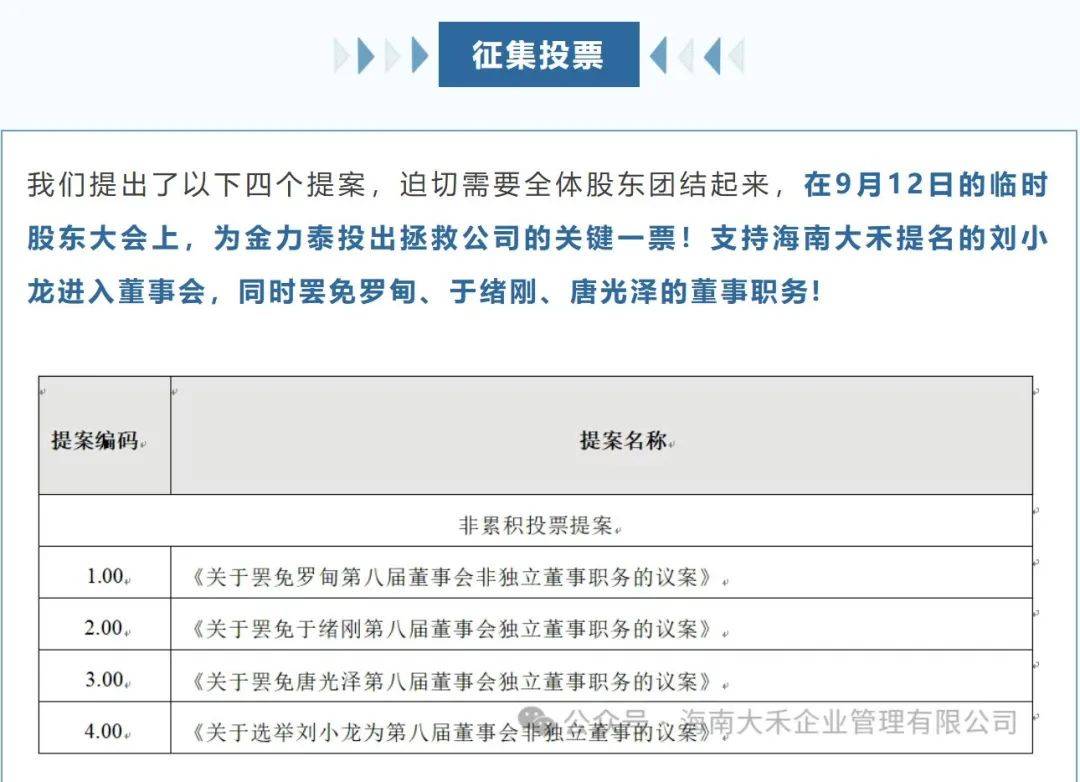
Group 1 - The largest shareholder of Jinlitai, Hainan Dahe, is seeking support from all shareholders to remove three directors and elect a new one due to concerns over the company's management and potential delisting risks [1][2][3] - Hainan Dahe has publicly stated that Jinlitai is at high risk of delisting and accused the current board of misappropriating company funds [3][4] - There are ongoing disputes within the company regarding the management's responses to inquiries, with significant disagreements among board members [4][14] Group 2 - Jinlitai's 2024 annual report revealed an audit report with no opinion, indicating internal issues and prompting regulatory scrutiny over potential non-operational fund occupation [7][8] - The company has been accused of transferring funds under the guise of a "strategic reserve," which may involve significant risks of fund misappropriation [10][13] - The audit committee has expressed that the strategic reserve actions do not align with normal procurement practices and should be classified as non-operational fund occupation [15] Group 3 - There are allegations of "false repayments" related to transactions with two entities, raising questions about the legitimacy of the funds' flow [18][20] - The audit committee suspects that repayments from one entity may have returned to the original fund provider, indicating potential financial manipulation [22][24] - Jinlitai's management has denied any wrongdoing, asserting that the transactions were legitimate despite the concerns raised by board members [21][22] Group 4 - The actual control of Jinlitai is under scrutiny, with claims that a mysterious individual, Pei Jian, may be the real controller behind the scenes [25][30] - There are connections between Pei Jian and a trading company accused of fund misappropriation, suggesting a complex web of control and influence [32][41] - Internal sources indicate that Pei Jian has significant influence over the company's operations, despite the official stance that there is no actual controller [41][42]

采购仅4000万竟预付10多亿,*ST金泰16亿资金被疑占用
Di Yi Cai Jing· 2025-08-14 08:37
Core Viewpoint - *ST Jintai is facing scrutiny over nearly 1.5 billion yuan in abnormal fund flows, with significant discrepancies between the funds paid to suppliers and actual procurement needs, raising concerns about potential non-operational fund occupation and mismanagement [1][3][10] Group 1: Abnormal Fund Flows - In 2024, *ST Jintai reported nearly 1.5 billion yuan in abnormal fund flows, including over 900 million yuan for "strategic inventory" and 460 million yuan in equity investment payments [3][4] - The company disclosed that the actual procurement amount was only about 29 million yuan, indicating a severe mismatch between funds transferred and actual purchases [3][4] - The strategic inventory funds were transferred to suppliers, who then moved the funds to non-supplier entities, suggesting potential misuse of funds [3][6] Group 2: Strategic Inventory Practices - The company initiated a "strategic inventory" strategy to mitigate raw material price risks, but the audit committee found that this practice no longer aligned with normal procurement principles [2][7] - The actual procurement conversion rate from strategic inventory was less than 4%, with significant costs incurred from fund occupation [3][6] - The strategic inventory suppliers, particularly Rui Nai and Yue Rui, accounted for over 85% of the payments in 2024, indicating a concentrated risk in supplier relationships [6][8] Group 3: Equity Investment Transactions - The company engaged in two equity transactions involving Yitai Ji, with a total of 460 million yuan in payments, raising questions about the true purpose and flow of these funds [4][10] - The audit committee suggested that the funds for these transactions were linked to the strategic inventory, indicating potential non-operational fund occupation [10][11] - Concerns were raised about the flow of funds from related parties, with allegations of a closed-loop system that could lead to asset misappropriation [11][12] Group 4: Governance and Internal Disputes - Three board members opposed the company's responses to regulatory inquiries, citing concerns over management's handling of funds and potential collusion with actual controllers [1][8] - The audit committee highlighted discrepancies in the company's disclosures regarding supplier relationships and fund flows, suggesting a lack of transparency [7][8] - The company claimed no controlling shareholder exists, despite evidence suggesting that key suppliers are linked to the same controlling entity [8][12]
采购仅4000万竟预付10多亿!*ST金泰16亿资金被疑占用
第一财经· 2025-08-14 08:18
Core Viewpoint - *ST Jintai is facing scrutiny over nearly 1.5 billion yuan in abnormal fund flows, with significant discrepancies between procurement needs and actual expenditures, raising concerns about potential non-operational fund occupation and mismanagement [3][7][11]. Group 1: Abnormal Fund Flows - In 2024, *ST Jintai reported nearly 1.5 billion yuan in abnormal fund flows, including over 900 million yuan for "strategic inventory" and 460 million yuan in equity investments [7][8]. - The company engaged in a "seasonal transfer" of funds, with 9.31 billion yuan transferred out and the same amount returned, while actual procurement amounted to only about 29 million yuan, indicating a severe mismatch [7][10]. - The strategic inventory funds were primarily funneled through suppliers like Ruinai and Yue Rui, which received over 85% of the total payments in 2024 [10][11]. Group 2: Strategic Inventory Practices - The strategic inventory initiative, started in 2022, aimed to secure raw material supply and lock in prices, but the actual procurement ratio has drastically declined from 78.12% in 2022 to just 3.18% in 2024 [10][11]. - The cost of capital for these strategic inventory practices has increased significantly, with costs rising from 136.26 thousand yuan in 2022 to 756.05 thousand yuan in 2024 [10][11]. - The audit committee expressed concerns that the strategic inventory behavior in 2024 did not align with normal procurement practices and was likely aimed at manipulating financial reports [4][5][11]. Group 3: Equity Investment Anomalies - The company made two significant equity investments in Shenzhen Yitai Technology Co., totaling 460 million yuan, with unclear final destinations for these funds [3][8][16]. - The audit committee noted that the funds from these equity transactions appeared to be funneled back into the strategic inventory, suggesting a potential cycle of non-operational fund occupation [16][17]. - There are allegations that the funds from these transactions were used to mask the true financial state of the company, with claims of collusion among various parties involved [17][18].

采购4000来万预付10多亿,股权款流向配资公司,*ST金泰16亿资金被疑占用
Di Yi Cai Jing Zi Xun· 2025-08-14 05:39
Core Viewpoint - *ST Jintai is facing scrutiny over nearly 1.5 billion yuan in abnormal fund flows, with significant discrepancies between procurement needs and actual expenditures, raising concerns about potential non-operational fund occupation and mismanagement [1][3][10]. Group 1: Abnormal Fund Flows - In 2024, *ST Jintai reported nearly 1.5 billion yuan in abnormal fund flows, including over 900 million yuan for "strategic reserve funds" and 460 million yuan in equity investment payments [3][4]. - The company engaged in a "seasonal transfer" of funds, where 9.31 billion yuan was transferred out and 9.3 billion yuan was returned, but actual procurement amounted to only about 29 million yuan, indicating a severe mismatch [3][4]. - The strategic reserve funds were primarily funneled through suppliers like Ruinai and Yue Rui, with over 85% of the payments in 2024 going to these two entities [6][8]. Group 2: Strategic Reserve Practices - The strategic reserve practice, initiated in 2022 to mitigate raw material price risks, has seen a drastic decline in actual procurement rates, dropping from 78.12% in 2022 to just 3.18% in 2024 [6][7]. - The cost of capital associated with these strategic reserves has increased significantly, with costs rising from 136.26 million yuan in 2022 to 756.05 million yuan in 2024 [6][7]. Group 3: Equity Transactions and Fund Flow - The company’s equity transactions involving Yitai Ji raised questions about the flow of funds, with 1.38 billion yuan received from a buyback and 3.23 billion yuan paid for a subsequent acquisition, both linked to the strategic reserve funds [10][11]. - The audit committee expressed concerns that the funds used for these transactions may constitute non-operational fund occupation, as they were sourced from the strategic reserve [11][12]. - Allegations have been made regarding the potential collusion among management and external parties to misappropriate company assets through these transactions [12].