房地产去杠杆

Search documents
中国地产:“三道红线” 或边际放松,但短期难重启投资加杠杆-China Property Three Red Lines to Ease but Unlikely to Leverage Up for Investment in ST
2026-01-30 03:14
Summary of China Property Sector Conference Call Industry Overview - **Industry**: China Property Sector - **Key Policies**: Easing of "three red lines" regulations, aimed at limiting debt and encouraging deleveraging in the property sector [1][2] Core Insights and Arguments 1. **Easing of Regulations**: The removal of the "three red lines" indicates a shift in policy, allowing property firms to operate without stringent debt reporting requirements [1] 2. **Policy Changes**: - PBOC reduced downpayment for commercial property from 50% to 30% [1] - MOF extended income tax refund for home sellers purchasing another home within one year until December 2027 [1] - VAT reduced to 3% for homes sold within two years of purchase [1] - Local governments in cities like Beijing, Shanghai, and Nanjing have introduced supportive measures [1] 3. **Limited Impact on Investment**: Despite the easing of regulations, it is unlikely that firms will significantly increase leverage due to ongoing debt restructuring and compliance requirements for state-owned enterprises [2] 4. **Market Sentiment**: The policy changes may signal that the deleveraging process in the property sector has been largely achieved, potentially improving market sentiment [2] Transaction Trends 1. **Secondary Transactions**: - Improved secondary transaction volume to 25.6k units in recent weeks, above the average of 24k units in late 2025 [3] - Year-over-year increase of 19% in secondary sales for the week ending January 25, 2026 [3] 2. **New Home Sales**: - New home sales increased by 15% week-over-week but are down approximately 30% year-over-year [4] - The decline in primary sales is expected to continue into Q1 2026 due to last year's high base [4] 3. **Sales Validation**: The current sales trends are not yet indicative of a sustainable recovery, with potential for a short-lived rebound driven by policy changes [5] Market Performance and Expectations 1. **Stock Performance**: The sector's share price gains in January reflect positive expectations from policy changes, but this rebound may be temporary due to weak sales and declining prices in major cities [5] 2. **Profit Downgrades**: Anticipation of profit downgrades in the upcoming reporting season, particularly for well-known companies in the sector [5] 3. **Luxury Retail**: Luxury mall retail maintained positive same-store sales growth in Q4, but December performance decelerated [5] Additional Insights 1. **Secondary Listings**: A slight decrease in secondary listings, down 1.4% month-over-month to 4.57 million units [3] 2. **Policy Support**: A summary of supportive policies indicates a focus on stabilizing the property market and managing expectations [16] This summary encapsulates the key points discussed in the conference call regarding the current state and outlook of the China property sector, highlighting both the regulatory environment and market dynamics.
高盛 | 中国房价何时止跌
Xin Lang Cai Jing· 2025-12-30 03:38
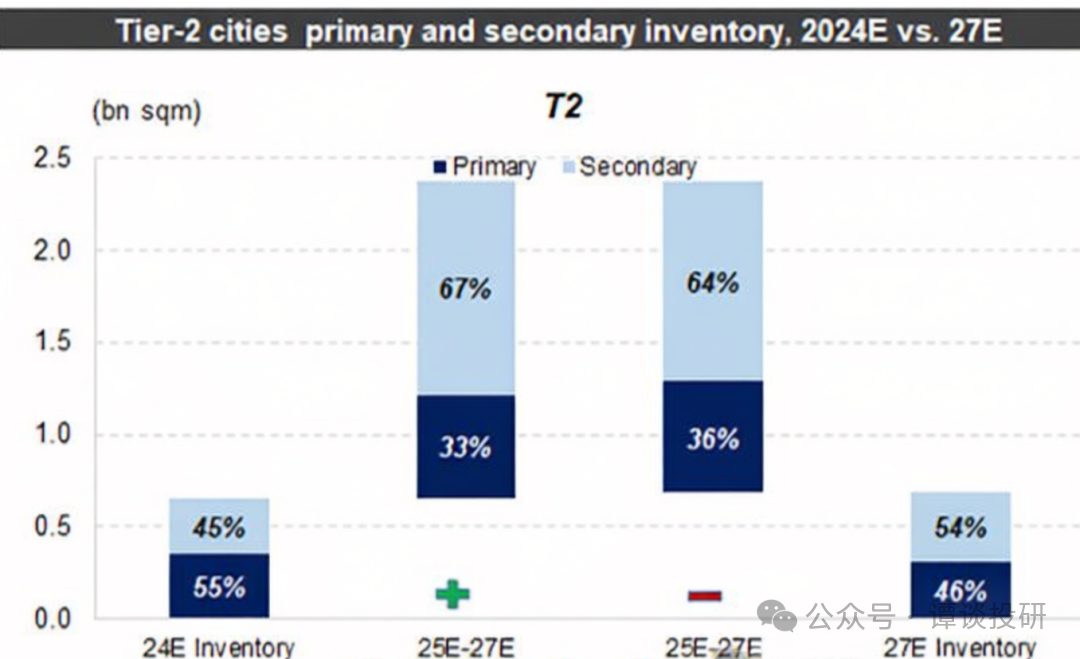
Core Insights - Goldman Sachs predicts that the trend of deleveraging in China's real estate market will pause around 2026-2027, potentially leading to a new buying cycle if economic conditions improve [1][26] - The share of real estate assets in total household assets is expected to decline from approximately 70% to around 50% by 2027, still above developed markets but significantly lower than peak levels [2][27] Market Dynamics - A significant portion of high loan-to-value (LTV) housing sold between 2021 and 2023 may face negative equity risks if average selling prices decline by 20-30% [3][28] - If housing prices drop by 20-30%, many homeowners may choose to default on their mortgages, leading to an increase in foreclosures and further price declines, creating a vicious cycle [4][28] Government Intervention - Goldman Sachs estimates that approximately RMB 8 trillion (5.8% of 2025 GDP) in funding will be required to stabilize the market and support inventory reduction and project completion [5][29] - A more feasible alternative proposed is for the government to directly purchase second-hand homes, requiring around RMB 600 billion [6][30] Housing Supply and Demand - By 2027, the volume of secondary listings is expected to account for about 3% of the total housing stock, with homeowners likely motivated to sell vacant properties before economic conditions stabilize [7][32] - In first-tier cities, 76% of new housing supply from 2025 to 2027 will be second-hand homes, while second-tier cities will see a more balanced distribution between new and second-hand homes [8][32] Economic Context - The contribution of the real estate sector to GDP has fallen below 6%, returning to levels comparable to 2014, indicating a potential for continued downward trends in the sector [18][42] - Current economic conditions, including declining incomes and rising unemployment, are significantly weaker than in previous downturns, affecting consumer confidence and purchasing power [21][44] Historical Comparisons - The report draws parallels between the current situation in China and Japan's real estate crisis in the 1990s, highlighting the risks of prolonged downturns if substantial government support is not provided [11][37] - Historical data suggests that previous government interventions, such as the 2014-2015 stimulus, led to significant rebounds in property prices, indicating potential for similar outcomes if effective measures are implemented [40][41]