手写文本识别

Search documents
谷歌Gemini 3发布预期拉满,历史学者称其解决了AI领域两个最古老难题
3 6 Ke· 2025-11-13 03:19
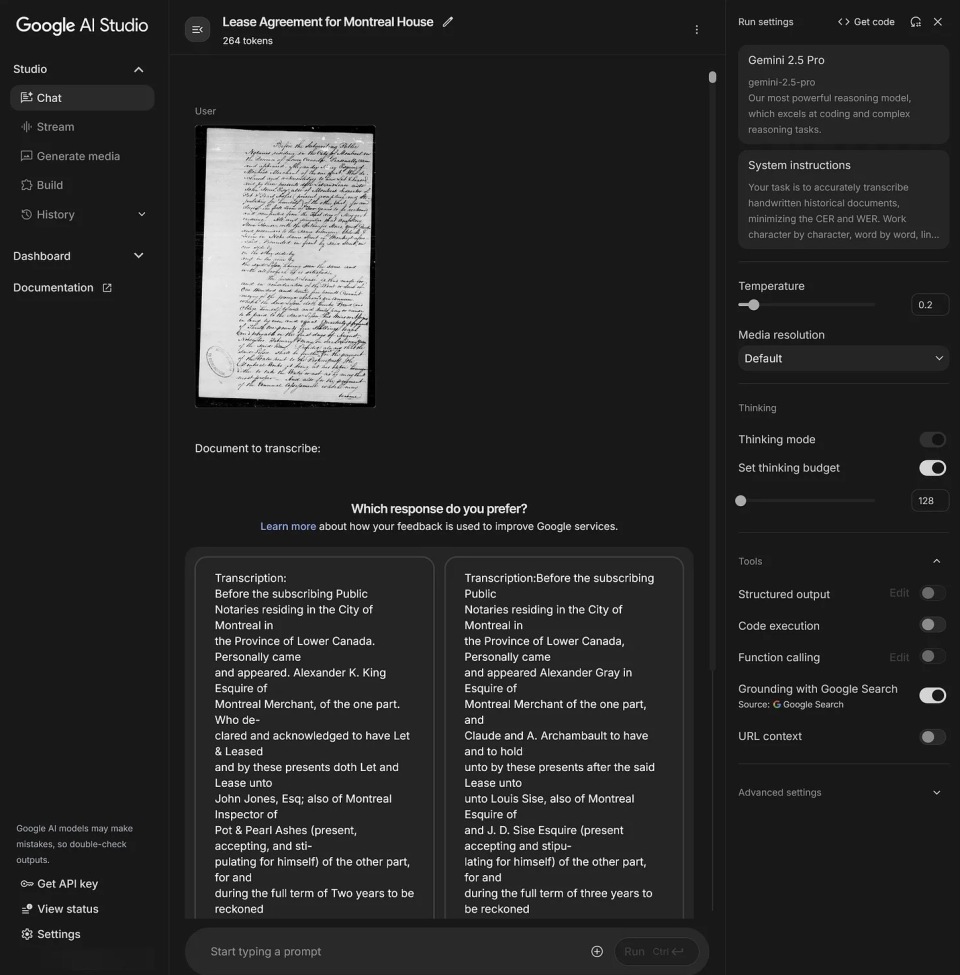
Core Insights - The article discusses a significant breakthrough in AI, particularly in handwritten text recognition and symbolic reasoning, achieved by Google's AI model, potentially Gemini-3 [1][3][22] - The findings suggest that the model not only excels in recognizing handwritten text but also demonstrates an ability to reason and understand the context behind the text, marking a potential shift in AI capabilities [2][19][21] Group 1: AI Model Performance - The AI model tested by Mark Humphries showed "almost perfect" handwriting recognition and the ability to perform "spontaneous, abstract, symbolic reasoning" [1][2] - The model achieved a character error rate (CER) of 0.56% and a word error rate (WER) of 1.22%, indicating a significant improvement over previous models [7][19] - This performance aligns with the "scaling laws," suggesting that as model parameters increase, capabilities in complex tasks improve exponentially [7][22] Group 2: Historical Document Recognition - Recognizing historical documents is more complex than standard text due to issues like spelling inconsistencies and semantic ambiguities [5][22] - The model's ability to infer the author's intent and correct errors in historical documents indicates a level of understanding previously thought unattainable by AI [5][19] - The implications for historical research are profound, as AI could automate the transcription and analysis of vast amounts of historical data [22][23] Group 3: Theoretical Implications - The findings challenge the long-held belief that symbolic reasoning is beyond the reach of deep learning models, suggesting a convergence of statistical learning and symbolic manipulation [20][21] - The emergence of implicit reasoning capabilities in AI models raises questions about the nature of understanding and cognition in machines [21][22] - This breakthrough could signify a move towards general intelligence in AI, as models begin to demonstrate understanding rather than mere pattern recognition [22][23]