符号推理

Search documents
意识产生、符号推理……AI下一站该往哪走?
3 6 Ke· 2025-12-01 03:52
Group 1: Core Perspectives on AI Development - The current phase of AI is characterized as a critical platform shift, with uncertainty in its development forms. The deployment of technology must go through three stages: absorption, innovation, and disruption, with the current focus on absorption in areas like programming and marketing [1][4][6] - AI is fundamentally about "computable pattern recognition" and lacks true consciousness. Current AI can only find patterns based on data and execute rules without understanding their essence. The limitations of existing computer technology prevent the emergence of consciousness [1][11][12] - The future of AI will not be limited to a single form but will evolve in four key directions: symbolic reasoning, spatial intelligence, emotional intelligence, and intelligent agents. This evolution signifies a diversification and specialization of intelligence [1][18][19] Group 2: Optimism and Preparedness for AI - Maintaining optimism in the face of AI development is essential, viewing progress as a "Protopia" where the world improves incrementally each day. This perspective encourages innovation and preparation rather than fear [2][22][23] - The uncertainty surrounding the realization of general artificial intelligence remains, with the possibility of many specialized "weak AIs" emerging instead of a singular form of intelligence [14][20] - The future AI landscape may feature a hybrid architecture of centralized cloud computing and decentralized edge computing, balancing efficiency and privacy concerns [15][16] Group 3: Implications for Industries and Workforce - AI is expected to enhance human work efficiency rather than replace jobs, as it allows individuals to focus on more creative and judgment-based tasks by automating repetitive ones [16][17] - The evolution of AI will lead to the emergence of a new economic system centered around intelligent agents, which will operate seamlessly in the background [21]

AI大家说 | 意识产生、符号推理……AI下一站该往哪走?
红杉汇· 2025-12-01 00:05
Core Insights - The article consolidates viewpoints from experts Benedict Evans, Roger Penrose, and Kevin Kelly regarding the future development of AI, focusing on the evolution of AI consciousness, its potential impact on industries, and how to navigate the uncertainties of AI advancement [3][6]. Group 1: Benedict Evans' Perspective - Evans highlights that AI is currently at a critical platform transition phase, with its development still uncertain. The deployment of technology must go through three stages: absorption, innovation, and disruption, with the current focus on "absorption" scenarios like programming and marketing [3][9]. - He emphasizes that while many successful use cases are in the "absorption" stage, the real questions lie in what "innovation" and "disruption" will look like, particularly in terms of how AI can redefine industry problems [9][10]. - Evans notes that despite the significant capital investments by tech giants, the clarity around product forms, business models, and value capture remains ambiguous, indicating a transformative change is underway regardless of potential market bubbles [11][12]. Group 2: Roger Penrose's Viewpoint - Penrose argues that true intelligence must involve consciousness, asserting that current AI is merely a computational concept that identifies patterns without genuine understanding [15][16]. - He references Gödel's theorem to explain that existing computational technologies cannot achieve consciousness, as they are limited to rule application without understanding the underlying principles [16][17]. - Penrose expresses skepticism about the potential for AI to develop consciousness, suggesting that any future intelligent devices would need to be fundamentally different from current computers [17]. Group 3: Kevin Kelly's Insights - Kelly posits that the future of AI will not be singular but will encompass various forms of intelligence, with a focus on four key areas: symbolic reasoning, spatial intelligence, emotional intelligence, and intelligent agents [20][21]. - He discusses the uncertainty surrounding whether AI will enhance human work efficiency or directly replace jobs, noting that current evidence suggests AI improves efficiency without leading to mass unemployment [21]. - Kelly introduces the concept of "Protopia," advocating for a perspective that embraces gradual improvement rather than utopian or dystopian extremes, suggesting that small daily advancements can lead to significant long-term changes [22][23].

凯文·凯利最新演讲:这个能力,下一个10年最具竞争力
创业邦· 2025-11-18 10:39
Core Viewpoints - The importance of preparing for the future rather than predicting it in an era of uncertainty [7] - AI is seen as a complement to human capabilities, enhancing efficiency and creativity rather than replacing jobs [20] - The future will be shaped by those who can collaborate with AI, rather than those who resist it [8] AI and Uncertainty - There are three key uncertainties regarding AI: the possibility of achieving general artificial intelligence, the direction of AI computing (centralized vs. decentralized), and the impact of AI on employment [10][14][16] - Current investments are heavily focused on exploring general intelligence, but the future may consist of various specialized AI systems rather than a single general system [11][13] - The trend towards edge computing is emerging, with a significant portion of computing already occurring at the edge, which offers advantages in speed, privacy, and energy efficiency [14][15] AI's Role in Employment and Industry - AI is not leading to mass unemployment but is instead enhancing productivity, with studies showing an average efficiency increase of about 25% for employees using AI [17][19] - The introduction of AI changes the nature of work, allowing humans to focus on more creative and judgment-based tasks while AI handles repetitive ones [20][41] - AI's role is to augment human capabilities rather than replace them, leading to a reorganization of job structures rather than job losses [43] Future Directions of AI - Future AI innovations will focus on four key areas: symbolic reasoning, spatial intelligence, emotional intelligence, and intelligent agents [22] - Symbolic reasoning will reintroduce structured intelligence to enhance AI's understanding and reasoning capabilities [22][23] - Spatial intelligence will enable AI to interact with and understand the real world, moving beyond text-based learning [24][27] - Emotional intelligence will allow AI to recognize and respond to human emotions, fostering deeper human-AI interactions [29][30] - Intelligent agents will evolve from mere tools to partners capable of executing tasks and collaborating with other agents [30][31] The Concept of "Cool China" - "Cool China" refers to a nation that attracts others through creativity and charm rather than force, with potential to lead in innovation and cultural influence [60][61] - China has the opportunity to produce world-class products and technologies, enhancing its global standing [62] - Cultural output will play a significant role in shaping China's soft power, allowing it to resonate with global audiences [63] - The development of attractive cities that blend technology and culture will further enhance China's appeal [64] Challenges and Responsibilities - The rise of an AI-driven society will bring challenges related to privacy, data usage, and the balance between personalization and individual rights [66][68] - AI has the potential to create a more just and efficient society, particularly in areas like social governance and resource distribution [69] - The realization of "Cool China" depends on a commitment to innovation, openness, and responsibility, shaping a respected and admired global presence [71]

谷歌Gemini 3发布预期拉满,历史学者称其解决了AI领域两个最古老难题
3 6 Ke· 2025-11-13 03:19
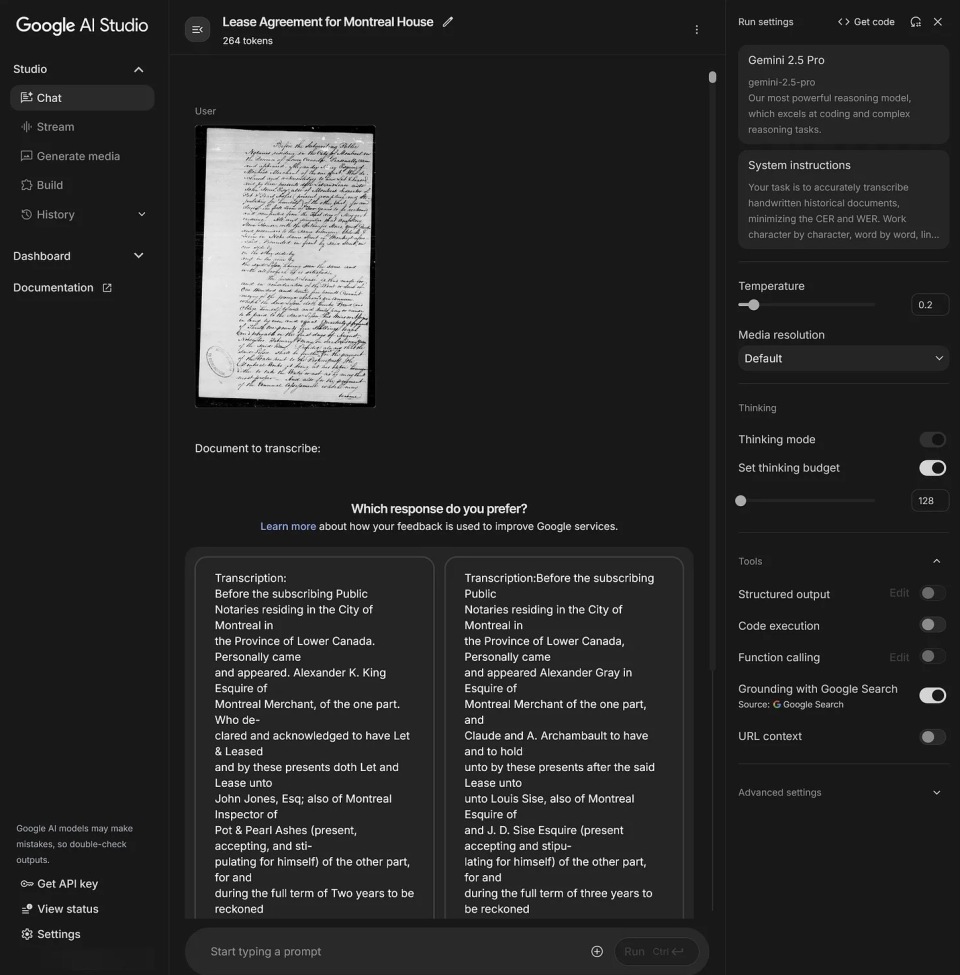
Core Insights - The article discusses a significant breakthrough in AI, particularly in handwritten text recognition and symbolic reasoning, achieved by Google's AI model, potentially Gemini-3 [1][3][22] - The findings suggest that the model not only excels in recognizing handwritten text but also demonstrates an ability to reason and understand the context behind the text, marking a potential shift in AI capabilities [2][19][21] Group 1: AI Model Performance - The AI model tested by Mark Humphries showed "almost perfect" handwriting recognition and the ability to perform "spontaneous, abstract, symbolic reasoning" [1][2] - The model achieved a character error rate (CER) of 0.56% and a word error rate (WER) of 1.22%, indicating a significant improvement over previous models [7][19] - This performance aligns with the "scaling laws," suggesting that as model parameters increase, capabilities in complex tasks improve exponentially [7][22] Group 2: Historical Document Recognition - Recognizing historical documents is more complex than standard text due to issues like spelling inconsistencies and semantic ambiguities [5][22] - The model's ability to infer the author's intent and correct errors in historical documents indicates a level of understanding previously thought unattainable by AI [5][19] - The implications for historical research are profound, as AI could automate the transcription and analysis of vast amounts of historical data [22][23] Group 3: Theoretical Implications - The findings challenge the long-held belief that symbolic reasoning is beyond the reach of deep learning models, suggesting a convergence of statistical learning and symbolic manipulation [20][21] - The emergence of implicit reasoning capabilities in AI models raises questions about the nature of understanding and cognition in machines [21][22] - This breakthrough could signify a move towards general intelligence in AI, as models begin to demonstrate understanding rather than mere pattern recognition [22][23]

凯文·凯利谈AI趋势:空间智能是方向,人工智能让中国“更酷”
Xin Hua Cai Jing· 2025-10-21 03:07
Core Insights - The future of AI will be shaped by optimists, with expectations for an AI-empowered human development over the next 5-10 years, focusing on symbolic reasoning, spatial intelligence, emotional intelligence, and AI agent ecosystems [1][2] AI Technology Trends - AI is expected to enhance global society significantly, acting as a productivity amplifier rather than a job replacer, potentially increasing productivity by 25% to 50% [2][3] - Four key trends in AI development are identified: 1. **Symbolic Reasoning**: A method based on logical rules and symbolic representation, essential for AI to think and act [2][3] 2. **Spatial Intelligence**: The ability to understand spatial relationships, enabling AI to learn from physical and biological domains [3] 3. **Emotional Intelligence**: The capacity for AI to recognize and respond to emotions, fostering stronger emotional connections with humans [3] 4. **AI Agents**: The evolution of AI agents that will operate in the background, with minimal direct human interaction [3][4] China's AI Development Potential - The potential for AI to help China become "cool" is emphasized, focusing on three elements: the ability to create excellent products, lead global fashion trends, and develop attractive cities [4][5] - AI is seen as a key driver for enhancing China's global influence, particularly in cultural products and sustainable technology exports [5] - Predictions include significant breakthroughs in hard technology sectors like space exploration and chip manufacturing within five years, positioning China as a leader in AI and sustainable development [5]
草稿链代替思维链,推理token砍掉80%,显著降低算力成本和延迟
量子位· 2025-03-10 03:29
Core Viewpoint - The article discusses the introduction of a new method called "Chain of Draft" (CoD) that significantly reduces token usage and inference costs while maintaining accuracy in reasoning tasks, inspired by human problem-solving processes [1][2][4]. Cost Efficiency - CoD reduces token usage by 70-90% compared to the traditional Chain of Thought (CoT) method, leading to lower inference costs. For enterprises processing 1 million reasoning queries monthly, costs can drop from $3,800 (CoT) to $760, saving over $3,000 per month [6][7]. Experimental Validation - Experiments evaluated three types of reasoning tasks: arithmetic reasoning, common sense reasoning, and symbolic reasoning. The accuracy of models like GPT-4o and Claude 3.5 Sonnet improved significantly with CoD, achieving around 91% accuracy in arithmetic reasoning compared to over 95% with CoT [8][9]. - In terms of token usage, CoT generated approximately 200 tokens per response, while CoD only required about 40 tokens, representing an 80% reduction [9]. - CoD also reduced average latency for GPT-4o and Claude 3.5 Sonnet by 76.2% and 48.4%, respectively [10]. Task-Specific Results - In common sense reasoning tasks, CoD maintained high accuracy, with Claude 3.5 Sonnet showing an increase in accuracy under CoD conditions [12]. - For symbolic reasoning tasks, CoD achieved 100% accuracy while significantly reducing both token usage and latency [14]. Limitations - The effectiveness of the CoD method significantly decreases in zero-shot settings, indicating potential limitations in its application [16]. - For smaller models with fewer than 3 billion parameters, while CoD still reduces token usage and improves accuracy, the performance gap compared to CoT is more pronounced [18].