投资者适当性

Search documents
买金门槛再提升!又一国有大行发布积存金交易新规
证券时报· 2026-01-26 23:55
Core Viewpoint - Agricultural Bank of China (ABC) is increasing the risk tolerance assessment requirements for personal clients participating in gold accumulation transactions to enhance consumer protection and comply with regulatory demands [1][2]. Group 1: Changes in Risk Assessment Requirements - Starting from January 30, 2026, personal clients must complete a risk tolerance assessment and achieve at least a cautious level to engage in gold accumulation services [1]. - Existing clients with valid assessment results are exempt from re-evaluation for certain operations like selling or withdrawing [1]. Group 2: Industry Trends and Market Conditions - ABC is the second state-owned bank to adjust investment thresholds for gold accumulation since 2026, following Industrial and Commercial Bank of China (ICBC) which raised the risk assessment level from C1 to C3 [2]. - The increase in investment thresholds is attributed to the high volatility of gold prices, which recently surpassed $5,100 per ounce [2]. - Experts indicate that the shift in gold's market perception from a stable savings alternative to a high-risk asset is driving these regulatory changes [2][3]. Group 3: Investor Behavior and Risks - There are concerns about investors potentially misrepresenting their risk tolerance during assessments, which could lead to mismatched risk profiles and inadequate investor protection [4]. - Such behavior undermines the integrity of the investor suitability framework, exposing investors to significant risks and complicating their ability to seek recourse in case of losses [4].




600万理财亏了14万,光大银行一分行被判承担客户一半损失!推销基金时未充分告知风险
Sou Hu Cai Jing· 2026-01-23 04:24
Core Viewpoint - The case highlights the responsibility of financial institutions in providing adequate risk disclosures and assessments to clients when selling investment products, as demonstrated by the court's ruling against China Everbright Bank's Jinzhou branch for failing to inform the client about the risks associated with the investment product [1][3]. Group 1: Case Details - Ms. Wang invested 6 million yuan in a medium-risk fund recommended by a financial manager at China Everbright Bank's Jinzhou branch, leading to a loss of over 140,000 yuan upon redemption [1][2]. - The court found that the bank did not conduct a written risk assessment or adequately inform Ms. Wang about the product's risks, resulting in a ruling that the bank must compensate 50% of the principal loss [3]. Group 2: Regulatory Compliance - The bank's failure to provide written risk disclosures and timely updates on product performance during the investment period was a key factor in the court's decision [3]. - The testing of the bank's mobile app revealed that clients could purchase higher-risk products despite having a lower risk tolerance, raising questions about compliance with the "suitability" principle in financial product sales [4][5]. Group 3: Legal and Industry Implications - Legal experts emphasize that financial institutions must adhere to strict sales processes, including comprehensive risk assessments and clear written disclosures to clients [6]. - The ruling serves as a warning to the banking industry to ensure compliance with regulatory standards and to improve operational procedures in the sale of financial products [6].

颀中科技:提示“颀中转债”投资者适当性及转股风险
Xin Lang Cai Jing· 2025-12-21 07:36
Core Viewpoint - The company announced the issuance of 850 million yuan in convertible bonds, which will be listed on the Shanghai Stock Exchange starting November 21, 2025 [1] Group 1 - The convertible bond has a conversion period starting from May 7, 2026, until November 2, 2031 [1] - As a company listed on the Sci-Tech Innovation Board, investors participating in the conversion must meet specific suitability requirements for investing in Sci-Tech stocks [1] - The company warns investors to pay attention to the risks and impacts associated with the inability to convert bonds for those who do not meet the requirements [1]

金融教育宣传周|富国基金:选基金为什么要重视适当性管理
Xin Lang Ji Jin· 2025-09-23 09:34
Core Viewpoint - The article emphasizes the importance of "suitability" management in fund investment, which involves matching appropriate fund products or services to suitable investors based on their risk tolerance, investment goals, and experience [2][3]. Investor Suitability - Accurate assessment of investors' risk tolerance, investment goals, and experience is crucial for effective fund product recommendations [2][3]. - Different investors have varying investment capabilities and goals, indicating that no single fund product is suitable for everyone [3]. Fund Product Characteristics - Fund products are categorized into four main types based on expected risk, ranked from high to low: equity funds, mixed funds, bond funds, and money market funds [13]. - Fund companies classify products into five risk levels (R1 to R5) to help investors understand the risk attributes of each product [13][14]. Risk Assessment - Investors are typically required to undergo a risk tolerance assessment before purchasing funds, which involves answering a questionnaire about their financial situation, investment experience, and goals [15][16]. - The results of the assessment categorize investors into different risk levels, guiding them to select appropriate risk-level products [16]. Dynamic Nature of Risk Tolerance - Investors' risk tolerance can change over time due to factors such as age, income, and accumulated investment knowledge, necessitating periodic reassessments by sales institutions [17].

【金融教育宣传周】了解投资者适当性
天天基金网· 2025-09-17 10:34
Group 1 - The article emphasizes the importance of financial education and consumer protection in the financial sector, highlighting the upcoming Financial Education Promotion Week scheduled for September 15-21, 2025 [1] - It outlines a structured approach for investors to assess their suitability for financial services, categorized into five risk levels from R1 (lowest risk) to R5 (highest risk) [2] - The article provides a matching framework between investor risk profiles (C1 to C5) and financial service risk levels, indicating which profiles are suitable for which risk levels [2]

基金公司强迫员工买基金,俩月亏8万多?
Sou Hu Cai Jing· 2025-08-15 01:40
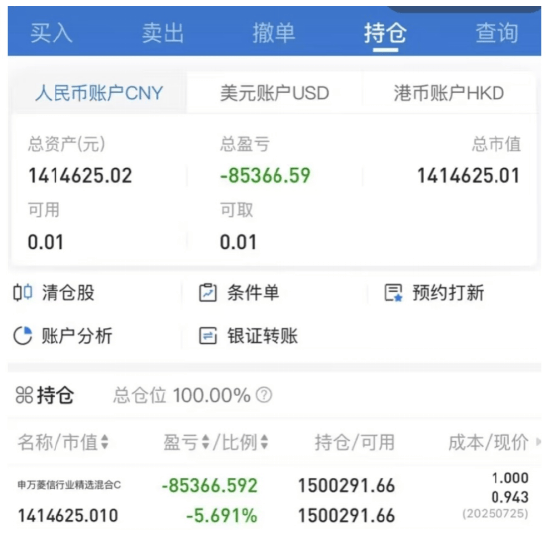
Core Viewpoint - The news highlights allegations from a whistleblower claiming that employees of Shenwan Hongyuan Securities were coerced into purchasing the Shenwan Lingshin Industry Select Mixed Fund, resulting in significant losses within a short period. The fund's performance has been notably poor compared to market indices, raising concerns about management practices and potential regulatory violations. Group 1: Allegations and Fund Performance - A Shenwan Hongyuan employee reported being forced to invest 1.5 million yuan in the Shenwan Lingshin Industry Select Mixed Fund, which lost 85,400 yuan in just two months [1][2] - The fund, managed by star fund manager Jia Chengdong, was established on June 3, 2025, and has seen its A-class shares decline by 8.23%, ranking 4672 out of 4673 similar funds, while the Shanghai Composite Index rose by 8.96% during the same period [3][5] - The fund's strategy promised high dividends and a gradual investment approach, but it reportedly built a 60% position within three days and made aggressive trades that led to losses [3][5] Group 2: Company Response and Implications - Shenwan Lingshin denied the allegations of forcing employees to buy the fund, stating that there was no coercion and that the management personnel's subscription volume was zero [5] - The company acknowledged that the fund's short-term performance has not met expectations but encouraged investors to focus on long-term results [5] - If the allegations are proven true, they could violate regulations regarding investor suitability and prohibition of forced purchases, indicating potential governance issues within the company [5][6]