按疗效付费

Search documents
“医生,要手术吗?”上亿肺结节人群之问,催生带病体保险从“被动承保”走向“风险减量”
Mei Ri Jing Ji Xin Wen· 2026-01-08 11:49
Core Insights - Lung cancer remains the leading cause of cancer-related deaths globally for the past decade, with a significant number of patients diagnosed at advanced stages in China [1] - The rise of low-dose chest CT screening has led to an estimated 120 to 150 million individuals in China being identified with lung nodules, surpassing the number of diabetes patients [1] Group 1: Medical and Psychological Impact - The management of lung nodules is not only a medical issue but also a psychological one, causing anxiety among patients [2] - Over 25% of lung nodule patients exhibit significant anxiety symptoms, highlighting the need for continuous management rather than one-time assessments [4] Group 2: Insurance and Healthcare Integration - The insurance market is beginning to adapt to the needs of patients with lung nodules, with a focus on risk assessment and management [2][5] - A strategic partnership between Sichuan University West China Hospital and China Pacific Insurance aims to create an innovative model that integrates quality medical resources with commercial insurance [6] Group 3: Innovative Insurance Solutions - The launch of a digital management system for lung nodule patients will provide comprehensive services from screening to follow-up, incorporating a layered insurance mechanism [6] - This system represents a significant shift in insurance design, allowing for coverage of patients with varying levels of cancer risk, which was previously not addressed by traditional health insurance [6] Group 4: Market Trends and Future Outlook - The market for insurance products catering to patients with pre-existing conditions is expanding, with projections indicating a growth to a billion-dollar market within five years [8] - The health insurance industry is shifting from a focus on scale to optimizing product structures that cater to elderly and chronic disease populations, aligning with regulatory encouragement for innovative insurance products [11]

健康险新政!或将成为创新器械“第二张门票”?
思宇MedTech· 2025-10-02 02:45
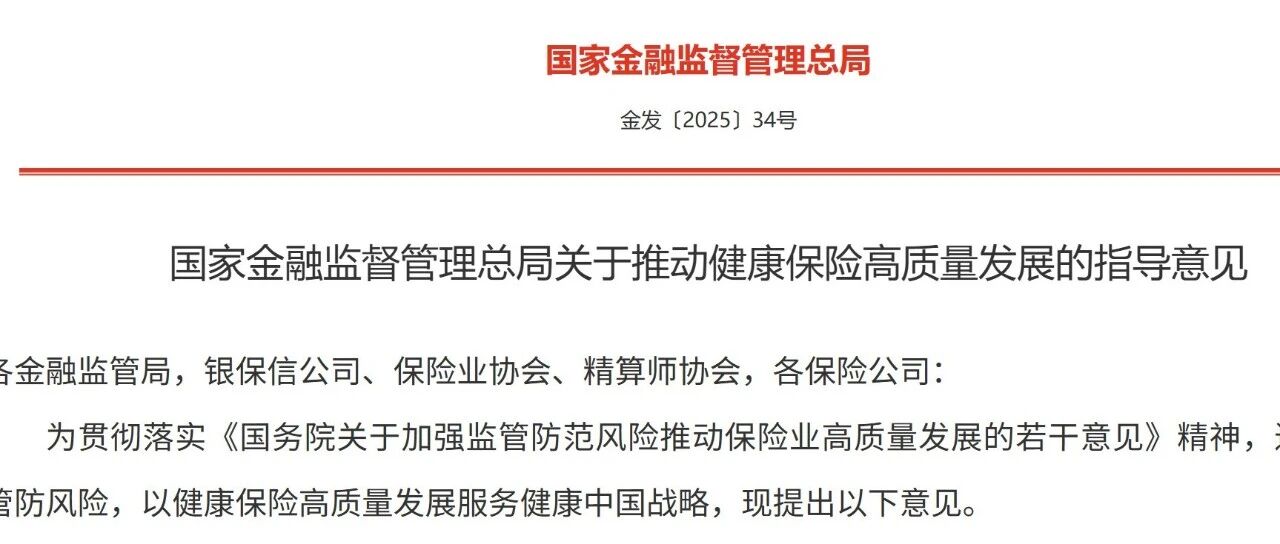
Core Insights - The article discusses the new guidelines issued by the National Financial Supervision Administration aimed at promoting high-quality development in health insurance, emphasizing the integration of new medical technologies, drugs, and devices into commercial insurance coverage by 2030 [2][14]. Group 1: Overview of the Health Insurance Landscape - China's medical security system is structured into three layers: basic medical insurance, personal out-of-pocket expenses, and commercial health insurance [3]. - As of the end of 2024, the basic medical insurance covers 1.327 billion people, maintaining a coverage rate of 95% [4]. - The total income of the basic medical insurance fund is 3.49 trillion yuan, with expenditures of 2.98 trillion yuan, resulting in a cumulative balance of 3.86 trillion yuan [5]. - The payment levels for employee medical insurance cover approximately 85% of inpatient costs, while resident medical insurance covers about 69% [6]. - Basic medical insurance is the primary payment pool but has strict entry mechanisms for innovative drugs and devices due to sustainability concerns [7]. Group 2: Personal Out-of-Pocket Expenses - Despite broad coverage, patients still face significant out-of-pocket expenses for high-value medical consumables and innovative devices [8]. - Medical assistance covers 79.16 million people with expenditures of 79.2 billion yuan, but its scale is limited [9]. Group 3: Commercial Health Insurance - In 2024, the total premium income for commercial health insurance reached 977.4 billion yuan, accounting for about 17% of the national insurance market [10]. - The claims expenditure was 405.2 billion yuan, representing around 5% of the total resident medical expenses of approximately 850 billion yuan [10]. - The growth of products like "惠民保" and "百万医疗险" is expanding coverage for specific diseases and rare conditions, although overall coverage remains weak [11]. - Commercial insurance is becoming an important supplement between basic medical insurance and personal payments, facilitating the entry of innovative devices into the payment system [12]. Group 4: Policy Implications - The new guidelines signal an expansion of payment coverage, innovative payment methods, and deeper industry collaboration [14]. - The inclusion of new devices in insurance coverage indicates that commercial health insurance will no longer be limited to traditional disease coverage [18]. - The exploration of "pay-for-performance" models provides new collaboration opportunities for medical device companies [19]. - Group health insurance may become an efficient funding channel, while individual health insurance is emerging as a primary means for covering specific diseases and rare devices [20][21]. Group 5: Market Challenges - The low claims payout levels and insufficient coverage perception pose challenges for commercial health insurance [24]. - The imbalance in product structure leads to inadequate coverage for chronic disease populations, which are key users of innovative devices [27]. - There is a lack of data sharing among the three medical sectors, making it difficult for insurance companies to obtain real-world efficacy evidence for accurate pricing [28]. Group 6: Insights for the Medical Device Industry - Commercial insurance is positioned as a "pre-payment" avenue for innovative devices, allowing for a pathway of "insurance coverage first, data accumulation, then entry into basic medical insurance" [30]. - Data will be a crucial bargaining chip in collaborations with commercial insurance, emphasizing the need for real-world evidence to demonstrate product efficacy [31]. - Group insurance and "惠民保" are identified as key entry points for promoting device applications [32]. Group 7: Future Outlook - The high-quality development of health insurance represents a transformation in the insurance industry and a rebalancing of China's medical security system [33]. - The evolving payment structure will significantly impact the clinical implementation and market penetration of innovative devices [34].