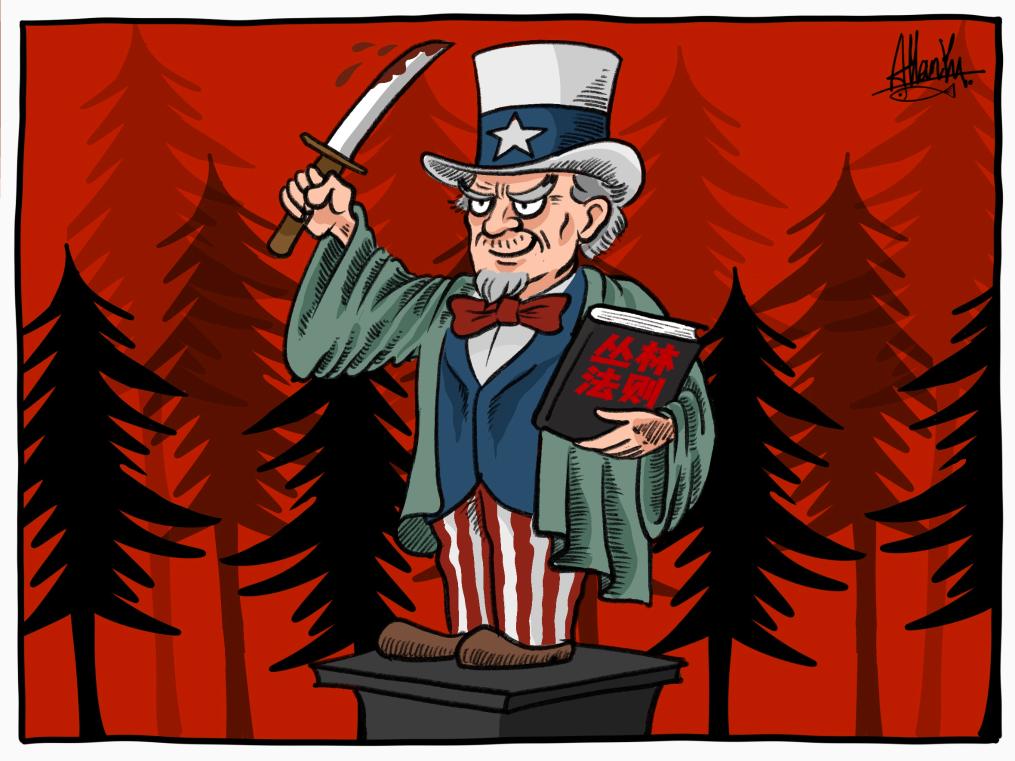
掠夺性外交

Search documents
国际观察丨不止资源:美国觊觎格陵兰岛的操作与盘算
Xin Hua She· 2025-12-24 01:38
Core Viewpoint - The U.S. government's recent actions regarding Greenland, including high-profile appointments and declarations of intent to acquire the territory, reflect a predatory diplomatic approach that has sparked strong opposition from Denmark and the EU [1][3][10]. Group 1: U.S. Actions and Reactions - President Trump has emphasized the necessity of acquiring Greenland for national security, stating, "We must get it" [2]. - The appointment of Louisiana Governor Jeff Landry as the U.S. Special Envoy to Greenland aims to promote American interests, with Landry suggesting that Greenland should become part of the U.S. [3]. - Denmark's Prime Minister and Greenland's Premier issued a joint statement opposing U.S. territorial claims, reaffirming respect for Denmark's territorial integrity [3][6]. Group 2: Diplomatic Tensions - The U.S. has employed various tactics, including public pressure and covert operations, to influence Greenland's affairs, with Trump making aggressive statements about potential military or economic coercion [7]. - High-level U.S. visits to Greenland have been perceived as provocations, with local officials describing them as attempts to undermine Danish authority [7]. - Reports indicate that U.S. intelligence activities have intensified regarding Greenland, focusing on local independence movements and attitudes towards U.S. resource extraction [7]. Group 3: Strategic and Economic Considerations - Analysts suggest that the U.S. interest in Greenland is driven by its strategic location, which has been significant since the Cold War, and its role in NATO's defense strategy [10]. - Greenland is rich in natural resources such as rare earth elements, graphite, copper, and nickel, which are critical for energy transition and technology manufacturing [10]. - The melting ice in Greenland is making resource extraction more feasible, increasing its attractiveness for U.S. manufacturing revival efforts [10]. Group 4: Political Ambitions - Trump's ambitions regarding Greenland are seen as part of a broader desire to leave a political legacy, with comparisons drawn to 19th-century imperialism [12]. - The administration's expansionist rhetoric may exacerbate international tensions and lead to greater isolation for the U.S. [12].

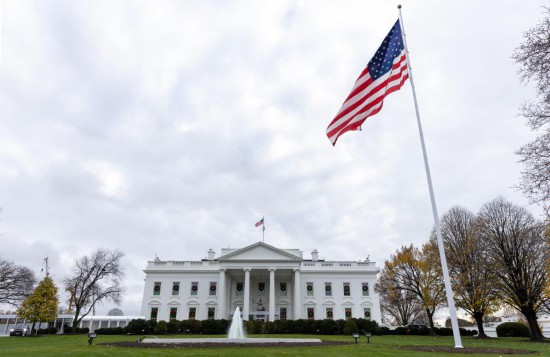
觊觎格陵兰岛,美明暗招数齐上阵
Xin Hua She· 2025-12-23 22:33
Core Viewpoint - The recent actions of President Trump regarding Greenland have sparked strong protests from Denmark and the EU, revealing the predatory nature of U.S. diplomacy and exacerbating transatlantic tensions [1]. Group 1: U.S. Actions and Statements - Trump emphasized the necessity of acquiring Greenland for national security, stating, "We need Greenland, we must get it" [2]. - The appointment of Louisiana Governor Jeff Landry as the U.S. Special Envoy to Greenland aims to promote U.S. interests in the territory, with Landry asserting the goal of making Greenland "part of America" [2]. - Since taking office, Trump has repeatedly expressed a desire to acquire Greenland, even suggesting the potential use of force [2]. Group 2: Diplomatic Tensions and Reactions - The U.S. has employed various methods, including media pressure and covert interventions, to influence Greenland's affairs, which has drawn opposition from Denmark and other European nations [2]. - A high-level U.S. delegation, led by Vice President Pence, visited Greenland on the same day the island announced a new autonomous government, which was perceived as a provocation by Greenlandic officials [3]. - Reports indicate that the Trump administration is using intelligence activities to covertly interfere in Greenland's affairs, reflecting a broader ambition reminiscent of 19th-century imperialism [4].
美国“必须得到格陵兰岛”
Xin Lang Cai Jing· 2025-12-23 19:08
Core Viewpoint - The U.S. President Trump has expressed a strong desire for the U.S. to acquire Greenland, citing national security concerns rather than resource acquisition, which has led to significant backlash from Denmark and the EU [2][3]. Group 1: U.S. Actions and Statements - Trump stated that the U.S. "must get Greenland" to ensure national security and criticized Denmark for not investing adequately in the territory [2]. - The appointment of Louisiana Governor Jeff Landry as the U.S. special envoy for Greenland was announced by Trump, emphasizing the importance of Greenland to U.S. national security [3]. - Trump has previously indicated that he would not rule out the use of military force to achieve U.S. interests in Greenland [3]. Group 2: International Reactions - French President Macron and other Nordic countries expressed strong support for Denmark's sovereignty over Greenland, emphasizing that the matter should be decided by Denmark and the Greenlandic people [4][5]. - The Danish government has faced pressure from the U.S. regarding Greenland, with analysts noting that Trump's actions reflect a predatory diplomatic approach that exacerbates transatlantic tensions [6][8]. Group 3: Strategic and Economic Considerations - Analysts suggest that the U.S. interest in Greenland is driven by multiple factors, including its strategic location, natural resources, and the potential for economic gain as climate change opens new shipping routes [9][10]. - Greenland's rich deposits of rare earth elements and other minerals are seen as critical for U.S. manufacturing and energy transition efforts [10]. - Trump's ambitions for territorial expansion are likened to 19th-century imperialism, which could lead to increased international tensions and U.S. isolation [11].
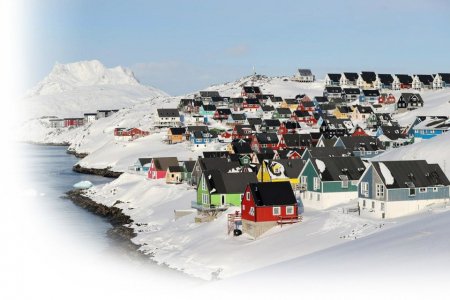
国际观察|不止资源:美国觊觎格陵兰岛的操作与盘算
Xin Hua She· 2025-12-23 12:45
Core Viewpoint - The article discusses the United States' aggressive interest in Greenland, highlighting President Trump's actions and statements that reflect a desire for territorial acquisition, which has sparked strong opposition from Denmark and the EU [2][3][4]. Group 1: U.S. Actions and Reactions - President Trump appointed Louisiana Governor Jeff Landry as the U.S. Special Envoy to Greenland, emphasizing the need for Greenland for national security and expressing intentions to make it part of the U.S. [3] - Denmark's Prime Minister and Greenland's Premier issued a joint statement opposing U.S. claims over Greenland, asserting the importance of respecting Denmark's territorial integrity [3][4]. - The EU Commission President expressed support for Denmark, reinforcing the principles of territorial integrity and sovereignty under international law [4]. Group 2: U.S. Strategies and Tactics - The Trump administration has employed various tactics, including public pressure, domestic interference, and covert operations, to influence Greenland's affairs [5]. - Reports indicate that U.S. intelligence agencies have intensified their operations in Greenland, focusing on the local independence movement and attitudes towards U.S. resource extraction [5][6]. - The U.S. has made uninvited visits to Greenland, with high-level officials attempting to sway local governance and public opinion towards favoring U.S. interests [5]. Group 3: Geopolitical and Economic Considerations - Analysts suggest that the U.S. interest in Greenland is driven by multiple factors, including its strategic location, economic resources, and Trump's desire to leave a political legacy [8]. - Greenland's rich natural resources, such as rare earth elements and minerals, are increasingly valuable as climate change makes extraction easier, aligning with U.S. manufacturing goals [8]. - The strategic significance of Greenland in military and geopolitical terms has been recognized since the Cold War, with its location being crucial for NATO operations [8].
国际观察丨“把世界当作丛林”——起底美国“掠夺性外交”
Xin Hua Wang· 2025-06-02 05:30
Core Viewpoint - The Trump administration's foreign policy is characterized as "predatory diplomacy," revealing a strong inclination towards territorial expansion and resource appropriation, reminiscent of colonial practices [2][3][4][5]. Group 1: U.S. Foreign Policy Actions - The Trump administration has openly expressed intentions to "take over" the Gaza Strip, suggesting that it is a target for U.S. acquisition [3]. - The administration has made claims about Canada becoming the "51st state," indicating a broader ambition to expand U.S. territory [3]. - There are reports of the U.S. pressuring Ukraine to relinquish mineral rights, showcasing a pattern of coercive diplomacy [3][13]. Group 2: International Reactions and Implications - Global reactions to U.S. actions have included significant market volatility, with investors beginning to divest from U.S. assets, indicating a shift towards "de-risking" from the U.S. economy [12]. - The European Central Bank's president has noted that the U.S.-led economic order is "collapsing," suggesting a potential decline in the dollar's dominance [12]. - Analysts have warned that the Trump administration's approach could lead to the fragmentation of the international order, with severe consequences for global trade and alliances [14]. Group 3: Historical Context and Ideological Underpinnings - The current U.S. foreign policy is compared to historical imperialistic actions, with references to the McKinley era and the Spanish-American War, highlighting a long-standing pattern of expansionism [7][9]. - The ideology of "Manifest Destiny" is invoked to explain the administration's belief in a natural right to expand U.S. influence globally [9][10]. - The Trump administration's approach is seen as a departure from traditional U.S. diplomacy, which has historically been more subtle in its imperialistic tendencies [11][14].