掺氢燃烧

Search documents
三部委发文!燃料电池商用车规模化迎来“天大”利好 | 头条
第一商用车网· 2026-03-16 09:47
Core Viewpoint - The article discusses the new opportunities for the development of hydrogen energy commercial vehicles following the announcement of a pilot program by the Ministry of Industry and Information Technology, the Ministry of Finance, and the National Development and Reform Commission to promote comprehensive hydrogen energy applications [1][5]. Summary by Sections Pilot Program Overview - The pilot program aims to promote the large-scale application of hydrogen energy across various scenarios, reduce costs, and support technological innovation in hydrogen energy equipment [1][5]. - The program will select urban clusters with strong industrial foundations and rich application scenarios to explore commercial pathways for hydrogen energy [2][6]. Goals and Targets - By 2030, the average price of hydrogen for end-use is expected to drop below 25 yuan per kilogram, with a target of around 15 yuan in some advantageous regions [2][6]. - The number of fuel cell vehicles is projected to double by 2025, aiming for a total of 100,000 vehicles [2][6]. Application Scenarios - Urban clusters are encouraged to prioritize applications in fuel cell vehicles, green ammonia, hydrogen-based chemical raw materials, hydrogen metallurgy, and hydrogen blending combustion [2][7]. - The focus will be on building hydrogen highways and corridors to facilitate the large-scale application of commercial vehicles, particularly in logistics and public transport [3][7]. Technical Requirements - Fuel cell commercial vehicles must meet specific technical standards, including a minimum hydrogen consumption rate and power density requirements [3][4]. - Vehicles should have a warranty of no less than five years or 200,000 kilometers [3]. Funding and Support - The central government will provide financial rewards to urban clusters based on their hydrogen application scenarios, with a maximum funding cap of 1.6 billion yuan per cluster over a four-year pilot period [4][11]. - The funding is intended to lower hydrogen costs and ensure effective transmission to end-user products [12]. Performance Evaluation - Each urban cluster must submit an annual self-evaluation report detailing progress, challenges, and future plans, which will be reviewed by relevant authorities [13]. - Performance evaluations will influence the allocation of reward funds, with a system in place for pre-allocation and subsequent settlement based on performance [13]. Implementation and Coordination - Provincial authorities are tasked with coordinating the pilot program, ensuring effective communication and collaboration among cities [14]. - Urban clusters are responsible for establishing leadership teams and work groups to oversee the implementation of the pilot program [14]. Supervision and Management - The three departments will provide ongoing guidance and support for the pilot program, with measures in place to address underperformance [15]. - Regular updates to technical requirements and pilot goals will be made based on technological advancements and industry developments [15].


订单排至3年后!AI数据中心引燃全球燃机需求,中国产业链企业分羹
第一财经· 2025-11-20 14:48
Core Viewpoint - The global gas turbine market is experiencing a historic surge, driven by increasing demand from data centers and a tightening supply chain among major players like GE Vernova, Siemens Energy, and Mitsubishi Heavy Industries [2]. Group 1: Market Demand - Siemens Energy's unfulfilled order backlog reached a record high of €138 billion for FY2025, with approximately 60% of new gas turbine orders in the first half of the year coming from data centers [2]. - GE Vernova added 20.2 GW in new gas turbine orders last year, marking a 112.6% year-on-year increase, with current order backlogs extending to 2028 [2]. - The U.S. Department of Energy reported that data centers consumed 176 TWh of electricity in 2023, accounting for 4.4% of total electricity demand, with projections indicating consumption could rise to between 325 TWh and 580 TWh by 2028, increasing their share to 6.7%-12% [2]. Group 2: Supply Constraints - The aging power grid in North America is leading to the retirement of many old coal and gas projects, while the construction cycle for traditional gas projects exceeds three years, and nuclear projects take even longer, making it difficult to alleviate power supply and demand imbalances in the short term [3]. - CICC predicts that the annual increase in U.S. electricity load could exceed 30 GW over the next five years, with approximately 20 GW coming from data center operations, resulting in an average annual electricity shortfall of around 15 GW [3]. - Gas-fired power generation, which accounts for over 40% of U.S. electricity supply, is seen as the optimal solution to address the power supply-demand imbalance due to its high thermal efficiency, quick start-up, short construction cycle, stable power output, low cost, and relative cleanliness [3]. Group 3: Industry Trends - The construction costs for gas power plants in the U.S. have surged by approximately 50% over the past three years, reflecting growing demand and tight supply of gas turbines [3]. - Bloomberg New Energy Finance estimates that the new gas-fired generation capacity to be commissioned in the U.S. from 2026 to 2031 could reach 16.8 GW [3]. - The high demand in the gas turbine sector has positively impacted the Chinese capital market, with significant stock price increases for gas turbine concept stocks, including a 20% daily limit increase for Triangle Defense and over 150% year-to-date increase for Yingliu Technology [3]. Group 4: Supply Chain Dynamics - Chinese companies are deeply integrated into the global supply chain, with Yingliu Technology being the exclusive supplier of Siemens Energy's H-class blades in China, and Wanze shares having signed a three-year gas turbine supply agreement with Siemens Energy [4]. - Aerospace Technology has completed numerous new product introductions for GE Vernova, covering key components such as compressors, combustion chambers, and turbine end parts [4]. - Triangle Defense has also signed a development and framework order agreement with Siemens Energy for gas turbine projects [4]. Group 5: Technological Developments - The trend of hydrogen blending in gas turbines is emerging as a significant development in the industry, with the potential to reduce carbon emissions and mitigate cost pressures from natural gas price fluctuations [5]. - A U.S. gas turbine manufacturer indicated that dual-fuel power plants using natural gas and hydrogen have already been implemented in China, and collaborations with Chinese state-owned power companies are underway to explore hydrogen blending technologies [5]. - As the penetration of renewable energy increases and the large-scale application of green hydrogen becomes feasible, the demand for hydrogen-blended gas turbines is expected to grow, further enhancing the role of gas turbines in China's electricity supply [5].
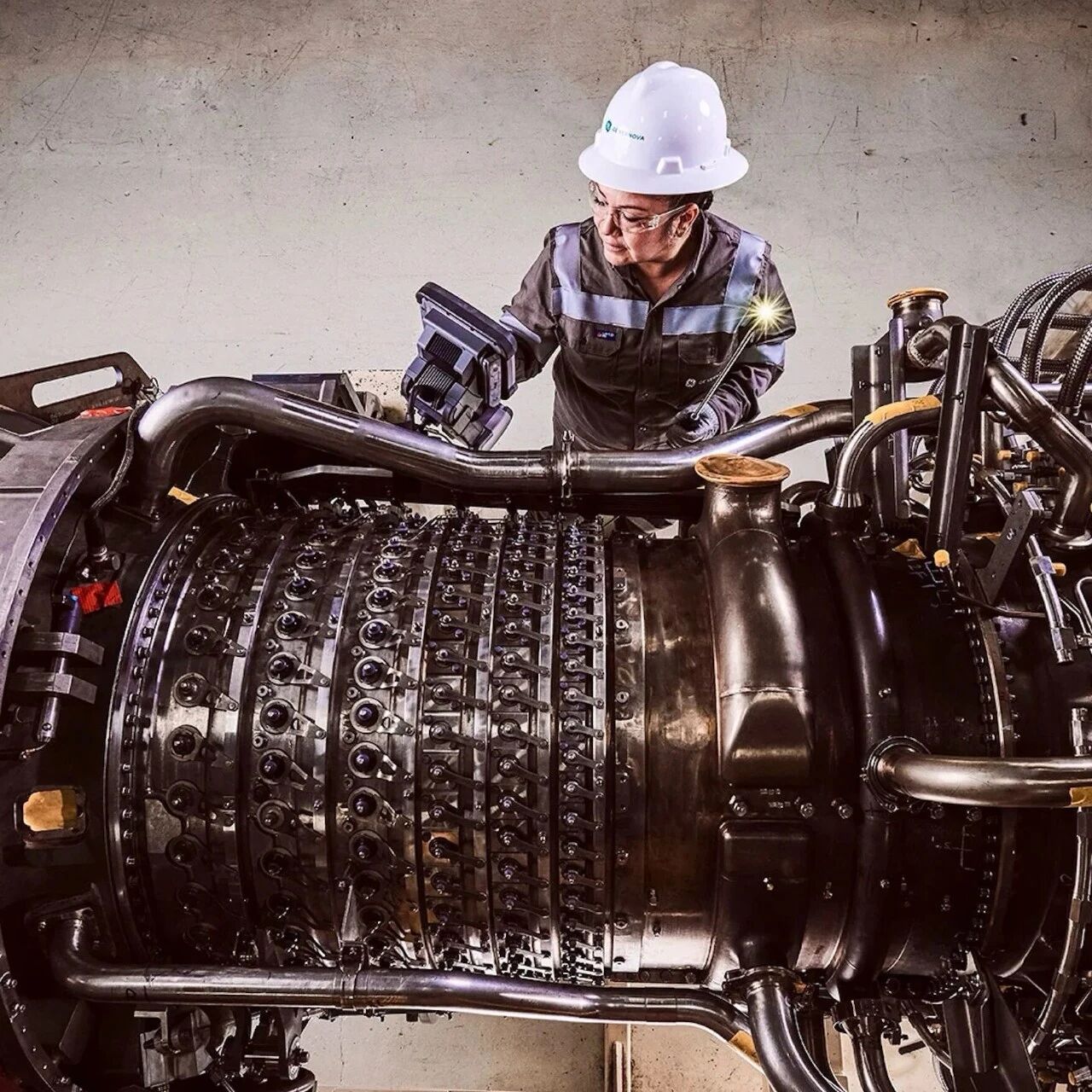
订单排至3年后!AI数据中心引燃全球燃机需求 中国产业链企业分羹
Di Yi Cai Jing· 2025-11-20 13:34
Group 1 - The global gas turbine market is experiencing a historic surge, with major players like GE Vernova, Siemens Energy, and Mitsubishi Heavy Industries seeing accelerated orders and tight production capacity [1] - Siemens Energy's unfulfilled order volume reached a record high of €138 billion for FY2025, with approximately 60% of new gas turbine orders in the first half coming from data centers [1] - GE Vernova added 20.2 GW in new gas turbine orders last year, a year-on-year increase of 112.6%, with current backlog extending to 2028 [1] Group 2 - The demand surge is driven by escalating power supply-demand conflicts in North America, particularly due to the rapid expansion of AI data centers [1][2] - The U.S. Department of Energy reported that data centers consumed 176 TWh of electricity in 2023, accounting for 4.4% of total electricity demand, with projections of consumption rising to between 325 TWh and 580 TWh by 2028 [1] - North America's top four cloud providers are expected to have total capital expenditures of $362 billion this year, a year-on-year increase of 58.5% [1] Group 3 - The aging power grid in North America and the retirement of many old coal and gas projects are exacerbating the power supply-demand imbalance, with a projected annual power load increase of over 30 GW in the next five years [2] - Gas-fired power generation is seen as the optimal solution to alleviate power supply-demand conflicts, given its high thermal efficiency, quick start-up, short construction cycle, stable power output, low cost, and relative cleanliness [2] - Bloomberg New Energy Finance predicts that the new gas-fired power generation capacity in the U.S. will reach 16.8 GW from 2026 to 2031 [2] Group 4 - The high industry prosperity is reflected in the Chinese capital market, with significant stock price increases for gas turbine concept stocks [2] - Companies like Yingliu Technology and Weichai Power have seen substantial stock price gains, with Yingliu Technology's stock rising over 150% this year [2] Group 5 - Chinese companies are deeply integrated into the global supply chain, with Yingliu Technology being the exclusive supplier of Siemens Energy's H-class blades in China [3] - The trend of hydrogen co-firing is emerging in the gas turbine industry, which can reduce carbon emissions and stabilize natural gas price fluctuations [3] - The increasing penetration of renewable energy and the large-scale application of green hydrogen in China may drive demand for hydrogen co-firing gas turbines, enhancing their share in the power supply [3]
订单排至3年后!AI数据中心引燃全球燃机需求,中国产业链企业分羹
Di Yi Cai Jing· 2025-11-20 13:24
Group 1 - The global gas turbine market is experiencing a historic surge, with major players like GE Vernova, Siemens Energy, and Mitsubishi Heavy Industries seeing accelerated orders and tight production capacity [1] - Siemens Energy's unfulfilled order backlog reached a record high of €138 billion for FY2025, with approximately 60% of new gas turbine orders in the first half coming from data centers [1] - GE Vernova added 20.2 GW of new gas turbine orders last year, a year-on-year increase of 112.6%, with current backlog extending to 2028 [1] - Mitsubishi Heavy Industries plans to double its gas turbine production capacity within the next two years [1] Group 2 - The demand surge is driven by the escalating power supply-demand imbalance in North America, particularly due to the rapid expansion of AI data centers [2] - In 2023, U.S. data centers consumed 176 TWh of electricity, accounting for 4.4% of total power demand, with projections indicating consumption could rise to 325 TWh-580 TWh by 2028, increasing its share to 6.7%-12% [2] - North American cloud providers are expected to have a total capital expenditure of $362 billion this year, a year-on-year increase of 58.5%, maintaining a high growth rate of around 30% through 2026 [1][2] Group 3 - The aging power grid in North America and the retirement of many old coal and gas projects create a short-term challenge in alleviating the power supply-demand imbalance [2] - Gas-fired power generation is seen as the optimal solution to address this imbalance, with gas turbines offering high thermal efficiency, quick start-up, short construction periods, stable power output, low costs, and relatively clean energy [2] - The construction cost of gas power plants in the U.S. has surged by approximately 50% over the past three years, reflecting growing demand and tight supply of gas turbines [2] Group 4 - The high industry growth is also reflected in the Chinese capital market, with significant stock price increases for gas turbine-related companies [5] - Companies like Yingliu Technology and Weichai Power have seen substantial stock price gains, indicating a deep integration of the Chinese supply chain with international giants [5] - Key domestic suppliers are expected to benefit from the opportunity to enter the global supply chain, particularly in high-value components like turbine blades and core parts [5] Group 5 - Hydrogen combustion is emerging as a development trend in the gas turbine industry, with the potential to reduce carbon emissions and mitigate natural gas price volatility [6] - Collaborations between gas turbine manufacturers and Chinese power companies are underway to explore hydrogen combustion technologies [6] - The increasing penetration of renewable energy and the anticipated arrival of the green hydrogen era may drive demand for hydrogen-blended gas turbines, enhancing their role in China's power supply [6]