
撒哈拉以南非洲经济增长

Search documents
撒哈拉以南非洲经济有望保持温和增长
Xin Lang Cai Jing· 2026-01-26 01:29
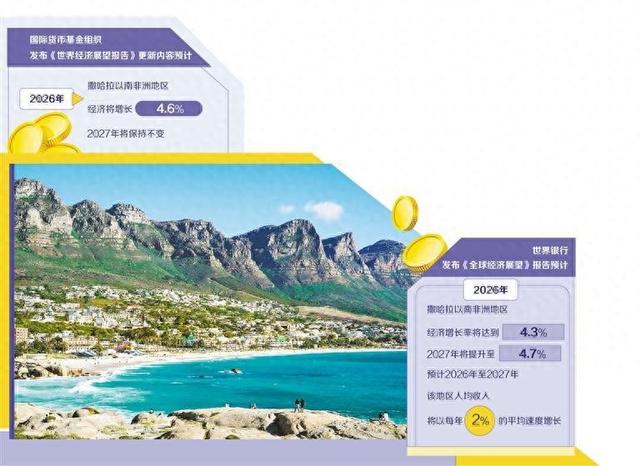
Core Insights - The economic growth in Sub-Saharan Africa is projected to remain moderate and above the global average, with various international economic organizations forecasting a growth rate of 4.6% in 2026, up from 4.4% in 2025 [3][4] - Major economies in the region, such as Nigeria and South Africa, are expected to show varying growth rates, with Nigeria at 4.4% and 4.1% for 2026 and 2027 respectively, while South Africa is projected at 1.4% and 1.5% for the same years [3] - The region's economic performance is supported by improved macroeconomic stability, increased investment, and a recovery in agriculture, despite facing challenges such as domestic security issues and geopolitical conflicts [5][7] Economic Forecasts - The International Monetary Fund (IMF) predicts that Sub-Saharan Africa's economic growth will accelerate to 4.6% in 2026, maintaining this rate into 2027, driven by macroeconomic stability and reforms [3] - The World Bank has adjusted its forecasts, expecting the region's growth to reach 4.3% in 2026 and 4.7% in 2027, bolstered by stronger investment and export performance [4] - The United Nations Conference on Trade and Development (UNCTAD) anticipates a slight increase in Africa's economic growth from 3.9% in 2025 to 4.0% in 2026, supported by improved macroeconomic stability and consumer demand [6] Positive Economic Indicators - Key economies like Nigeria and South Africa are experiencing positive trends such as reduced inflation and increased fiscal revenues, contributing to overall economic growth [5] - The region benefits from factors like stable electricity supply, recovery in agriculture, and expansion in the service sector, particularly in finance and information technology [5] - Improved financial conditions have allowed several economies, including Angola and Kenya, to regain access to international capital markets [5] Challenges and Risks - Economic growth in the region is still vulnerable to domestic security and geopolitical conflicts, which may hinder progress [7] - The anticipated growth rates are insufficient to make significant strides in reducing extreme poverty, particularly in conflict-affected areas [7] - A significant reduction in official development assistance (ODA) since 2024 has limited fiscal space for many countries, weakening their ability to withstand adverse shocks [7] - The region's economies remain heavily reliant on a limited number of export markets, particularly the United States, which poses risks to economic stability [7] - Employment generation remains a challenge, with growth not keeping pace with labor force increases, leading to limited job opportunities [7]

世行报告:撒南非洲增长具韧性,但面临就业挑战
Shang Wu Bu Wang Zhan· 2025-10-15 17:10
Core Insights - The World Bank's semi-annual economic update for Africa, titled "Africa Pulse," focuses on "Pathways to Job Creation in Africa" [1] - Sub-Saharan African economies, including Kenya, are expected to maintain resilience, with an average growth rate projected at 3.8% for 2025, up from 3.5% in 2024 [1] - Kenya's GDP grew by 4.9% year-on-year in the first quarter of this year, driven by strong performance in agriculture, mining, information and communication, and financial services [1] Economic Outlook - The World Bank highlights significant downside risks, including uncertainties in global trade policies, declining investor interest, and a shrinking pool of external financing [1] - The report outlines a series of policy priorities aimed at helping countries stimulate large-scale job creation [1] - Reducing the cost of doing business is deemed crucial for enterprise expansion and the entry of new high-growth firms into the market [1]