
宏观经济稳定

Search documents
Loma Negra pania Industrial Argentina Sociedad Anonima(LOMA) - 2025 Q4 - Earnings Call Transcript
2026-03-06 16:02
Financial Data and Key Metrics Changes - In Q4 2025, net revenue totaled ARS 225 billion (approximately $152 million), reflecting a 1.7% year-over-year decline compared to Q4 2024 [5] - Consolidated adjusted EBITDA reached $37 million with a margin of 19.7%, representing a contraction of 938 basis points year-over-year [18] - For the full year 2025, adjusted EBITDA amounted to $146 million with a margin of 21.3%, down 454 basis points from 2024 [5][21] Business Line Data and Key Metrics Changes - Cement segment revenues decreased by 4.4% year-over-year, primarily due to softer pricing conditions [13] - Concrete revenues increased by 37% year-over-year, driven by a 62% expansion in volumes [14] - Aggregates revenues were stable, down 0.9% year-over-year, with volumes increasing by 8.2% [15] Market Data and Key Metrics Changes - The Argentine economy grew by 4.4% in 2025, with significant contributions from agriculture, mining, and financial intermediation, while the construction sector remained flat [10] - The cement industry closed the year with a 5.6% growth, reversing previous declines [11] - The bulk segment outperformed due to larger-scale projects, while retail demand remained subdued [11] Company Strategy and Development Direction - The company emphasizes cost discipline and operational efficiency to preserve profitability amid challenging demand [27] - Loma Negra is well-positioned to play a central role in addressing Argentina's significant infrastructure gaps, with ongoing investment initiatives in infrastructure, mining, and energy [29] - The company aims to gradually improve its energy mix, increasing the share of renewable energy sources [34] Management Comments on Operating Environment and Future Outlook - Management noted that the recovery in the cement industry was slower than anticipated due to political uncertainty and financial tensions [27] - Looking ahead to 2026, management is optimistic about macroeconomic stabilization and expects a gradual easing of monetary constraints to support economic activity [29] - The company anticipates that investment initiatives will begin to positively impact dispatch volumes as the year progresses [29] Other Important Information - The company reported a net financial loss of ARS 9.8 billion for Q4 2025, compared to a net financial gain of ARS 1.1 billion in Q4 2024 [22] - Net debt decreased by $23 million quarter-over-quarter to $183 million, with a debt-to-EBITDA ratio of 1.47 times [6][24] - The company issued a new Class 6 corporate bond for $60 million in January 2026, reflecting strong investor demand [26] Q&A Session Summary Question: Energy management approach for 2026 - Management highlighted a focus on natural gas as the primary energy source, with contracts signed at lower prices for the upcoming year [33] - Renewable energy participation has improved, with contracts signed for additional renewable sources [34] Question: 2026 guidance on volumes and margins - Management indicated expectations for growth in volumes, despite a slow start in January and February due to seasonal effects [39] - Margins are expected to improve as pricing recovery continues [40] Question: Sales volumes and pricing expectations for 2026 - Management acknowledged a 6% decline in sales volumes for the first two months but expects recovery as projects commence [44] - Pricing guidance was not provided, but management anticipates continued recovery in pricing trends [45]
央行公告:明日操作6000亿元
Shang Hai Zheng Quan Bao· 2026-02-24 13:38
Group 1 - The central bank announced a 600 billion MLF operation on February 25, with a one-year term, to maintain ample liquidity in the banking system [1] - This operation marks the 12th consecutive month of increased MLF operations, with a net injection of 300 billion [1] - The total net liquidity injection for February reached 900 billion, indicating a continued high level of net injection [1] Group 2 - February is a month with concentrated bank credit issuance, and market demand for liquidity remains strong [1] - The central bank's actions are aimed at ensuring sufficient liquidity and stabilizing the financial market, especially after the Spring Festival [1] - The central bank has significantly increased the net injection of liquidity tools, including MLF and reverse repos, to support major project funding and stabilize macroeconomic operations [1][2]
惠誉:孟加拉国近期政治和政策不确定性降低
Jin Rong Jie· 2026-02-23 05:08
Core Viewpoint - Fitch Ratings indicates that the recent reduction in political and policy uncertainty in Bangladesh may contribute to improvements in macroeconomic stability, emphasizing that the implementation of reforms is crucial [1] Group 1 - The political and policy uncertainty in Bangladesh has decreased recently [1] - This reduction in uncertainty is expected to aid in stabilizing the macroeconomic environment [1] - The successful implementation of reforms is identified as a key factor for achieving economic stability [1]
撒哈拉以南非洲经济有望保持温和增长
Xin Lang Cai Jing· 2026-01-26 01:29
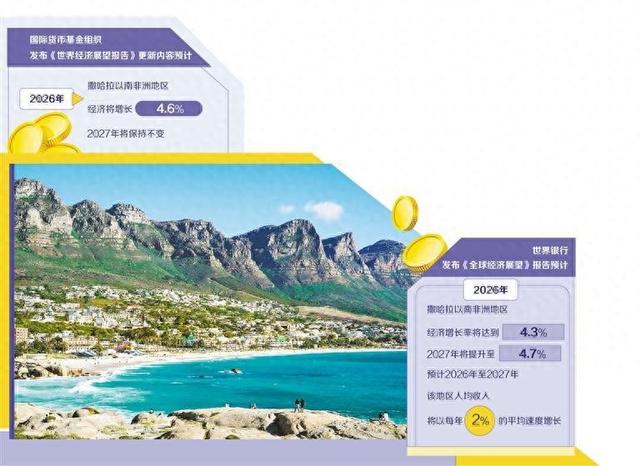
Core Insights - The economic growth in Sub-Saharan Africa is projected to remain moderate and above the global average, with various international economic organizations forecasting a growth rate of 4.6% in 2026, up from 4.4% in 2025 [3][4] - Major economies in the region, such as Nigeria and South Africa, are expected to show varying growth rates, with Nigeria at 4.4% and 4.1% for 2026 and 2027 respectively, while South Africa is projected at 1.4% and 1.5% for the same years [3] - The region's economic performance is supported by improved macroeconomic stability, increased investment, and a recovery in agriculture, despite facing challenges such as domestic security issues and geopolitical conflicts [5][7] Economic Forecasts - The International Monetary Fund (IMF) predicts that Sub-Saharan Africa's economic growth will accelerate to 4.6% in 2026, maintaining this rate into 2027, driven by macroeconomic stability and reforms [3] - The World Bank has adjusted its forecasts, expecting the region's growth to reach 4.3% in 2026 and 4.7% in 2027, bolstered by stronger investment and export performance [4] - The United Nations Conference on Trade and Development (UNCTAD) anticipates a slight increase in Africa's economic growth from 3.9% in 2025 to 4.0% in 2026, supported by improved macroeconomic stability and consumer demand [6] Positive Economic Indicators - Key economies like Nigeria and South Africa are experiencing positive trends such as reduced inflation and increased fiscal revenues, contributing to overall economic growth [5] - The region benefits from factors like stable electricity supply, recovery in agriculture, and expansion in the service sector, particularly in finance and information technology [5] - Improved financial conditions have allowed several economies, including Angola and Kenya, to regain access to international capital markets [5] Challenges and Risks - Economic growth in the region is still vulnerable to domestic security and geopolitical conflicts, which may hinder progress [7] - The anticipated growth rates are insufficient to make significant strides in reducing extreme poverty, particularly in conflict-affected areas [7] - A significant reduction in official development assistance (ODA) since 2024 has limited fiscal space for many countries, weakening their ability to withstand adverse shocks [7] - The region's economies remain heavily reliant on a limited number of export markets, particularly the United States, which poses risks to economic stability [7] - Employment generation remains a challenge, with growth not keeping pace with labor force increases, leading to limited job opportunities [7]

佩斯科夫:俄总统特别代表计划在达沃斯与美国代表会面
Jing Ji Guan Cha Wang· 2026-01-20 10:36
Group 1 - The Russian government, represented by spokesperson Peskov, is planning to engage in discussions with U.S. representatives at the Davos meeting, although there is no confirmation of a potential meeting with Trump [1] - Peskov emphasized the importance of understanding the negotiations between the U.S., EU, and Kyiv regarding solutions to the Ukraine issue [1] - Russia is monitoring the rising prices domestically and is taking measures to maintain macroeconomic stability, with no current concerns about inflation exceeding the predicted range of 4% to 5% [3] Group 2 - Peskov stated that Russia advocates for the restoration of trade and economic cooperation with the United States [2] - Russia has not yet received an invitation to participate in the G7 summit in Paris [3] - Regarding Moldova's announcement to withdraw from the CIS, Peskov indicated that this development was not surprising [2]
加纳完成IMF贷款计划后仍将获得持续支持与监督
Shang Wu Bu Wang Zhan· 2026-01-19 15:42
Core Viewpoint - Ghana is nearing the completion of the IMF-supported Extended Credit Facility program, with ongoing partnership and support from the IMF emphasized beyond the program's conclusion [1] Group 1: IMF's Position and Support - The IMF has stated that the end of the program does not signify the termination of cooperation, with economic oversight and technical assistance being central to future interactions [1] - Dr. Adrian Alt, the IMF representative in Ghana, indicated that the IMF will continue to monitor Ghana's economic development and reform implementation post-program [1] - The IMF's commitment to providing technical assistance to help Ghana address potential policy challenges was reaffirmed [1] Group 2: Ghana's Economic Reforms - Ghana is currently advancing reforms aimed at achieving macroeconomic stability and strengthening fiscal discipline [1] - The IMF's recent statements are seen as recognition of Ghana's reform progress and reflect the international community's ongoing interest in the country's long-term economic governance [1] - Balancing policy autonomy with international cooperation will be a critical dimension in assessing the effectiveness of Ghana's economic transformation [1]
越南统计局:2025年全国GDP增长8.02%
Shang Wu Bu Wang Zhan· 2026-01-09 15:12
Economic Growth - Vietnam's GDP is projected to grow by 8.02% in 2025, reaching approximately 12.847 trillion VND (about 514 billion USD), which is an increase of 38 billion USD year-on-year [1] - The per capita GDP is expected to be around 1.255 million VND (approximately 5,026 USD), reflecting a year-on-year increase of 326 USD [1] Sector Contributions - Agriculture, forestry, and fishery sectors are expected to grow by 3.78%, contributing 5.3% to GDP [1] - The industrial and construction sectors are projected to grow by 8.95%, contributing 43.62% to GDP, achieving the highest growth rate since 2019 [1] - The services sector is anticipated to grow by 8.62%, contributing 51.08% to GDP [1] Trade and Consumption - Final consumption is expected to grow by 7.95%, while asset accumulation is projected to increase by 8.68% [1] - Exports of goods and services are expected to grow by 16.27%, with imports increasing by 17.12% [1] Labor Productivity - Labor productivity is estimated at 2.45 million VND per person (approximately 9,809 USD per person), with a year-on-year increase of 626 USD [2] - When calculated at constant prices, labor productivity is expected to grow by 6.83%, primarily due to improvements in worker skill levels [2] Future Economic Goals - For 2026, the government aims for a double-digit GDP growth while maintaining macroeconomic stability and controlling inflation, which presents a significant challenge requiring collective efforts from the government, businesses, and the public [2]
国际货币基金组织拟将加纳救助计划延长3个月
Shang Wu Bu Wang Zhan· 2025-12-30 17:25
Core Viewpoint - The International Monetary Fund (IMF) has proposed a three-month extension of Ghana's Extended Credit Facility (ECF) program to allow for the implementation of reforms necessary for the sixth and final review of the program [1][2] Group 1: ECF Program Extension - The proposed extension would move the end date of the ECF program from May 2026 to August 2026 [1] - The extension aims to facilitate consensus on policies needed to complete the sixth review and to provide adequate time for the preparation and distribution of board documents [1] Group 2: Program Modifications - The IMF has suggested modifications to Ghana's program, including changes to indicative targets (IT) and monetary policy consultation clauses (MPCC) [1] - Adjustments to the basic balance and non-oil revenue investment targets are expected by the end of March 2026 to align with macroeconomic developments [1] Group 3: Economic Performance and Risks - Ghana's ECF arrangement, approved in May 2023, allows access to funds equivalent to 303.8% of its quota, approximately $3 billion [2] - Despite satisfactory execution of the program, the IMF expressed concerns about Ghana's economic outlook, citing risks from external factors such as commodity price volatility and potential policy missteps [2] - Delays in comprehensive debt restructuring pose additional risks, alongside vulnerabilities related to regional conflicts and energy sector recovery plans [2]
古巴公布2026年经济计划
Shang Wu Bu Wang Zhan· 2025-12-27 16:51
Core Viewpoint - The Cuban government is planning its 2026 economic strategy focused on crisis management, mitigating the impact of economic warfare, and achieving gradual recovery, with an expected GDP growth of approximately 1% at constant prices [1] Group 1: Economic Strategy - The 2026 economic plan will prioritize macroeconomic stability, increasing foreign exchange income, and enhancing domestic food production and import substitution [1] - The plan includes deepening state enterprise reforms and restoring the national power system [1] - Promoting technological innovation is also a key objective of the economic strategy [1]
国际货币基金组织对加纳经济的综评
Shang Wu Bu Wang Zhan· 2025-12-26 17:13
Group 1 - The International Monetary Fund (IMF) approved Ghana's fifth review, confirming the country has largely met its planned targets, which will trigger the sixth disbursement of $385 million, bringing the total loans from the IMF to approximately $2.8 billion [1] - Ghana's economic situation is stabilizing and cautiously recovering, supported by a $3 billion aid program, with all performance criteria and indicative targets for June 2025 being met [1] - The IMF has raised Ghana's GDP growth forecast for 2025 to 4.8%, with expectations of growth returning to around 5% in the medium term [1] Group 2 - The Ghanaian Parliament approved the mid-year budget review for 2025, fully aligning with IMF targets and committing to a primary surplus target of 1.5% of GDP [2] - Non-oil revenues and increased fuel taxes have supported the budget adjustments, with audits enhancing government credibility by disqualifying a portion of outstanding commitments due to procedural violations [2] Group 3 - The fifth review indicates mixed progress in structural reforms, with some previously delayed indicators now implemented, including a strategy for state-owned banks and the completion of taxpayer registration cleanup [3] - Debt restructuring has seen some progress, but remains incomplete, with the IMF warning that any delays could reverse recent gains in debt sustainability [3] Group 4 - The IMF's fifth review suggests that Ghana has temporarily avoided a crisis but must adhere to established policies to convert macroeconomic stability into long-term benefits [4] - The IMF recommends that the central bank rely more on open market operations to absorb liquidity and enhance policy effectiveness as the program approaches its conclusion in 2026 [4]