效率红利

Search documents
增长、盈利、分红同时发生:水滴走到了哪一步?
美股研究社· 2026-03-26 10:36
Core Viewpoint - The Chinese internet industry is transitioning from a growth-centric model to one focused on efficiency and cash flow, marking a significant shift in investor expectations and company operations [1][14]. Group 1: Company Transformation - Waterdrop has evolved from a "traffic-driven internet platform" to an "efficiency-driven insurance technology company," reflecting a broader trend in the internet insurance sector towards sustainable growth and profitability [2][5]. - The company reported a 43.5% year-on-year revenue growth and a 54.8% increase in net profit attributable to shareholders for the year 2025, alongside 16 consecutive quarters of profitability, indicating a robust business model [4][8]. - Waterdrop's insurance business revenue reached 3.577 billion yuan, a 51.3% increase, demonstrating a shift in product and user structure rather than mere traffic expansion [5]. Group 2: Efficiency and AI Integration - AI is deeply embedded in Waterdrop's operations, enhancing customer acquisition, underwriting, claims processing, and customer service, leading to a shift from "traffic dividends" to "efficiency dividends" [6][12]. - The introduction of AI has significantly improved operational efficiency, with AI medical insurance experts contributing to a 145% increase in premium growth and AI quality inspection enhancing productivity by 175% [6]. - Waterdrop's model combines AI with human advisors, allowing for a more scalable and efficient service delivery compared to traditional insurance intermediaries [10]. Group 3: Profitability and Valuation - Continuous profitability over 16 quarters indicates that Waterdrop is not merely a company with paper profits but possesses a stable and sustainable business model [8]. - The company's decreasing sales expense ratio alongside rising premium volumes suggests a healthy scale effect rather than mere budget cuts, indicating improved customer retention and lower customer acquisition costs [10]. - The market's current valuation may not fully reflect Waterdrop's transition to a technology-driven insurance company, potentially leading to undervaluation of its stable profit generation capabilities [11]. Group 4: Future Outlook and Industry Trends - The integration of AI into Waterdrop's operations could redefine industry efficiency boundaries, particularly in addressing traditionally underserved markets such as elderly insurance [12][13]. - Waterdrop's diversification into clinical trial services and its brand trust through Waterdrop Fund may create additional growth avenues, reinforcing its market position [13]. - The shift from a focus on user growth to operational efficiency is expected to yield superior returns, as the industry moves away from a reliance on traffic growth towards sustainable profitability [15].



瑞幸新一轮9.9元“上价值”:锚定鲜活,重仓健康
第一财经· 2026-03-19 08:13
Core Viewpoint - Luckin Coffee's recent promotional strategy emphasizes fresh and healthy products at competitive prices, showcasing its ability to combine pricing and value in a challenging market environment [1][4]. Group 1: Promotional Strategy - The "Fresh Origin Season" promotion launched on March 16, 2026, features a diverse range of seasonal drinks, moving beyond coffee to include innovative health-focused beverages [5][6]. - The new promotion includes products like "Fresh Brewed Longjing" tea and "Bitter Melon Light Body Fruit and Vegetable Tea," highlighting the integration of health and freshness into the product lineup [5][9]. - The shift in product structure reflects Luckin's commitment to health and innovation, as evidenced by its recognition as a "Health Consumption Leading Brand" and the implementation of health standards across its supply chain [5][9]. Group 2: Financial Performance - In 2025, Luckin Coffee reported total net revenue of 49.288 billion yuan, a 43% year-on-year increase, with 4.1 billion cups of drinks sold and over 450 million cumulative customers [9]. - The introduction of over 140 new products in 2025, with non-coffee beverages accounting for more than 20% of total sales, indicates a significant diversification in its product offerings [9]. Group 3: Supply Chain and Cost Efficiency - Luckin has developed a robust supply chain strategy, establishing a "Fresh Origin Matrix" that includes sourcing from key coffee-producing regions and exclusive local suppliers [9][13]. - The company has built four roasting bases, increasing its annual coffee roasting capacity to 155,000 tons, which enhances its control over the supply chain and reduces costs [15]. - With over 30,000 stores nationwide, Luckin benefits from economies of scale, allowing it to maintain competitive pricing while ensuring quality and freshness in its products [12][15]. Group 4: Digitalization and Operational Efficiency - Luckin's commitment to digital management enhances operational efficiency, enabling real-time data analysis across its supply chain, from order placement to inventory management [18]. - The company's agile production mechanism supports the rapid iteration of over 100 new products annually, minimizing inventory waste and improving responsiveness to market changes [18]. - The recent promotion is not merely a price war but a strategic move to deliver greater value to consumers through a well-structured product matrix [18].


大众公用:斩获年度A+H卓越企业奖,展望2026的“确定性”与“高弹性”
Ge Long Hui· 2026-01-13 10:33
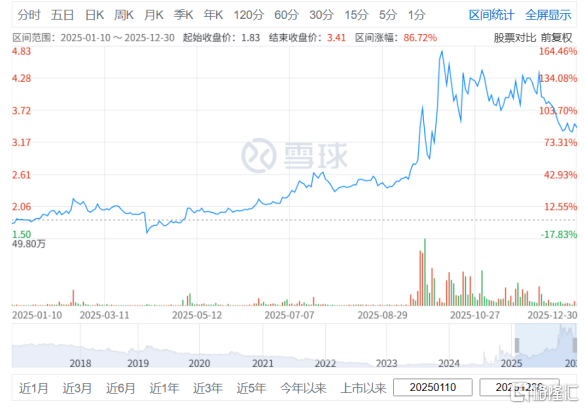
Core Viewpoint - Dazhong Public (600635.SH/01635.HK) was awarded the "Annual A+H Outstanding Enterprise Award" at the recent Gelonghui "Golden Award" annual selection, reflecting its strong performance in a complex market environment and the effectiveness of its dual-driven strategy for future growth [1] Group 1: 2025 Year-End Review - In 2025, Dazhong Public's A-share price increased by 52.57%, with a peak increase exceeding 90%, while H-shares rose by 86.72%, with a maximum increase over 160%, indicating a positive market re-evaluation of the company's value [1] - The company's net profit saw a year-on-year growth of over 200% in the first three quarters of 2025, with a non-recurring net profit reaching 309 million yuan, up 104.79%, showcasing significant improvement in core profitability [4] - By the end of Q3 2025, the company's debt-to-asset ratio was 54.06%, maintaining a reasonable level, and its net cash flow from operating activities surged by 93.84% to 944 million yuan, exceeding net profit, which supports ongoing dividends and new project investments [5] Group 2: Dual-Driven Strategy - Dazhong Public operates under a unique "public utility + financial investment" dual-driven model, with the public utility sector providing stable cash flow and acting as a "ballast" for overall operations [7] - The pipeline gas supply business remains the primary revenue source, with significant advantages in seven administrative regions and exclusive service in Nantong, creating a strong supply barrier [8] - The investment sector serves as a "growth engine," with the company actively managing existing projects and benefiting from its stake in Shenzhen Innovation Investment Group, which has led to multiple successful IPOs in 2025 [9][10] Group 3: 2026 Outlook - The first main line for 2026 focuses on "safety and renovation" in the public utility sector, with investments in pipeline upgrades and smart management expected to enhance operational efficiency and stability [11] - The second main line comes from the value realization of the investment sector, with anticipated A-share market inflows of 2 trillion yuan and an IPO scale of 200 billion yuan in 2026, indicating a favorable environment for technology companies [12] - Overall, Dazhong Public's dual-driven strategy has not only achieved significant results in 2025 but also laid a solid foundation for growth in 2026, offering stable dividends while maintaining patience for the realization of technology investments [13]

头部电商玩家们,已经换上了会思考的AI表格
凤凰网财经· 2025-11-06 13:03
Core Viewpoint - The article discusses the transformation of the e-commerce industry in China, emphasizing the need for advanced AI tools to overcome traditional operational inefficiencies and data silos, particularly during high-stakes events like "Double Eleven" [1][2][3]. Group 1: E-commerce Challenges - The e-commerce sector in China generates vast amounts of real-time data but relies on outdated tools like Excel, leading to operational inefficiencies and data silos [3][4]. - The reliance on manual processes creates delays in decision-making, especially when responding to customer feedback or inventory changes [2][6]. - The complexity of e-commerce operations, involving multiple departments and real-time data, exacerbates the challenges of coordination and efficiency [5][6]. Group 2: Adoption of AI Tools - Leading companies like Semir and Yintai have adopted new AI-driven tools, such as DingTalk's AI spreadsheets, to enhance operational efficiency and real-time data management [2][10]. - DingTalk's AI spreadsheet can handle up to 10 million active rows, allowing e-commerce professionals to manage data without manual segmentation, thus improving response times during peak sales [2][10]. - The introduction of AI tools has transformed traditional roles, enabling employees to focus on strategic decision-making rather than repetitive data tasks [17][19]. Group 3: Case Studies - A case study from Yintai illustrates how the use of DingTalk's AI spreadsheet streamlined the management of promotional activities across multiple brands and locations, significantly reducing preparation time [7][10]. - Semir's customer service team has benefited from AI integration, allowing for real-time feedback analysis and quicker response times, thus enhancing customer satisfaction [12][13]. - The AI tools have enabled companies to predict sales trends and adjust resource allocation dynamically, improving overall operational efficiency [15][19]. Group 4: Strategic Shift in the Industry - The article highlights a strategic shift in the e-commerce industry from a focus on "traffic dividends" to "efficiency dividends," as companies recognize the need for deeper technological investments [18][19]. - Alibaba's commitment to investing 380 billion in AI infrastructure over the next three years reflects a broader industry trend towards integrating AI capabilities into core business processes [18][19]. - The evolution of AI tools like DingTalk's AI spreadsheet represents a significant advancement in organizational efficiency, impacting various sectors beyond e-commerce [19][20].