
教育公平与伦理

Search documents
用搭载GPT-5.2的眼镜做题,是一种什么体验?
Guan Cha Zhe Wang· 2025-12-27 05:21
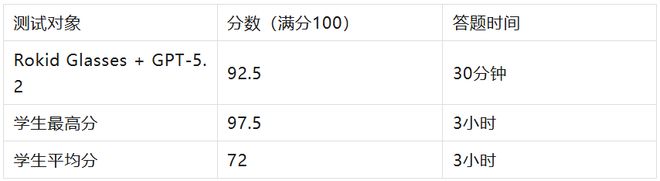
Core Insights - The experiment conducted by Hong Kong University of Science and Technology demonstrated that the Rokid smart glasses equipped with OpenAI's GPT-5.2 model scored 92.5 out of 100 in a final exam, which is lower than the highest student score of 97.5 but significantly higher than the class average of 72 [1][2][3]. Technical Performance - The GPT-5.2 model showed strong understanding and application of specialized knowledge, scoring full marks on multiple-choice and single-page questions, but struggled with cross-page questions, indicating limitations in maintaining coherent understanding across different contexts [4][5]. - The model's performance highlighted its inability to effectively integrate information dispersed across multiple pages, revealing a core limitation in current AI systems regarding global cognition and working memory [4][5]. Educational Assessment Challenges - The experiment prompted discussions in the education sector about the need to rethink assessment methods, as AI tools challenge the traditional assumption that students independently apply knowledge [7]. - Experts suggest that educational evaluation should shift focus from knowledge reproduction to problem definition, innovative solution design, and the ability to collaborate with AI tools [7][8]. Ethical and Equity Considerations - The proliferation of AI-assisted learning tools raises concerns about educational equity, as access to quality AI resources may initially benefit well-resourced schools and students, potentially widening the educational gap [9]. - Institutions are revising academic integrity policies to clarify the acceptable use of AI, emphasizing that AI should serve as an auxiliary tool rather than a means for academic dishonesty [9][11]. Regulatory and Policy Recommendations - The research team advocates for immediate action from educators and policymakers to establish reasonable regulatory frameworks that ensure technology serves ethical purposes [11]. - The goal is to balance technological advancement with moral considerations, ensuring that educational technology fosters innovation while maintaining academic integrity [11].

用搭载GPT-5.2的AI眼镜做题,是一种什么体验?
Guan Cha Zhe Wang· 2025-12-27 05:20
Core Insights - The experiment conducted by Hong Kong University of Science and Technology demonstrated that the Rokid smart glasses equipped with OpenAI's GPT-5.2 model scored 92.5 out of 100 in a computer networking exam, outperforming the class average of 72 but falling short of the highest student score of 97.5 [1][2] Group 1: Technical Performance - The GPT-5.2 model showed strong understanding and application of specialized knowledge, but it did not achieve a perfect score, primarily losing points on questions requiring information integration across multiple pages [3][4] - The model scored 29 out of 29 on multiple-choice questions, 18 out of 18 on single-page answers, and 45.5 out of a possible score for cross-page answers, highlighting its limitations in maintaining coherent understanding and reasoning across different contexts [4][3] - The experiment revealed that AI systems struggle with tasks requiring long-term dependencies and multi-step reasoning, indicating a need for improvements in memory modules and document understanding architectures [3][4] Group 2: Educational Assessment Reformation - The experiment has sparked discussions in the education sector regarding the need to rethink assessment methods, as AI tools challenge the traditional assumption that students independently apply knowledge [6][7] - Experts suggest shifting assessment focus from knowledge reproduction to problem definition and innovative solution design, emphasizing the learning process over final answers [7][8] - There is a call to cultivate human-AI collaboration skills and design assessments that integrate knowledge from multiple disciplines [8][7] Group 3: Ethical and Equity Considerations - The proliferation of AI-assisted learning tools raises concerns about educational equity, as high-quality AI resources may primarily benefit well-resourced schools and students, potentially widening educational gaps [8][9] - Academic integrity frameworks are also under review, with institutions like Tsinghua University establishing guidelines for the appropriate use of AI in academic settings [9][11] - The research team emphasizes the need for immediate action from educators and policymakers to create regulatory mechanisms that ensure technology serves educational purposes ethically and effectively [11][9]
